ROLLEIFLEX 2.8F
The Rolleiflex 2.8F is widely regarded as the pinnacle of twin-lens reflex (TLR) camera design, combining precision engineering, optical excellence, and refined ergonomics in a compact 6x6cm format body. Produced from 1960 to 1981, it represents the final and most advanced evolution of the Rolleiflex TLR line, favored by professional photographers and serious amateurs for its reliability and image quality.
Overview
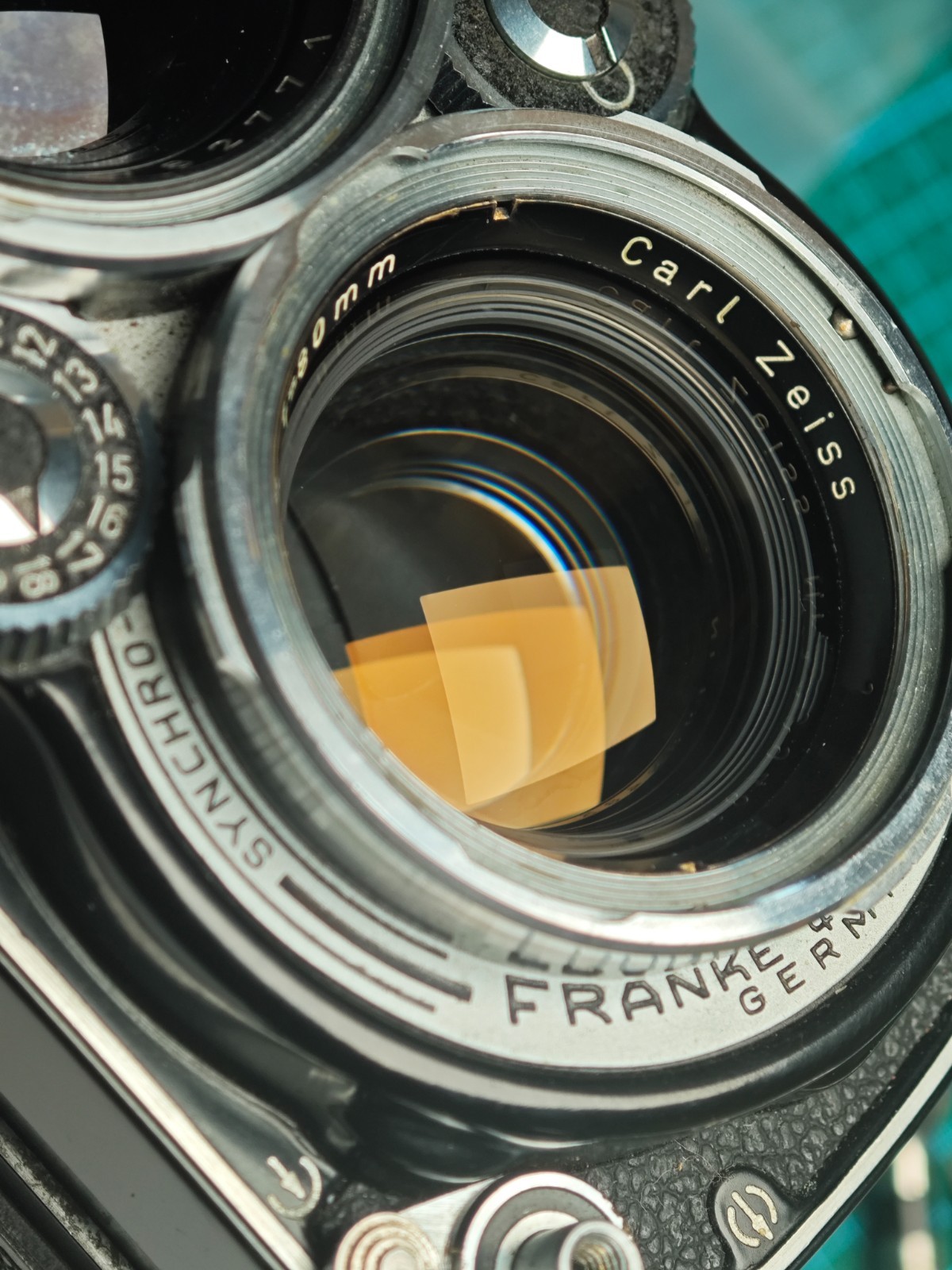
Introduced in 1960, the Rolleiflex 2.8F succeeded the 2.8D and 2.8E models, incorporating numerous refinements that solidified its reputation as the ultimate TLR. Manufactured by Franke & Heidecke in Braunschweig, West Germany, the 2.8F was designed for photographers demanding the highest standards in medium format photography—particularly in portrait, studio, and street applications. It featured a fixed lens configuration with a Carl Zeiss Planar 80mm f/2.8 taking lens and a matching Heidosmat 80mm f/2.8 viewing lens, both optically matched for superior focusing accuracy and brightness.
The 2.8F was positioned at the top of Rolleiflex’s TLR range, above the 3.5F and 2.8E models, and was distinguished by its fully coupled exposure meter, improved film transport mechanism, and redesigned focusing hood with a magnifying lens that flips up for precise manual focusing. The camera’s build quality was exceptional, with machined metal components, precision gearing, and a robust leaf shutter system. Its ergonomic redesign included a relocated film advance knob to the left side (when viewing from the rear), allowing for smoother, more intuitive operation and reducing the risk of camera shake during winding.
Historically, the 2.8F marked the culmination of decades of TLR development by Rolleiflex, which had dominated the medium format market since the 1930s. By the 1960s, however, single-lens reflex (SLR) systems like the Hasselblad 500C and later the Rolleiflex SL66 were beginning to displace TLRs in professional studios. Nevertheless, the 2.8F remained in production for over two decades due to its loyal user base and unmatched handling characteristics. It ceased production in 1981, marking the end of an era for high-end TLRs.
Specifications
| Specification | Value |
| Type | Twin-Lens Reflex (TLR) |
| Film Format | 6x6cm (120 roll film) |
| Years Produced | 1960–1981 |
| Lens Mount | Fixed Carl Zeiss Planar f/2.8, 80mm (taking lens); Heidosmat f/2.8, 80mm (viewing lens) |
| Shutter | Compur-Rapid MXV Leaf Shutter; speeds 1–1/500 sec, B, and X-sync at 1/30 sec |
| Aperture Range | f/2.8 to f/22 |
| Metering | Coupled, center-weighted selenium cell meter (no battery required) |
| Exposure Modes | Manual only; shutter speed and aperture set independently |
| Viewfinder | Waist-level with pop-up magnifier, Fresnel focusing screen |
| Focusing | Helical focusing mechanism with ground glass screen |
| Film Advance | Single-stroke crank with automatic frame counter; red window backup |
| Flash Sync | PC terminal with X and M settings; sync speed up to 1/30 sec |
| Dimensions | 100 × 105 × 215 mm (approx.) |
| Weight | ~1,350 g (with film) |
Key Features
- Carl Zeiss Planar 80mm f/2.8 Lens: Renowned for its sharpness, contrast, and minimal distortion, this lens delivers exceptional image quality even wide open.
- Fully Coupled Selenium Meter: The built-in exposure meter uses ambient light without requiring batteries, with a needle visible in the viewing hood for exposure guidance.
- Precision Compur-Rapid Shutter: Offers shutter speeds from 1 second to 1/500 second, enabling handheld shooting in a wide range of lighting conditions.
- Improved Film Transport: The single-stroke film advance with automatic stop at the next frame reduces winding time and prevents double exposures.
- Ergonomic Redesign: Left-side film advance knob, improved focusing hood with flip-up magnifier, and repositioned controls enhance usability and reduce operator fatigue.
Historical Context
The Rolleiflex 2.8F was launched at a transitional moment in photographic history. While TLRs had been the preferred medium format system for decades—especially in press, portrait, and fashion photography—the rise of modular SLRs in the 1960s began to challenge their dominance. Cameras like the Hasselblad 500C (introduced in 1957) offered interchangeable lenses, through-the-lens metering, and greater compositional flexibility, appealing to professionals seeking versatility.
Despite this shift, the 2.8F carved out a niche by refining the TLR formula to its limits. Its compact size, quiet operation, and parallax-free viewing (at set distances) made it ideal for candid and portrait work. The inclusion of a high-speed f/2.8 lens gave it an edge over slower TLRs like the Yashica Mat series (typically f/3.5), allowing better performance in low light and shallower depth of field. The 2.8F was also exported globally and became a favorite among photojournalists, studio photographers, and fine art practitioners, including notable users like Diane Arbus and Richard Avedon, who appreciated its discreet operation and image quality.
Collectibility & Value
Today, the Rolleiflex 2.8F is highly collectible and considered one of the most desirable TLRs ever made. Well-maintained examples in working condition typically sell for $1,200 to $2,500 USD, with mint specimens or rare variants (such as those with special engraving or limited editions) commanding higher prices. Its value is driven by its reputation, optical quality, and status as the final evolution of the classic Rolleiflex TLR line.
When purchasing a 2.8F, collectors should inspect for key issues: shutter accuracy (especially at high speeds), lens cleanliness (haze, fungus, or separation in the Planar), and smooth film transport. The selenium meter, while durable, can degrade over time, leading to underexposure—though the camera remains fully functional without it. Service history is important; these cameras benefit from CLA (clean, lubricate, adjust) by specialists familiar with vintage TLRs. The Compur-Rapid shutter is serviceable but requires expertise due to its complexity.
Similar Cameras
- Hasselblad 500C – Modular 6x6cm SLR with interchangeable lenses and backs; professional alternative with greater flexibility.
- Mamiya C330 – TLR with interchangeable lenses and focusing bellows; popular with studio photographers.
- Yashica Mat-124G – Affordable TLR with built-in meter and excellent 80mm f/3.5 lens; common successor for budget-minded users.
- Rolleiflex 3.5F – Slightly slower aperture (f/3.5) but otherwise similar build and design; more affordable entry into the Rolleiflex TLR system.
- Pentax 6×7 – Large-format SLR offering 6x7cm negatives; used for high-resolution work where TLR limitations were prohibitive.
Repair & Maintenance
The Rolleiflex 2.8F requires no batteries for operation—the selenium cell meter generates its own power from light and does not need replacement. However, aged meters may lose sensitivity and should be checked against a digital meter. The Compur-Rapid shutter is robust but benefits from periodic servicing to maintain accuracy across all speeds. Common issues include stiff focusing knobs, light seals degradation (leading to light leaks), and worn film pressure plates. Repair difficulty is moderate to high due to the camera’s complexity and the need for specialized tools and expertise. Only experienced technicians should attempt disassembly, particularly of the lens/shutter assembly or film transport mechanism. Regular use and storage in a dry, temperature-stable environment are recommended to preserve functionality.
eBay Listings


As an eBay Partner, we earn from qualifying purchases. This helps support our independent vintage technology research.
Related Models
- Rolleiflex 3.5F (1956-1975)
- Rolleiflex Automat (1937-1949)
- Rolleiflex T (1958-1976)
- Lubitel 166 (1976-1990)
- Lubitel 2 (1955–1979)
- Mamiya C220 (1968-1975)
- Mamiya C330 (1969-1974)
- Mamiya C330f (1975-1983)
- Mamiya C330S (1983–1994)
- Rollei 2.8F (1960-1981)