Rollei 35 AF (2024)
MiNT's LiDAR-equipped reincarnation of the Rollei 35 - a genuine new film camera with autofocus, and a build quality debate attached to every unit.
Overview
At 284 grams with battery and film loaded, the Rollei 35 AF sits in the palm like the original Rollei 35 always did - compact and dense. The difference is that this one focuses itself. MiNT Camera, the Hong Kong-based outfit that spent over a decade restoring Polaroid SX-70s and building Instax cameras, licensed the Rollei name and shipped the 35 AF in October 2024 at $799. Pre-orders began in September 2024. It is not a reissue. Sources describe it as a completely new project, distinct from the original Rollei 35 lineage. It has a fixed 35mm f/2.8 five-element glass lens, an aperture range of F2.8-16 and a close focusing distance of 70cm (28 inches).
The headline feature is LiDAR autofocus. It uses the same ranging principle as the Polaroid SX-70 Sonar, except with invisible light rather than ultrasound. MiNT's Augustus told Analog.Cafe the system is "more accurate than the sonar system used in certain Polaroid SX-70 models and still better than the autofocus rangefinders in vintage point-and-shoots." The trade-off is documented: it may struggle focusing through glass, and MiNT acknowledges the limitation directly. The original needed manual zone focusing, and the manufacturer's own copy calls it one of the most difficult to use pieces of equipment in modern history. The 35 AF just points and shoots.
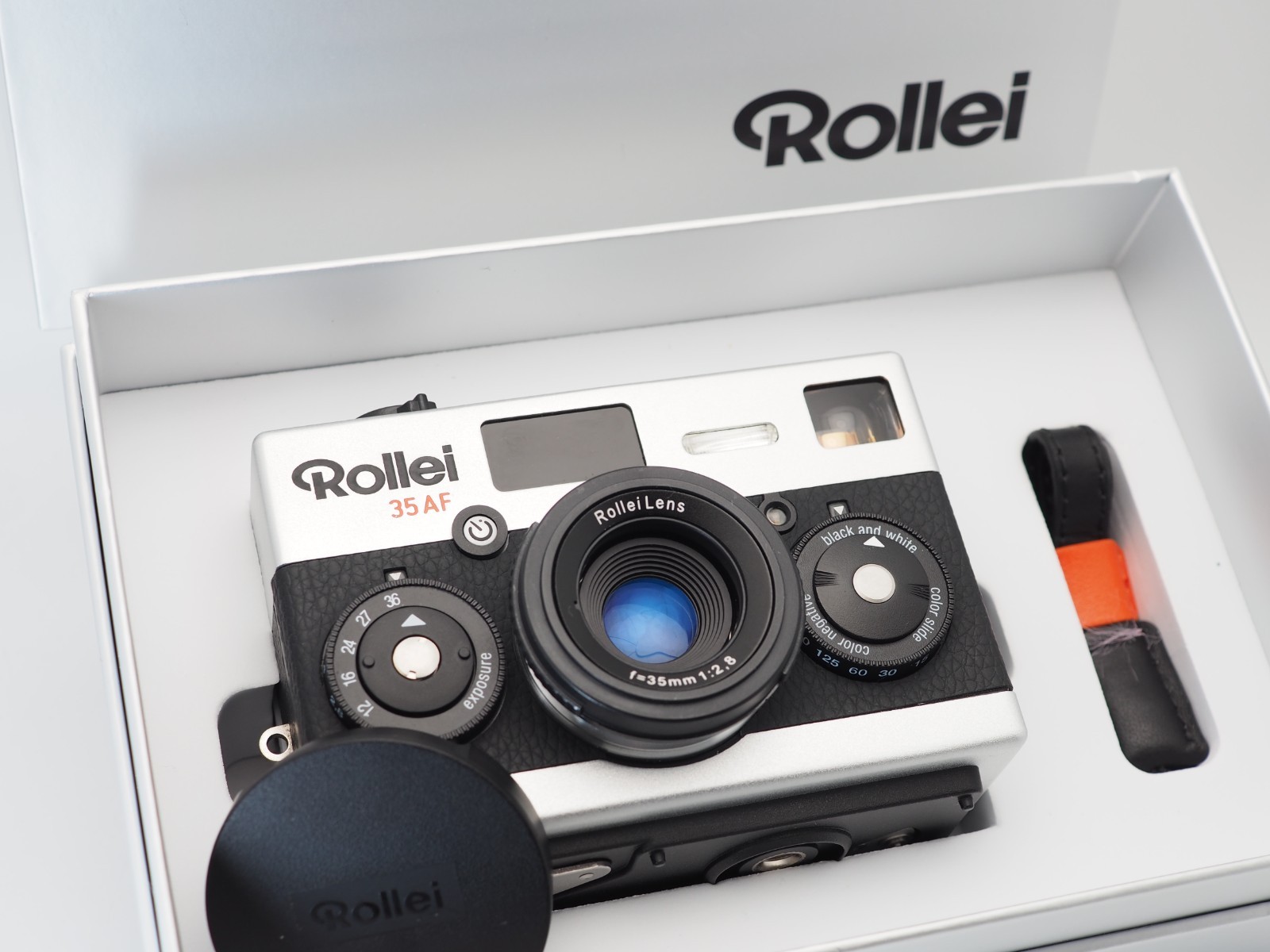
Two finishes exist: black (B&H model #10857) and chrome/silver-black (#10856). Both are the same camera. The chrome version has proven harder to find. Reviewers noted that silver versions were harder to obtain during the initial demand surge, and the camera sold out at release before being restocked.
Despite the marketing language around "automatic exposure," the 35 AF is not a true auto-everything camera. In practice it is an aperture-priority camera with a manual mode. There is no shutter-priority mode. That shapes how the camera behaves in difficult light, and how often it gets the exposure wrong.
Key Features
LiDAR Autofocus from 70cm to Infinity
The LiDAR system emits invisible pulses and measures the time it takes for them to bounce back. MiNT claims precise focusing from 70cm up to infinity, and says the system works in all light and weather conditions without the contrast-hunting problems that plague vintage point-and-shoot autofocus systems. The Olympus Mju I, for comparison, can miss focus and ruin frames in poor light, while the LiDAR grabs focus instantly. The one documented limitation is glass. If you shoot perpendicular to a window, the camera will detect the glass rather than what's behind it. MiNT's workaround is to listen for the focus motor's travel. A short sound means it focused close, a longer one means it drove the lens further out.
Fixed 35mm f/2.8 Five-Element Lens
The lens is fixed - it no longer retracts into the body as the original's did - and it is a five-element design in 35mm f/2.8, with an aperture range of F2.8-16. Reviewers consistently describe the lens as sharp. The original Rollei 35 typically used 40mm Zeiss lenses (Tessar f/3.5 or Sonnar f/2.8 under license), so the 35 AF's 35mm focal length is a slight widening, not a direct match. The fixed barrel means no collapsing mechanism, no dust ingress through a retracting tube, and one less thing to break. The lens cap is now a permanent accessory you'll need to keep track of, since it contributes roughly 9 grams when the camera is weighed at 293 grams fully loaded.
Shutter Speeds: 1 Second to 1/500, Plus 60-Second Long Exposures
In manual mode, shutter speeds run from 1 second to 1/500. Auto mode covers the same range: 1/500 down to 1 second. Separately, long exposures extend to 60 seconds, which is useful for night work and sets the 35 AF apart from most compact film cameras. The limitation is at the fast end. With ISO 800, 1600, or higher film loaded, the camera cannot cut light beyond f/16 at 1/500, so daytime shots with fast film will be overexposed. That is a hard ceiling, not a quirk. If you shoot fast film in daylight, you need ND filtration - and there is no filter thread.
OLED Display and Viewfinder Indicators
A mini-OLED display, activated on half-press of the shutter, shows the frame counter and, in manual mode, exposure deviation in stops. Reviewers called the exposure deviation readout a smart solution, since it gives real-time feedback without mental math. The viewfinder itself carries two indicators: focus confirmation and flash-ready. Beyond that, the viewfinder has drawn criticism. The frame illumination and autofocus point are described as not very accurate, and at least one published review called the viewfinder simply poor. It is functional, not precise.
Front Dials and Film Type Control
Two front control dials handle most shooting decisions: aperture on the left (under the camera logo), shutter speed and exposure compensation on the right. A separate control selects film type - black and white, color negative, or color slide - and also allows exposure compensation, or shutter speed if dialed to the white numbers. The frame-count selection wheel is marked with 12, 16, 24, 27, and 36. ISO is read from the DX code or entered manually via a gray button on the front panel, with the power lever turned to the ISO parameter. Film loads with the canister on the right and winds to the left.
Built-in Flash with Distance-Based Intensity
The 35 AF includes a built-in flash that adjusts its intensity based on the subject's distance. B&H's listing says this puts the camera "side by side with the top point-and-shoot cameras in the market." The flash-ready indicator lives in the viewfinder. Detailed flash specifications - guide number, recycle time, range - are not documented in available sources.
Historical Context
The original Rollei 35 was developed by engineer Heinz Waaske in 1962, came to market in 1966 at Photokina, and stayed in production for roughly three decades. Rollei produced approximately two million units. Early cameras used a Zeiss Tessar f/3.5. Later versions moved to a Sonnar f/2.8 under Zeiss license. Production began in Germany and later moved to Singapore. In 1996, one of Rollei's successor companies released a final anniversary series. Reviewers consistently cite two reasons it became a cult object: its compactness and its refusal to look like anything else on the market. Diane Arbus, Linda Ronstadt, and Queen Elizabeth are all cited as users.
Rollei itself was founded as Franke & Heidecke in Germany in 1920, starting with the Rolleiflex. It is one of the oldest camera brands in the world, alongside Kodak and Leica. The company entered crisis in 1963 after the war and management difficulties, and gradually ceased production of its famous cameras. Today it earns money licensing its brand, and it was Rollei that approached MiNT founder Gary Ho about a collaboration. The two companies had worked together before. Rollei advised MiNT's team on improving the finder for their InstantFlex cameras, which were briefly branded with the Rollei name. The 35 AF project was years in the making and arrived just months behind Ricoh's Pentax 17, released in June 2024. Minolta TC-1 and Contax T3 bodies were already fetching multiple thousands of dollars, despite being twenty to thirty-year-old cameras with no warranty and electronics bound to fail. Building a film camera in 2024, as one source put it, is not at all like building one in the 1990s or 1970s.
Collectibility & Value
The 35 AF launched at $799 USD, or HK$6,240.00 from the official store. In Russia, stores asked from 90,000 rubles for the new item, against an international price of 65,000 rubles. The camera sold out at release and was restocked. Demand reportedly remained high enough that the silver version was harder to obtain than the black. A second-anniversary promotion offered two rolls of film with purchase.
The used market is less kind. One source documents the resale market sitting roughly 30 percent below list, with long-term owner reports of film transport jams and autofocus misses. The build quality complaints are specific and repeated: fragile material, parts that can fall off the body, a back door that doesn't close fully and springs back leaving a gap, and film scratches that almost all users report. On one review unit the frame-count wheel fell off entirely, taking the aperture selection ring's fixation with it. One reviewer described the build quality as simply a nightmare. Another called the material fragile enough that something can fall off at any moment.
MiNT's customer service has drawn praise, and European owners can reportedly count on a free replacement of the entire camera if theirs fails. That procedure is not available in Russia. At least one reviewer answered the durability question, whether a 2025 Rollei 35 AF will hold up the way the originals did, pessimistically: more likely no than yes. The camera will not become a mass-market product, and its competitors on the secondary market cost significantly more.
eBay Listings


As an eBay Partner, we earn from qualifying purchases. This helps support our independent vintage technology research.