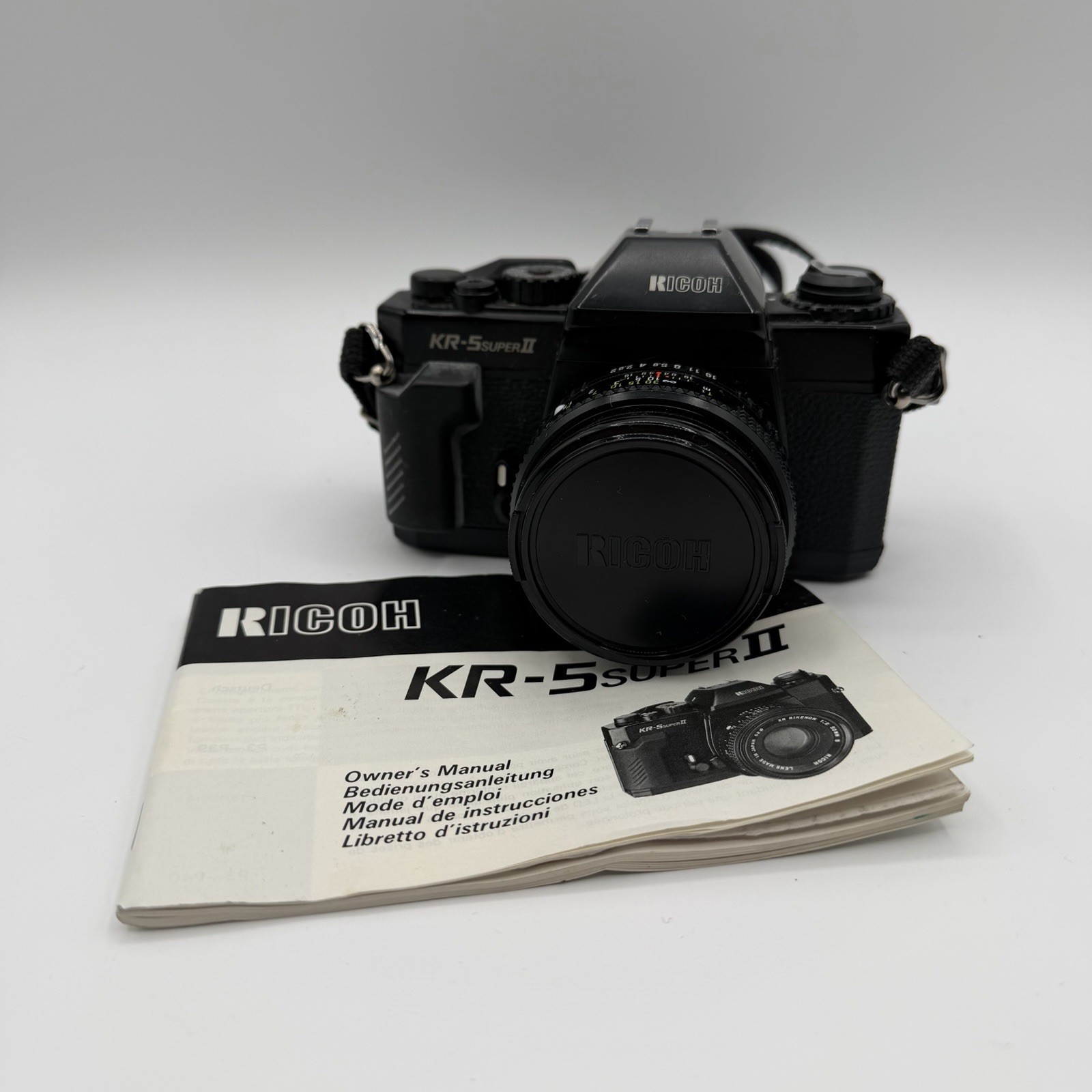
RICOH KR-5
The Ricoh KR-5 is an entry-level 35mm single-lens reflex (SLR) camera introduced in 1975 as part of Ricoh’s expansion into the K-mount SLR market. Designed for amateur photographers seeking an affordable yet reliable manual-focus SLR, the KR-5 combines solid mechanical construction with a simplified feature set, making it an accessible gateway into interchangeable-lens photography during the mid-1970s.
Overview
Released in 1975, the Ricoh KR-5 was positioned as an economical alternative within Ricoh’s growing line of K-mount SLR cameras. It followed the earlier KR-5 Super and KR-5 Super II models but distinguished itself as a more budget-conscious option, targeting novice photographers and students who required basic, dependable functionality without advanced automation or premium materials. The KR-5 was part of Ricoh’s strategic push to capture a share of the rapidly expanding consumer SLR market, which was dominated at the time by brands like Pentax, Canon, Nikon, and Minolta.
The KR-5 features a fully manual exposure system with a mechanical vertical-travel focal-plane shutter, supporting shutter speeds from 1 second to 1/1000 second, plus Bulb mode. It uses the Ricoh K-mount (also known as the Pentax K-mount), ensuring compatibility with a wide range of K-mount lenses from Ricoh, Pentax, and other licensed manufacturers. This cross-compatibility was a significant selling point, allowing users access to a broad ecosystem of optics. The camera lacks aperture-priority or shutter-priority automation, emphasizing manual control and simplicity.
Externally, the KR-5 is constructed with a polycarbonate-covered metal chassis, offering durability while keeping weight and production costs low. It features a fixed pentaprism viewfinder with a split-image rangefinder focusing aid and microprism collar, providing accurate manual focusing. The metering system is center-weighted and powered by a single PX625 (1.35V mercury) or equivalent modern battery (e.g., Wein Cell or adapter with 1.5V alkaline), using a cadmium sulfide (CdS) cell located in the prism housing. Metering is coupled to the lens aperture via a mechanical linkage, requiring stop-down metering when using non-K lenses or lenses without an automatic diaphragm pin.
The KR-5 fits into Ricoh’s mid-tier SLR lineup between the even simpler KR-3 and the more advanced KR-10 and KR-10 Super models. While lacking the shutter-priority automation of the KR-10 or the premium build of the KR-5 Super II, the KR-5 offered a compelling balance of functionality and affordability. It was succeeded in the early 1980s by newer models as Ricoh transitioned toward more automated electronics, but the KR-5 remained in production until approximately 1982, reflecting its steady demand in the budget SLR segment.
Specifications
| Specification | Value |
| Type | 35mm SLR |
| Film Format | 35mm (135 cartridge) |
| Years Produced | 1975–1982 |
| Lens Mount | Ricoh K-mount (compatible with Pentax K, KA, and later variants via mechanical linkage) |
| Shutter | Vertical-travel focal-plane shutter; speeds 1s – 1/1000s + B |
| Metering | Center-weighted CdS metering, stop-down via ASA/Meter switch |
| Exposure Modes | Manual exposure only; no automatic modes |
| Viewfinder | Fixed pentaprism with split-image/microprism focusing screen |
| Dimensions | Approx. 140 × 85 × 48 mm; Weight: ~590 g (body only, no battery) |
Key Features
- K-mount compatibility: Full support for K-mount lenses with automatic diaphragm coupling, enabling seamless use of a wide range of manual-focus lenses.
- Mechanical reliability: Fully mechanical shutter operation at all speeds except 1/1000s and 1/500s (which require battery power for timing), ensuring functionality even with dead batteries at slower speeds.
- Stop-down TTL metering: Center-weighted CdS metering system provides accurate exposure readings when lenses are stopped down, activated via the ASA/Meter switch on the lens mount.
- Split-image focusing screen: Integrated split-image rangefinder and microprism collar assist in achieving precise manual focus.
- Compact and lightweight design: Polycarbonate body shell reduces weight while maintaining structural integrity, ideal for casual and travel photography.
Historical Context
The Ricoh KR-5 was launched during a pivotal era in 35mm SLR development—the mid-1970s—when manufacturers were rapidly transitioning from all-mechanical designs to electronically controlled systems. Ricoh, already known for its compact cameras and lenses, sought to strengthen its presence in the SLR market by offering competitively priced models that leveraged the emerging K-mount standard. The K-mount, originally introduced by Pentax in 1975, became a de facto industry standard for manual-focus SLRs, and Ricoh’s adoption of it allowed for broad lens compatibility, a key advantage in a crowded market.
Competitors to the KR-5 included the Pentax K1000 (released in 1976), the Olympus OM-1 (1972), the Minolta SRT-101, and the Canon FTb. Among these, the Pentax K1000 became the most iconic budget SLR, often overshadowing the KR-5 in Western markets. However, the KR-5 held its own in regions where Ricoh had strong distribution, particularly in Asia and parts of Europe. It was marketed as a “student camera” or “first SLR,” emphasizing durability, ease of use, and affordability. While it lacked the brand cachet of Pentax or Nikon, the KR-5 earned a reputation for reliability and straightforward operation.
Collectibility & Value
Today, the Ricoh KR-5 is considered a modestly collectible camera, primarily sought after by enthusiasts of vintage SLRs, K-mount historians, and photographers building mechanical film camera kits. It is not rare, as it was produced in significant numbers throughout the late 1970s and early 1980s, but well-maintained examples with clean viewfinders and functioning shutters are increasingly harder to find. Current market value typically ranges from $50 to $120 USD, depending on condition, included accessories, and lens bundle.
When purchasing a KR-5, collectors should inspect the shutter operation at all speeds, check for mirror slap noise or sluggish movement, and verify that the light meter responds (though CdS cells often degrade over time). The original battery, a PX625 mercury cell, is obsolete, so users must rely on modern substitutes like zinc-air batteries or voltage adapters to achieve accurate metering. Fungal growth inside the viewfinder prism and light seals degradation are common issues in older units, especially those stored in humid environments. Given its mechanical simplicity, the KR-5 is relatively easy to service, though replacement parts are not widely available.
Similar Cameras
- Pentax K1000
- Olympus OM-1
- Minolta SRT-101
- Canon FTb
- Yashica FR-I
Repair & Maintenance
The Ricoh KR-5 uses a 1.35V PX625 mercury battery (or modern equivalent) for light meter operation; shutter speeds 1/500s and 1/1000s also require battery power for timing, while slower speeds are fully mechanical. Common issues include degraded light seals, stiff shutter curtains, and oxidized battery contacts. The CdS meter cell may lose sensitivity over time, leading to inaccurate readings. Repair difficulty is moderate: while the camera’s design allows for disassembly with standard tools, the internal layout is compact, and replacement parts (such as shutter curtains or meter cells) are scarce. Routine maintenance includes cleaning the mirror and focusing screen, checking the film advance mechanism, and replacing light seals during CLA (clean, lubricate, adjust) services.
eBay Listings



As an eBay Partner, we earn from qualifying purchases. This helps support our independent vintage technology research.
Related Models
- Ricoh Singlex (1962-1967)
- Ricoh Singlex TLS (1967-1972)
- Ricoh XR-2 (1977-1982)
- Ricoh XR-7 (1981-1985)
- Alpa 6 (1948-1953)
- Agfa Agfaflex
- Agfa Ambiflex
- Agfa Easy
- Agfa Futura Af zoom
- Agfa Isoflash-Rapid C