Revere T-100
A tape recorder that ended up in more living rooms than the camera counter it was filed under.
Overview
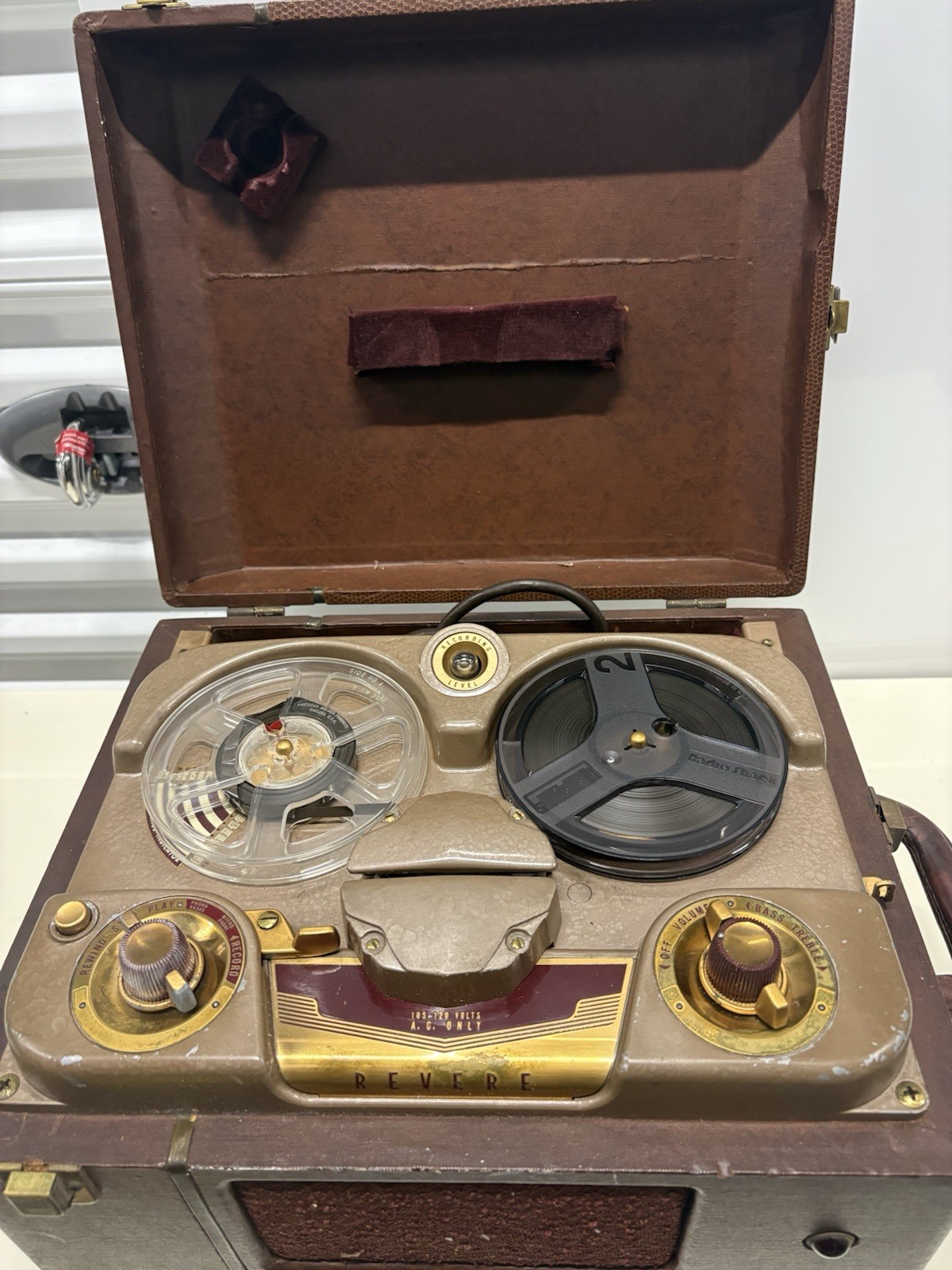
The Revere T-100 keeps landing in camera indexes because Revere Camera Company built it, but everything that survives about this machine is tape - classifieds, owner letters, and a stack of celebrity endorsements in the hi-fi press. The T-100 was a reel-to-reel tape recorder, sold with a one-hour play capacity, and it turns up in Audio-Record (August 1951, p.8) at $169.50. That price is the anchor fact here. A hundred and seventy bucks in 1951 was a serious household purchase, the kind of money that made a tape recorder a piece of furniture rather than a gadget.
Daily use comes through best in the owner testimonials, not in any spec sheet. A reader writing to Film and Tape Recording hauled the machine to Europe for a vacation sound-effects project and noted, with some understatement, that the Revere T100 is "no light-weight paraphernalia" - a fair warning that this was a transportable machine, not a pocketable one. Another owner, a Princeton researcher assembling a study of West African and jazz recordings, relied on the T-100's time-footage indicator scale under the take-up and feed reels. It let any selection on a tape be indexed and located quickly. That's a working feature, not a marketing bullet, and it suggests the T-100 was built for people who actually logged their tapes.
The machine had a following among working musicians, or at least Revere's advertising wanted buyers to think so. High Fidelity ran a series of endorsements through 1952 and 1953 in which Marian Anderson, Artur Rubinstein, Elena Nikolaidi, and Lauritz Melchior each put their name to the Revere Tape Recorder. Nikolaidi's testimonial, in High Fidelity (November 1952, p.14), claimed the Revere gave "the truest reproduction of my voice I have heard." Melchior's, in High Fidelity (July 1953, p.22), pitched it as a tool for scouting young American talent. These are advertising placements, not independent measurements, so read them as period marketing, not lab data. They do show that Revere was pushing the T-100 hard into the classical and concert market, and that the company had the budget to buy full-page testimonials from major artists.
So the T-100 sat at the entry point of a family, the cheaper machine in a lineup that climbed from there.
What Owners Actually Did With It
The surviving record of the T-100 is unusually domestic. It shows up in the for-sale columns constantly - $100, $85, $79.50, $75 - usually with the phrase "just factory serviced" or "good condition" attached, which suggests a machine that got used hard and then resold rather than shelved. One owner advertised a T-100 with 5" reels, used three years, factory serviced, at $75 and no less. A dealer in New York listed a used T-100 at $79.50 alongside a Brush BK 411 and an Ekotape 114. These are the real market numbers for the period, and they show the T-100 depreciating fast once the next model year arrived - a $169.50 machine trading at roughly half that within a few years.
Owners also used it for things Revere probably never put in the brochure. The Princeton researcher taped collectors' jazz platters in their homes, because the owners would not let the records leave the door. A traveling couple recorded European sound effects. A photographer's cousin bought a Revere Standard Model T-100 specifically to record synchronized commentary for color-slide lectures, after finding that reading notes aloud in a dark room didn't work. Slide shows with taped narration were apparently common enough that this one got a full write-up in the tape press.
Reception and the Celebrity Campaign
Independent technical reviews of the T-100 have not surfaced in the material available here. What exists instead is a sustained advertising campaign in High-Fidelity across 1952 and 1953, built entirely on artist endorsements. Vronsky and Babin, the duo-pianists, were featured in High-Fidelity (January 1953, p.16). Rubinstein's endorsement ran in High-Fidelity (March 1953, p.13), where he recommended the Revere Tape Recorder to "every pianist, whether master or student." Marian Anderson's testimonial led the campaign in High-Fidelity (September 1953, p.42), describing acquaintance with the Revere as "an unusually pleasant experience."
Read that run of ads as a group and the strategy is plain: Revere was not selling the T-100 to engineers. It was selling it to serious amateur musicians and music lovers who trusted names, not specs. The period record doesn't say whether the machine lived up to the company it kept. No independent lab numbers survive in this material, and the endorsements were paid placements.
Collectibility
The T-100 is a period curiosity more than a sought-after machine. It shows up in classifieds, and its main claim on a collector's attention is the Revere name and the celebrity ad campaign rather than any documented technical distinction. Prices in the period collapsed quickly - from $169.50 new to $75 - $100 used within a few years - and there's no evidence in this material of a modern collector market with established values.
What the T-100 does offer is documentation. The owner letters and classifieds paint a clear picture of who bought it and why: travelers, lecturers, researchers, and amateur musicians who needed to record and index their own material. For anyone building a picture of early-1950s home tape recording, the T-100 is a useful specimen — not because it was the best machine of its moment, but because so many ordinary owners wrote down what they did with it.
eBay Listings
As an eBay Partner, we earn from qualifying purchases. This helps support our independent vintage technology research.