PRAKTICA L
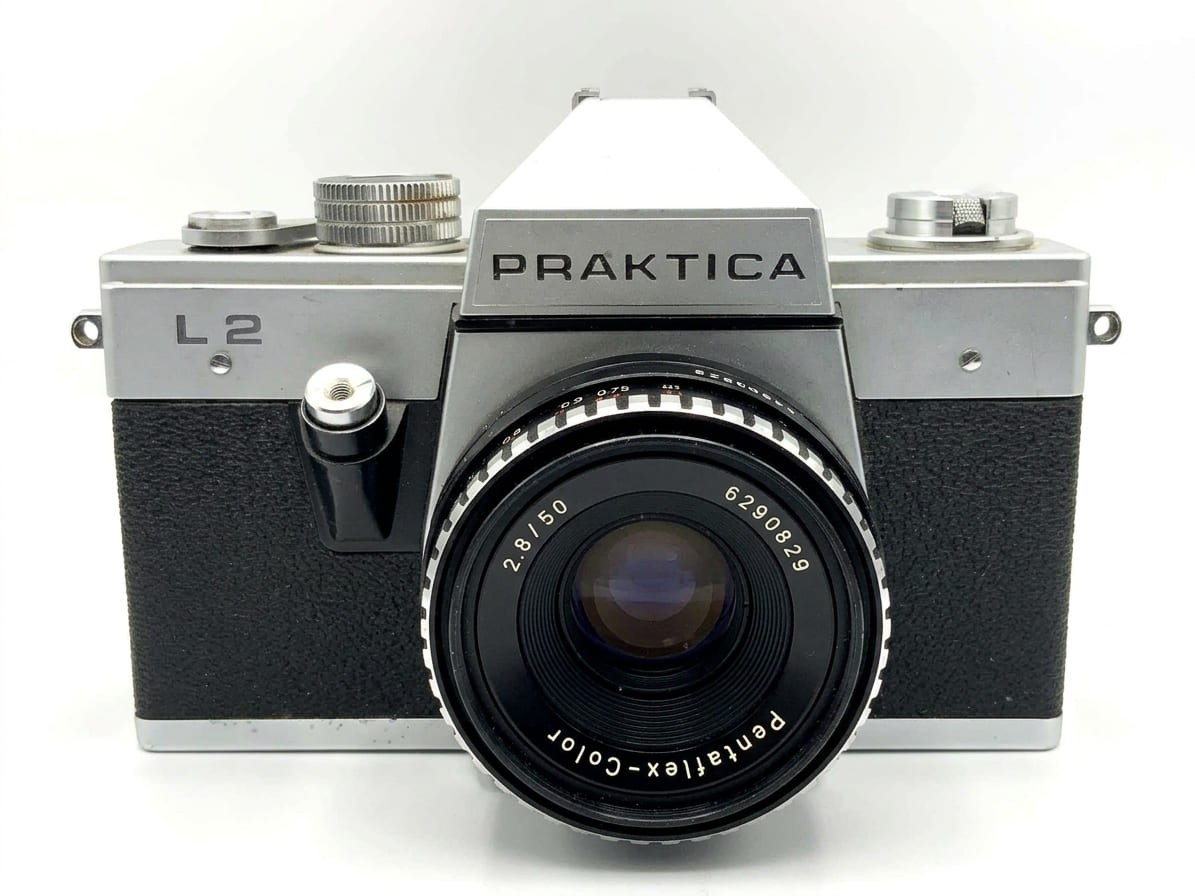
The Praktica L is a mechanically operated 35mm single-lens reflex (SLR) camera introduced in 1969 as part of Praktica’s effort to deliver a reliable, no-frills SLR for amateur photographers and students. Built with a robust all-metal chassis and utilizing the widely adopted M42 screw mount, the L model represents a minimalist yet functional design philosophy that prioritized durability and ease of use over automation.
Overview
Manufactured by VEB Pentacon Dresden in East Germany, the Praktica L was released during a period of increasing competition in the global SLR market. It served as the entry-level model in the L-series, succeeding earlier Praktica models like the FX and PLC series while introducing a simplified, more compact body design. The L was aimed at budget-conscious consumers who required a dependable manual camera without the complexity or cost of built-in light metering or electronic components. Its mechanical shutter and fully manual operation made it particularly suitable for users who preferred full control over exposure settings.
The Praktica L shares the lineage of the M42-thread mount tradition, which had become a de facto standard among many European and Japanese manufacturers. This interchangeability with a wide range of lenses from brands such as Carl Zeiss, Pentax, and Meyer-Optik enhanced its appeal. Despite its basic feature set, the L was engineered with precision typical of East German optical manufacturing, featuring a vertically traveling cloth focal-plane shutter and a fixed pentaprism viewfinder with a split-image rangefinder aid. It lacks any form of built-in exposure metering, requiring users to rely on external meters or handheld devices for accurate exposure.
Positioned as a foundational model in the Praktica lineup, the L was succeeded by slightly upgraded variants such as the Praktica LB (which introduced open-aperture metering compatibility) and the L2, which added a hot shoe. However, the L remains notable for its pure mechanical simplicity, making it a favorite among photographers interested in fully manual operation and vintage camera mechanics.
Specifications
| Specification | Value |
| Type | 35mm SLR (Single-Lens Reflex) |
| Film Format | 35mm (135 film) |
| Years Produced | 1969–1975 |
| Lens Mount | M42 × 1mm screw thread (Praktica thread mount) |
| Shutter | Vertically traveling cloth focal-plane shutter; speeds from 1 sec to 1/1000 sec, plus B (Bulb) |
| Metering | None (no built-in light meter) |
| Exposure Modes | Manual only |
| Viewfinder | Fixed pentaprism with ground-glass screen, split-image rangefinder center spot |
| Dimensions | Approx. 140 mm (W) × 88 mm (H) × 48 mm (D); weight: ~650 g (body only, without battery or lens) |
Key Features
- Fully mechanical operation: No batteries required for shutter function, enabling reliable performance even in extreme conditions or long-term storage.
- M42 lens compatibility: Supports a vast array of manual-focus lenses from multiple manufacturers, including Carl Zeiss Jena, Meyer-Optik, Schneider, and Pentax.
- High shutter speed range: Capable of 1/1000 sec, which was relatively fast for budget mechanical SLRs of the era.
- Split-image focusing screen: Integrated split-prism rangefinder for accurate manual focusing, essential in the absence of autofocus.
- Simple, durable construction: All-metal body with minimal moving parts, contributing to long-term reliability and ease of repair.
Historical Context
The Praktica L was launched at a time when SLR cameras were rapidly becoming the preferred choice for serious amateur photographers, displacing rangefinders and twin-lens reflex models. In the late 1960s and early 1970s, Japanese manufacturers such as Nikon, Canon, and Pentax were introducing increasingly sophisticated SLRs with through-the-lens (TTL) metering and electronic shutters. In contrast, East German camera makers like Pentacon focused on producing mechanically robust, cost-effective alternatives that emphasized function over automation.
The Praktica L was part of this strategic response—a no-nonsense, mechanically driven SLR that avoided reliance on batteries or complex electronics. While lacking the modern conveniences of its Japanese competitors, it offered excellent value for photographers who prioritized reliability and lens compatibility. It competed indirectly with models like the Pentax Spotmatic (introduced in 1964), though the Spotmatic featured TTL metering, giving it an edge in usability. Nevertheless, the Praktica L found a niche in Eastern Europe and among Western photographers seeking affordable, repairable mechanical cameras.
Collectibility & Value
Today, the Praktica L is regarded as a solid example of Cold War-era East German engineering and is sought after by collectors of vintage mechanical cameras and those interested in M42 system photography. While not particularly rare, well-maintained specimens in working condition are increasingly difficult to find due to age-related wear and the degradation of internal materials such as rubber shutter curtains and light seals.
In the current collector market (as of 2024), the Praktica L typically sells for $50–$100 USD when paired with a standard lens (e.g., Color-Pentacon 50mm f/1.8 or Meyer-Optik Orestegor 50mm f/1.8). Bodies without lenses may go for as low as $30. The value depends heavily on mechanical condition, presence of light leaks, and functionality of the shutter across all speeds. Cameras with original leatherette and clean viewfinders command higher prices.
When purchasing a Praktica L, buyers should test the shutter at all speeds, check for mirror movement smoothness, and inspect the film advance mechanism for proper frame spacing. Common issues include sticky shutter blades, deteriorated light seals leading to light leaks, and worn shutter cloth. The absence of a light meter simplifies repair, but replacement parts for the shutter or film transport can be difficult to source.
Similar Cameras
- Pentax Spotmatic (1964–1976) – A contemporary M42 SLR with TTL metering, considered more advanced but also more complex.
- Zenit-E (USSR, 1965–1982) – A rugged, fully mechanical M42 SLR with similar simplicity but less refined build quality.
- Praktica FX3 (1965–1968) – A direct predecessor with similar mechanics but different styling and slightly different shutter mechanism.
- Fujica ST705 (1968–1970) – Japanese-made M42 SLR with faster max shutter speed (1/1000 sec) and better ergonomics.
- Yashica TL Electro (1973–1976) – Later M42 model with electronic shutter, representing the transition toward automation.
Repair & Maintenance
The Praktica L requires no batteries for operation, as all functions—shutter actuation, film advance, and mirror movement—are purely mechanical. This makes it highly reliable in the absence of electronic components but also means that maintenance is essential for long-term functionality. Common issues include stiff or inconsistent shutter speeds due to dried lubricants, particularly in the vertical metal-blade shutter mechanism. The cloth focal-plane shutter is susceptible to wear, and replacement may be necessary if torn or perished.
Regular servicing should include cleaning of the mirror box, inspection of the film pressure plate, and replacement of deteriorated light seals to prevent light leaks. The film advance lever and rewind crank should operate smoothly; binding may indicate worn gears or dried grease. As the camera lacks electronics, repairs are generally limited to mechanical adjustments and lubrication by a technician experienced in vintage SLRs. Due to its modular design, many components can be disassembled and serviced individually, though original spare parts are scarce outside of East German camera specialty suppliers.
eBay Listings



As an eBay Partner, we earn from qualifying purchases. This helps support our independent vintage technology research.
Related Models
- Praktica BX20 (1987–1993)
- Praktica IV (1959-1966)
- Praktica LTL (1970-1975)
- Praktica MTL3 (1978-1984)
- Praktica MTL5 (1983–1985)
- Alpa 6 (1948-1953)
- Agfa Agfaflex
- Agfa Ambiflex
- Agfa Easy
- Agfa Futura Af zoom