PRAKTICA BX20
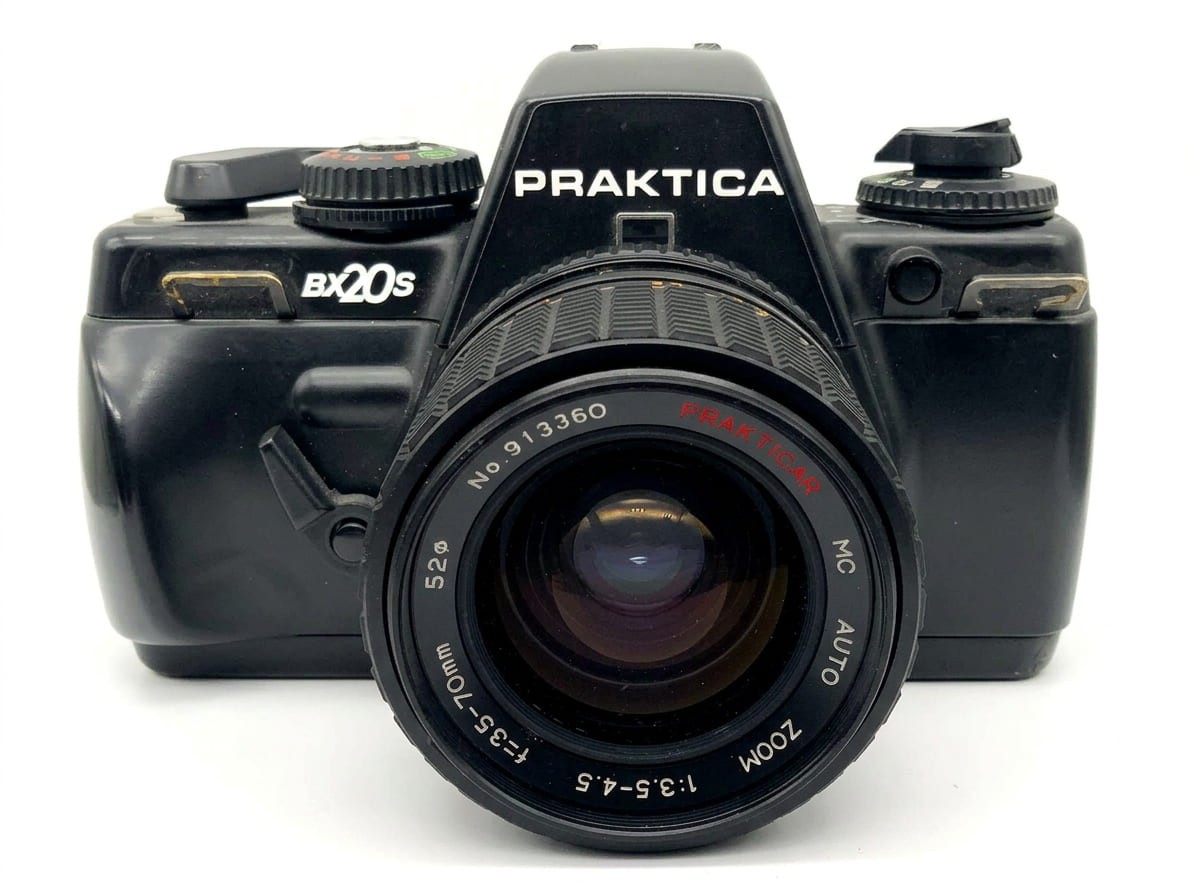
The Praktica BX20 is a 35mm single-lens reflex (SLR) camera produced by Pentacon under the Praktica brand between 1987 and 1993. Designed as a modern, electronically controlled SLR, the BX20 features full program auto-exposure and a dedicated B-mount lens interface, positioning it as an accessible yet technically advanced option in the late 1980s amateur photography market.
Overview
Introduced during the twilight years of East German camera manufacturing, the Praktica BX20 represented a significant evolution in Praktica’s SLR design philosophy. Manufactured at the Pentacon factory in Dresden, the BX20 was developed to modernize the Praktica lineup amid increasing competition from Japanese electronics-integrated SLRs. Unlike earlier mechanical Praktica models that relied on M42 screw mounts, the BX20 adopted the Praktica B bayonet mount—first introduced in the late 1970s—which allowed for faster lens changes and improved mechanical/electrical communication between lens and body. The BX20 was targeted primarily at amateur photographers seeking an easy-to-use, fully automated SLR without sacrificing manual control options.
The BX20 stands out in the Praktica lineage for its integration of advanced electronics, including a microprocessor-controlled exposure system, LED-based viewfinder display, and shutter-priority and program auto-exposure modes. It features a vertically traveling, focal-plane metal-blade shutter with electronic control, enabling precise exposure timing from 1/2000 sec to 4 seconds, plus Bulb mode. The camera supports TTL (through-the-lens) center-weighted metering using a silicon photodiode (SPD) sensor, with exposure data displayed via LEDs in the viewfinder. While the BX20 lacks aperture-priority or full manual mode, its program mode automatically selects both shutter speed and aperture, making it one of the first truly "point-and-shoot" SLRs in the Praktica range.
Despite being produced in East Germany during a period of economic and political instability, the BX20 was built with solid mechanical construction and a surprisingly modern feature set. It was marketed across Western Europe and distributed in several countries through third-party retailers, often with alternate branding. Its release coincided with the final years of the German Democratic Republic (GDR), and production ceased shortly after German reunification in 1990, although some units were assembled and sold into the early 1990s from existing stock.
Specifications
| Specification | Value |
| Type | 35mm Single-Lens Reflex (SLR) |
| Film Format | 35mm (135 film), 24 × 36 mm frame size |
| Years Produced | 1987–1993 |
| Lens Mount | Praktica B bayonet (compatible with B-series lenses with mechanical aperture linkage) |
| Shutter | Electronically controlled vertical-travel focal-plane metal shutter; speeds from 4 sec to 1/2000 sec in 1/3 EV steps, plus Bulb (B) |
| Metering | TTL, center-weighted silicon photodiode (SPD) metering |
| Exposure Modes | Program Auto, Shutter-Priority Auto, Manual (via aperture ring on lens) |
| Viewfinder | Fixed pentaprism, 0.95× magnification, 94% frame coverage; LED exposure indicators (up/down arrows and center dot) |
| Dimensions | 140 × 90 × 55 mm (W×H×D); weight: approx. 580 g (body only, no battery or lens) |
Key Features
- Praktica B Bayonet Mount: Enables fast lens interchangeability and supports electronic coupling with compatible lenses for accurate metering.
- Programmed Auto-Exposure: The camera automatically selects optimal shutter speed and aperture combinations, simplifying operation for novice users.
- TTL Center-Weighted Metering: Utilizes a silicon photodiode sensor for accurate exposure readings based on scene brightness through the lens.
- LED Viewfinder Display: Provides intuitive exposure feedback with up/down arrows and a center indicator to guide shutter speed selection in semi-automatic modes.
- Compact and Lightweight Design: Constructed with a die-cast aluminum chassis and polycarbonate shell, balancing durability with portability.
Historical Context
The Praktica BX20 was launched at a pivotal moment in European photographic history. By the mid-1980s, Japanese manufacturers like Minolta, Pentax, and Canon had firmly established dominance in the SLR market with advanced, electronics-heavy models such as the Minolta X-700 and Pentax ME-F. In response, Pentacon sought to modernize the Praktica brand to remain competitive. The BX20, along with its sibling the BX10, was part of this effort—bridging the gap between traditional mechanical SLRs and the new generation of automated cameras.
Unlike earlier Praktica models that emphasized mechanical reliability over automation, the BX20 embraced electronics to appeal to a broader consumer base. It was one of the first Praktica cameras to feature a microprocessor-driven exposure system, reflecting a strategic shift toward user-friendly automation. However, due to the economic constraints of the GDR and limited access to cutting-edge semiconductor technology, the BX20’s electronics were less sophisticated than those of its Japanese counterparts. Nevertheless, it offered a compelling value proposition in markets where price sensitivity was high, particularly in Eastern Europe and parts of Scandinavia.
Collectibility & Value
Today, the Praktica BX20 is considered a niche collectible, primarily sought after by enthusiasts of Cold War-era optics and vintage SLR technology. While not rare, complete working examples with original lenses (such as the 50mm f/1.8 or f/2.8 B-mount variants) are increasingly difficult to find. The camera’s value remains modest, typically ranging from €30 to €80 in working condition, depending on cosmetic state and included accessories.
When purchasing a BX20, collectors should verify the functionality of the shutter across all speeds, check for smooth film advance and rewind operation, and ensure the light meter responds accurately to changing light conditions. Common issues include degraded rubber grips, stiff shutter mechanisms due to dried lubricants, and failure of the SPD metering cell—often caused by age or exposure to moisture. The camera uses a single 3V lithium battery (CR1/3N or equivalent, two S76 cells in series), which powers both the meter and shutter control. Battery leakage is a frequent problem in poorly stored units and can damage the circuitry.
Similar Cameras
- Pentax ME Super – A compact, aperture-priority SLR with manual override and TTL metering.
- Minolta X-370 – Electronically controlled SLR with program mode, comparable in automation level.
- Yashica FX-3 Super – Affordable 35mm SLR with aperture-priority and TTL metering.
- Canon AE-1 Program – Iconic microprocessor-controlled SLR with shutter and program modes.
- Olympus OM20 – Entry-level OM series SLR with auto-exposure and compact design.
Repair & Maintenance
The Praktica BX20 operates on a 3V power source, typically supplied by a CR1/3N battery or two LR44/S76 cells in a stacked holder. This battery powers the shutter timing circuit and TTL metering system—without it, the camera cannot fire the shutter except in Bulb mode (with external power). Common maintenance issues include shutter lag at slow speeds, erratic meter behavior, and intermittent electrical contact in the battery compartment. Cleaning the contacts and replacing aged capacitors on the main circuit board often restores functionality. The camera’s mechanical components are generally robust, but periodic CLA (clean, lubricate, adjust) servicing is recommended for long-term reliability. Due to the limited availability of official service documentation and replacement parts, repairs are best handled by technicians experienced in Eastern Bloc camera systems.
eBay Listings


As an eBay Partner, we earn from qualifying purchases. This helps support our independent vintage technology research.
Related Models
- Praktica IV (1959-1966)
- Praktica L (1969-1975)
- Praktica LTL (1970-1975)
- Praktica MTL3 (1978-1984)
- Praktica MTL5 (1983–1985)
- Alpa 6 (1948-1953)
- Agfa Agfaflex
- Agfa Ambiflex
- Agfa Easy
- Agfa Futura Af zoom