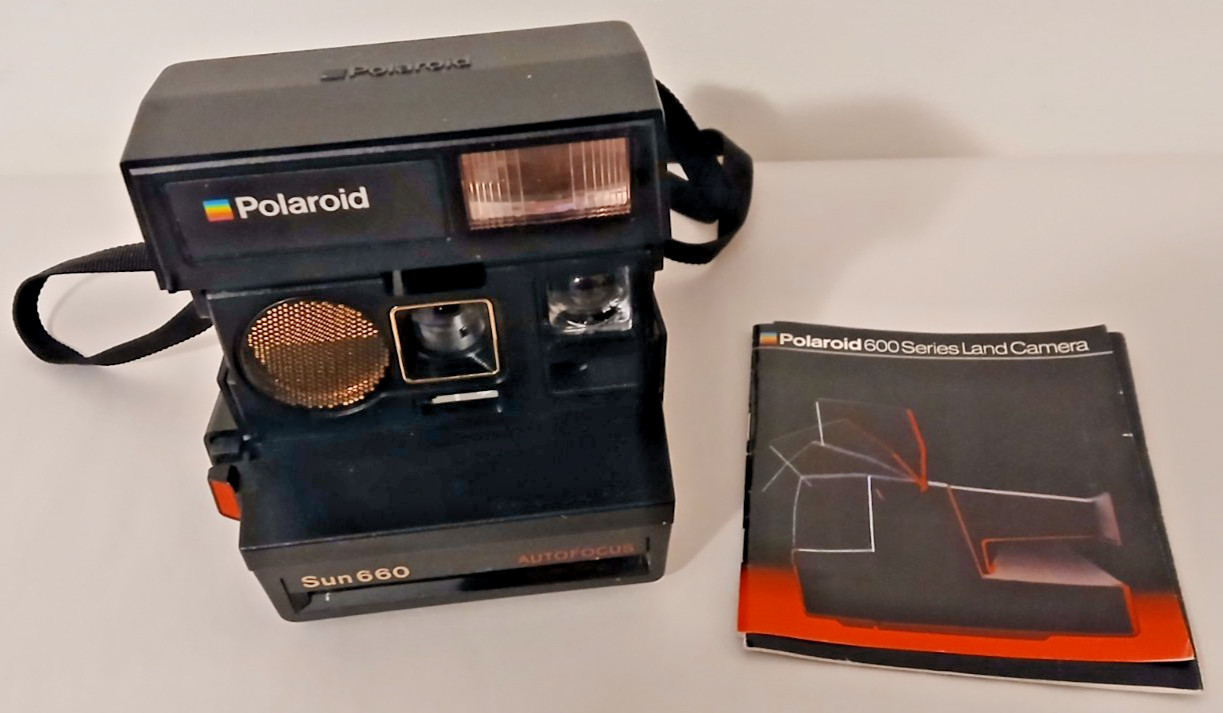
POLAROID 600 LAND CAMERA
The Polaroid 600 Land Camera is a consumer-grade instant film camera introduced by Polaroid Corporation in 1981 as part of its 600 series lineup. Designed for ease of use and reliable performance, it became one of the most widely recognized and best-selling instant cameras of the 1980s, leveraging high-speed 600 film and an integrated electronic flash for consistent indoor and low-light photography.
Overview
The Polaroid 600 Land Camera was launched during a pivotal era in instant photography, when Polaroid sought to expand its consumer market beyond professional and enthusiast users into mainstream household adoption. As the flagship model of the 600 series, it replaced earlier SX-70 models in many entry-level applications, offering faster film (ISO 640), automatic exposure, and a simplified point-and-shoot interface. The camera was marketed toward casual photographers seeking immediate results without the need for technical adjustments, making it ideal for parties, family events, and amateur use.
Built around a fixed-focus lens and automated exposure system, the 600 Land Camera utilized Polaroid’s proprietary 600 film cartridges, which contained both the film pack and a 6-volt battery (4LR44) that powered the camera’s electronics and flash. This integration of power within the film pack was a hallmark of Polaroid’s design philosophy, eliminating the need for separate batteries but tying camera functionality directly to film availability. The camera’s plastic construction and ergonomic design emphasized affordability and portability, contributing to its widespread distribution and cultural ubiquity.
Within Polaroid’s product hierarchy, the 600 Land Camera occupied the mid-to-lower tier, sitting beneath more advanced models like the SLR 680 and the folding SX-70, but above basic models such as the OneStep. Its success helped solidify the 600 film format as the dominant consumer standard for instant photography throughout the 1980s and early 1990s. Over its 14-year production run, the model underwent minor revisions and was rebranded under various names (including "OneStep" in some markets), but retained core functionality and design.
Specifications
| Specification | Value |
| Type | Fixed-lens instant camera |
| Film Format | Polaroid 600 film (integral instant film, 3.1 × 3.2 in image area) |
| Years Produced | 1981–1995 |
| Lens Mount | Fixed integral lens (non-interchangeable) |
| Lens | 116 mm f/12 plastic triplet |
| Focus | Fixed focus (optimized for 4 ft to infinity) |
| Shutter | Electronic leaf shutter, speeds from 1/2 to 1/200 second (auto-exposure controlled) |
| Aperture | Automatic, two-position (indoor/outdoor) via flash sync coupling |
| Metering | Built-in CdS (cadmium sulfide) light meter |
| Exposure Modes | Fully automatic exposure; flash sync triggers indoor mode |
| Flash | Integrated electronic flash (fixed, non-removable), powered by film pack battery |
| Viewfinder | Optical direct-vision viewfinder with parallax correction marks |
| Film Ejection | Automatic motorized ejection after exposure |
| Power Source | 6V from 4LR44 battery (integrated in 600 film pack) |
| Dimensions | Approx. 155 × 125 × 105 mm (6.1 × 4.9 × 4.1 in) |
| Weight | Approx. 540 g (1.2 lb) without film |
Key Features
- Integrated Electronic Flash: The built-in flash automatically activates in low-light conditions, enabling reliable indoor photography without manual intervention.
- Automatic Exposure System: Utilizes a CdS meter to adjust shutter speed and aperture settings based on ambient light, minimizing user error.
- Motorized Film Ejection: After exposure, the camera automatically advances and ejects the film, initiating the chemical development process.
- 600 Film Compatibility: Uses ISO 640 600 film with self-contained battery, simplifying operation and ensuring consistent power delivery.
- User-Friendly Design: Fixed focus, simple shutter button, and intuitive operation make it accessible to novice photographers.
Historical Context
The Polaroid 600 Land Camera was introduced in 1981 as part of Polaroid’s strategic shift toward mass-market consumer electronics. This move followed the success of the more sophisticated SX-70, which had established instant photography as a viable artistic and personal medium but remained relatively expensive. The 600 series was engineered to be more affordable and durable, targeting department store shelves and holiday gift markets. Its launch coincided with the peak of analog instant photography, before the rise of digital imaging and disposable cameras.
Competitors at the time included Kodak’s short-lived instant camera line (introduced in 1976 and discontinued by 1986 after a patent lawsuit with Polaroid), as well as later entrants like Fujifilm’s Instax precursors. However, Polaroid maintained a near-monopoly in the integral instant film market during this period. The 600 Land Camera’s combination of reliability, ease of use, and iconic design contributed to strong sales, with millions of units sold worldwide. It became a cultural fixture, appearing in films, advertisements, and homes across America and Europe.
Collectibility & Value
Today, the Polaroid 600 Land Camera is a common find in the vintage camera market, often available at thrift stores, online marketplaces, and camera specialty shops. Due to its high production volume and widespread use, it is not considered rare, and typical working models sell for $20–$50 USD. However, units in excellent cosmetic condition with original packaging or special editions (e.g., holiday-themed models) may command higher prices, particularly among instant photography enthusiasts and retro collectors.
When purchasing a used 600 Land Camera, buyers should verify that the electronics function properly, especially the flash and ejection motor. Common issues include corroded battery contacts (from old or leaking film packs), worn shutter mechanisms, and degraded light seals. Because the camera relies entirely on the film pack’s battery, it will not operate without a fresh 600 film cartridge—this also means that prolonged storage without film can lead to power-related failures. Enthusiasts often retrofit cameras with external battery mods to preserve functionality when using modern alternative films.
Similar Cameras
- Polaroid SX-70 Alpha SE – A higher-end folding SLR instant camera with manual focus and superior optics, aimed at enthusiasts.
- Polaroid OneStep 600 – A rebranded and simplified version of the 600 Land Camera, often identical in internal mechanics.
- Fujifilm Instax Mini 90 Neo Classic – A modern digital-inspired instant camera with manual controls and retro styling.
- Kodak Printomatic – A contemporary battery-powered instant camera using ZINK paper, lacking integral film chemistry.
- Polaroid Now / Now+ – Modern reboots of the 600-style design, compatible with 600 film and featuring Bluetooth connectivity.
Repair & Maintenance
The Polaroid 600 Land Camera requires a fresh 600 film pack to operate, as the 6V 4LR44 battery is housed within the film cartridge. Without film, the camera is electrically inert. Common maintenance issues include corroded battery contacts, which can be cleaned with isopropyl alcohol and a cotton swab. The electronic flash is prone to failure due to capacitor degradation; replacement capacitors (typically 100–120 µF, 330V) are available from electronics suppliers. The motorized film ejection system may jam if the film pack is misaligned or if the gears are worn. Disassembly requires careful handling of the plastic housing and ribbon cables. Repair difficulty is moderate: while not complex electronically, the tight integration of components and age-related plastic brittleness increase the risk of damage during servicing. Regular use with new film helps maintain contact conductivity and motor function.
eBay Listings



As an eBay Partner, we earn from qualifying purchases. This helps support our independent vintage technology research.
Related Models
- Polaroid Pronto (1976-1982)
- Polaroid SX-70 Sonar (1978-1981)
- Polaroid SX-70 (1972-1981)