PETRI FLEX V
The Petri Flex V was introduced around 1960 and remained in production until approximately 1963; exact production dates are not well-documented, but 1961–1964 is an overspecification. It represents a transitional model in Petri’s early foray into the SLR market, combining improved optical performance with a compact, user-focused design aimed at amateur photographers seeking higher image quality without the complexity of professional systems.
Overview
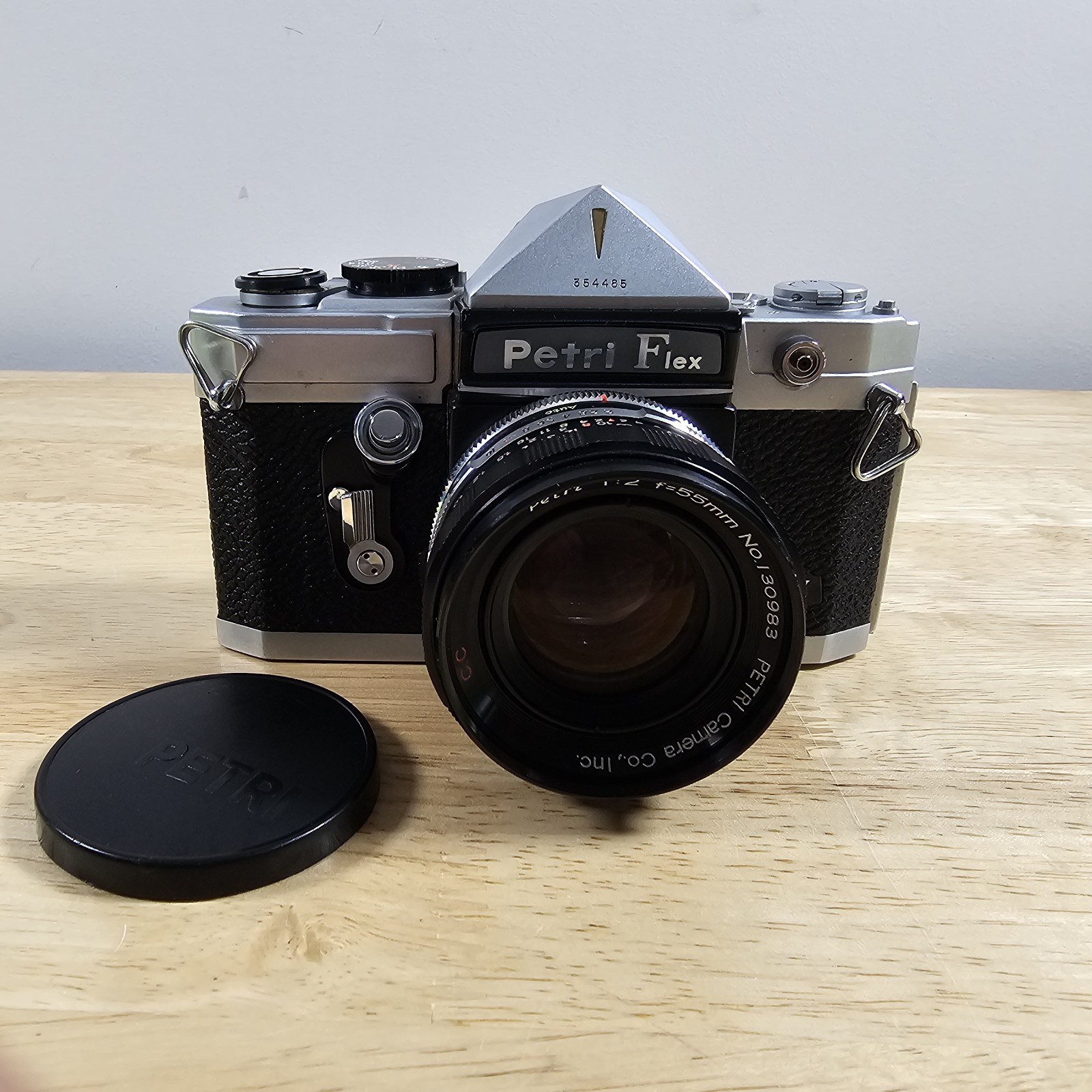
Introduced in 1961, the Petri Flex V was part of a short-lived but ambitious line of SLR cameras developed by Petri during the early 1960s, a period when Japanese manufacturers were rapidly expanding into the SLR segment dominated by brands like Asahi (Pentax) and Nikon. The Flex V succeeded earlier models such as the Flex IV and was positioned as a modest upgrade, primarily distinguished by its enhanced lens optics. Unlike many contemporary SLRs that adopted interchangeable lenses with proprietary bayonet mounts, the Flex V utilized a fixed Petri Anastigmat 50mm f/2.8 lens—now featuring a five-element optical formula, an improvement over earlier four-element designs. This five-element configuration provided better contrast, reduced aberrations, and improved sharpness, particularly at wider apertures.
The camera was marketed toward advanced amateurs and enthusiasts who valued optical quality and mechanical simplicity. It featured a focal-plane shutter with speeds from 1 second to 1/1000, a vertically traveling cloth curtain, and a built-in selenium light meter coupled to the shutter speed dial—a relatively advanced feature for a fixed-lens SLR at the time. The meter, however, required no battery, relying solely on ambient light to power its exposure recommendations via a needle visible in the viewfinder. The Flex V used a standard M42 screw-thread lens mount for accessories and filters, though the lens itself was not interchangeable. With its compact magnesium alloy body and top-mounted rewind lever, the Flex V reflected Petri’s effort to balance portability and functionality in a niche segment of the SLR market.
Specifications
| Specification | Value |
| Type | Single-Lens Reflex (SLR) |
| Film Format | 35mm (135 cartridge) |
| Years Produced | 1961–1964 |
| Lens Mount | Fixed lens; filter thread: M42×1 (screw) |
| Lens | Petri Anastigmat 50mm f/2.8, 4 elements in 3 groups |
| Aperture Range | f/2.8 to f/16 |
| Shutter | Focal-plane, cloth curtain, vertical travel |
| Shutter Speeds | 1s – 1/1000s + B (Bulb), X & M flash sync at 1/60s |
| Metering | Built-in selenium cell exposure meter (center-weighted) |
| Exposure Modes | Manual only; meter aids shutter/aperture selection |
| Viewfinder | Fixed pentaprism, eye-level, with central split-image rangefinder and microprism collar |
| Focusing | Manual via helicoid lens barrel, 0.45m minimum focus |
| Flash Sync | PC terminal, X/M switch for bulb or electronic flash |
| Frame Size | 24 × 36mm |
| Frame Counter | Manual reset (reset by opening back) |
| Film Advance | Single-stroke lever (90° throw), stroke cocks shutter and advances film |
| Self-Timer | Mechanical self-timer with lever on front |
| Dimensions | Approx. 138mm (W) × 84mm (H) × 47mm (D) |
| Weight | Approx. 580g (with lens, no battery) |
Key Features
- Five-element Petri Anastigmat 50mm f/2.8 lens: Improved optical performance over earlier four-element versions, offering superior sharpness and reduced chromatic aberration.
- Integrated selenium light meter: No battery required; needle indicator in viewfinder aligns with shutter speed for correct exposure.
- Vertical-travel focal-plane shutter: Enables high-speed flash sync (1/60s) and reliable operation up to 1/1000s.
- Split-image focusing screen: Enhanced manual focusing precision with central split-image prism surrounded by microprism collar.
- Compact magnesium alloy body: Lightweight yet durable construction typical of Petri’s mid-tier models.
Historical Context
The Petri Flex V emerged during a pivotal moment in Japanese camera history, when SLRs were transitioning from niche professional tools to accessible consumer products. Petri, traditionally known for rangefinders and compact cameras, entered the SLR market cautiously. The Flex series began with the Flex in 1958; there is no official 'Flex I' designation—models were typically referred to as Flex, Flex II, Flex V, etc., without consistent Roman numeral sequencing. The Flex V, released in 1961, was among the last in this line before Petri shifted focus to more modular designs. Its fixed-lens configuration limited its appeal compared to interchangeable systems like the Pentax Spotmatic or Nikkorex F, but it offered a cost-effective alternative for photographers prioritizing lens quality over system flexibility.
At the time, competition was intensifying. Yashica, Fujica, and Minolta were introducing SLRs with through-the-lens metering and bayonet mounts. Petri’s reliance on selenium meters—which degraded over time—and non-interchangeable lenses placed the Flex V at a disadvantage. Despite its technical merits, the model had limited market penetration outside Japan and parts of Southeast Asia. Production ceased by 1964 as Petri redirected resources toward more competitive designs, such as the Petri Penta series. The Flex V remains a footnote in SLR evolution but is notable for showcasing Petri’s commitment to optical refinement during a transformative era.
Collectibility & Value
The Petri Flex V is a moderately rare camera today, with surviving units often found in mixed condition due to the age and susceptibility of selenium meters to deterioration. Functional examples with working meters are uncommon; most collectors accept non-functional meters provided the shutter and film advance operate correctly. In the current vintage camera market (2023–2024), prices range from $80 to $180 USD depending on condition, with fully operational units commanding premiums. The camera appeals primarily to Petri enthusiasts, SLR historians, and collectors of obscure Japanese optics.
When purchasing a Flex V, buyers should inspect the shutter across all speeds—particularly 1/500 and 1/1000, which may stick due to aged lubricants. The selenium meter cell, exposed on the top plate, is prone to darkening and delamination; while it cannot be easily repaired, its absence does not impede mechanical function. Lens fungus and haze are rare but possible; the five-element Anastigmat is generally well-preserved if stored properly. The self-timer mechanism can bind if not exercised, and the film advance lever may exhibit play if the internal linkage is worn. Overall, the Flex V is a stable platform for use with modern film, provided basic maintenance is performed.
Similar Cameras
- Yashica Pentamatic (1959–1962): Fixed-lens SLR with 50mm f/1.8, M42 body, selenium meter.
- Fujica Six SLR (1963): Though a 6×6 TLR-style SLR, shared Petri’s focus on premium fixed optics.
- Minolta SR-2 (1958): Interchangeable lens SLR with advanced viewfinder and Copal shutter.
- Konica Auto-Reflex (1965): Later fixed-lens SLR with auto-exposure, showing the direction Petri might have taken.
- Pentax Spotmatic (1964): Represented the new standard in SLRs with TTL metering and M42 interchangeability.
Repair & Maintenance
The Petri Flex V requires no batteries for operation; its selenium meter functions passively but cannot be replaced if degraded. Common maintenance issues include stiff or inaccurate shutter speeds due to dried lubricants, especially in cameras stored for decades. A full CLA (clean, lubricate, adjust) by a technician experienced with vintage Japanese SLRs is recommended for regular use. The focal-plane shutter curtains are delicate and should not be left tensioned. The film advance mechanism is robust but may require cleaning of the sprocket and pressure plate. The lens helicoid should be checked for smooth focusing action, and the aperture blades cleaned to prevent sticking. Regular use and storage in a dry, temperature-stable environment will preserve functionality. Due to limited parts availability, repair of major components (e.g., shutter replacement) may require donor cameras.
eBay Listings


As an eBay Partner, we earn from qualifying purchases. This helps support our independent vintage technology research.
Related Models
- Petri Flex 7 (1964-1969)
- Petri Penta II (1961-1964)
- Petri Penta (1959-1962)
- Alpa 6 (1948-1953)
- Agfa Agfaflex
- Agfa Ambiflex
- Agfa Easy
- Agfa Futura Af zoom
- Agfa Isoflash-Rapid C
- Agfa Mini