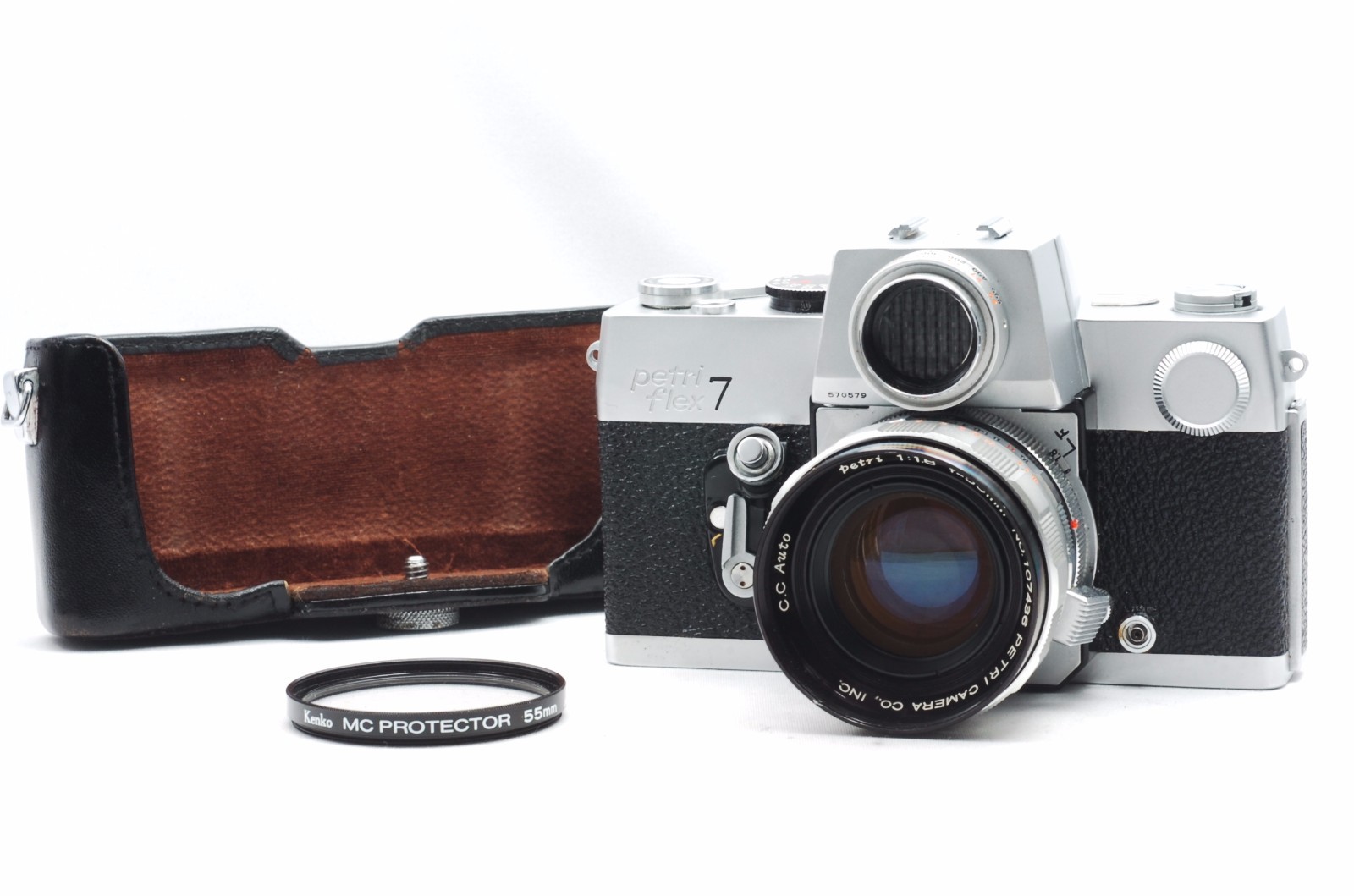
PETRI FLEX 7
The Petri Flex 7 is a 35mm single-lens reflex (SLR) camera introduced in 1964 by Kuribayashi Shashin Kōgyō (later known as Petri Camera Co., Ltd.). It stands out in Petri’s SLR lineup for its exceptionally fast 1/2000-second shutter speed, a rare feature among Japanese SLRs of the mid-1960s, positioning it as a technically advanced offering aimed at serious amateur and semi-professional photographers.
Overview
The Petri Flex 7 was released during a period of rapid innovation in Japanese SLR design, as manufacturers sought to compete with the growing dominance of brands like Nikon, Canon, and Pentax. Petri, historically known for compact 35mm rangefinders and subminiature cameras, entered the SLR market with a series of Flex models beginning in the late 1950s. The Flex 7, launched in 1964, represented the pinnacle of this line, incorporating advanced engineering and high-speed capabilities to appeal to performance-oriented users.
Targeted at advanced amateurs and photojournalists, the Flex 7 featured a vertically traveling focal-plane shutter capable of 1/2000 sec—the fastest shutter speed available on any Japanese 35mm SLR at its launch, matching the contemporaneous Nikon F’s optional high-speed unit. The camera used a fixed pentaprism with a ground-glass focusing screen and offered through-the-lens (TTL) viewing with a split-image rangefinder spot in the center for improved manual focusing accuracy. It accepted interchangeable lenses via Petri’s proprietary 48mm screw mount (often referred to as the "Petri 48mm thread mount"), which supported automatic diaphragm functionality.
Despite its advanced shutter, the Flex 7 retained a fully mechanical design with no built-in light meter, placing it in the same category as early Pentax Spotmatic prototypes and the Nikon F without metered prisms. This lack of metering reflected both cost constraints and the camera’s design philosophy: a rugged, high-performance tool for users who relied on external meters or experience. The Flex 7 was produced until 1969, when Petri shifted focus toward simpler, more cost-effective models amid increasing competition from Japanese SLRs with integrated metering and faster lens systems.
Specifications
| Specification | Value |
| Type | 35mm Single-Lens Reflex (SLR) |
| Film Format | 35mm (135 cartridge) |
| Years Produced | 1964–1969 |
| Lens Mount | Petri 48mm screw mount (with automatic diaphragm linkage) |
| Shutter | Focal-plane, cloth-curtain; speeds 1 sec – 1/2000 sec + B; X-sync at 1/60 sec |
| Metering | None (unmetered) |
| Exposure Modes | Manual only |
| Viewfinder | Fixed pentaprism with ground-glass screen and central split-image rangefinder |
| Dimensions | Approx. 145 × 95 × 55 mm; Weight: ~680 g (body only, no lens) |
Key Features
- 1/2000 sec shutter speed: One of the first Japanese SLRs to offer this high-speed capability, enabling sharp action photography in bright light.
- Petri 48mm screw mount: Supported a range of Petri and third-party lenses with automatic diaphragm coupling.
- Mechanical reliability: Fully mechanical operation with no batteries required, suitable for use in extreme conditions.
- X-sync at 1/60 sec: Flash synchronization compatible with electronic flashes and bulbs.
- Interchangeable focusing screens: Optional screens available for different shooting applications (e.g., microprism, grid).
Historical Context
The Petri Flex 7 was introduced at a critical juncture in the evolution of the 35mm SLR. By 1964, the SLR had begun to supplant rangefinders as the preferred format for serious photographers, driven by the success of the Asahi Pentax and Nikon F. Petri, aiming to establish credibility in this competitive segment, leveraged its experience in precision mechanics to deliver a technically impressive model. The 1/2000 sec shutter was a headline feature, achieved through a vertically traveling dual-curtain mechanism—a design that reduced shutter lag and allowed higher speeds than the more common horizontal shutters of the era.
Competitors at the time included the Nikkorex F (1962), Canonflex R (1960), and early Minolta SR-T models. However, most of these offered maximum speeds of 1/1000 sec. The Flex 7’s speed advantage was short-lived, as electronic shutters and improved mechanical designs soon made 1/2000 sec more common. Nevertheless, its release demonstrated Petri’s engineering ambition. Market reception was limited by the lack of built-in metering and a relatively small lens ecosystem compared to Pentax’s M42 or Nikon’s F-mount systems. As a result, the Flex 7 remained a niche product, appreciated by technicians and speed enthusiasts but overshadowed by more versatile offerings.
Collectibility & Value
Today, the Petri Flex 7 is a sought-after model among vintage camera collectors, particularly those interested in mechanical engineering milestones and rare high-speed SLRs. Its combination of a 1/2000 sec shutter and all-mechanical operation makes it a curiosity and a functional piece of photographic history. Units in working condition typically sell for $150–$300 USD, depending on lens inclusion, cosmetic state, and shutter functionality.
When purchasing a Flex 7, collectors should verify shutter operation across all speeds, especially at the extremes (1 sec and 1/2000 sec), as cloth shutters from this era are prone to stick or tear. The automatic diaphragm linkage should also be tested with a compatible lens. Common issues include light seals degradation, prism haze, and lubricant hardening in the film advance mechanism. Original Petri lenses—such as the Color Petri 55mm f/1.8 or 135mm f/3.5—are rare and add significant value. Complete sets with original case and manuals command premium prices.
Similar Cameras
- Nikon F (1959) with High Speed Motor Drive (1/2000 sec option)
- Pentax Spotmatic (1964) – M42 mount, TTL metering
- Canon FX (1964) – Canon’s first unmetered SLR
- Yashica Pentamatic (1959) – Early Japanese SLR with pentaprism
- Fujica ST 705 (1968) – Later model with 1/2000 sec and metering
Repair & Maintenance
The Petri Flex 7 requires no batteries, operating entirely mechanically. This makes it reliable in long-term storage but necessitates careful maintenance of its precision shutter and film transport mechanisms. The cloth focal-plane shutter is susceptible to wear, particularly at high speeds, and should be serviced by a technician experienced with vintage Japanese SLRs. Common issues include slow shutter speeds due to dried lubricants and inconsistent curtain travel. The film advance lever can bind if the internal gears are gummed with old oil. Light seals should be replaced to prevent light leaks and fogging. Due to the rarity of parts, repairability is moderate—while many components are serviceable, replacement shutters or viewfinders are not readily available. Regular use and cleaning are recommended to keep the camera functional.
eBay Listings


As an eBay Partner, we earn from qualifying purchases. This helps support our independent vintage technology research.
Related Models
- Petri Flex V (1961-1964)
- Petri Penta II (1961-1964)
- Petri Penta (1959-1962)
- Alpa 6 (1948-1953)
- Agfa Agfaflex
- Agfa Ambiflex
- Agfa Easy
- Agfa Futura Af zoom
- Agfa Isoflash-Rapid C
- Agfa Mini