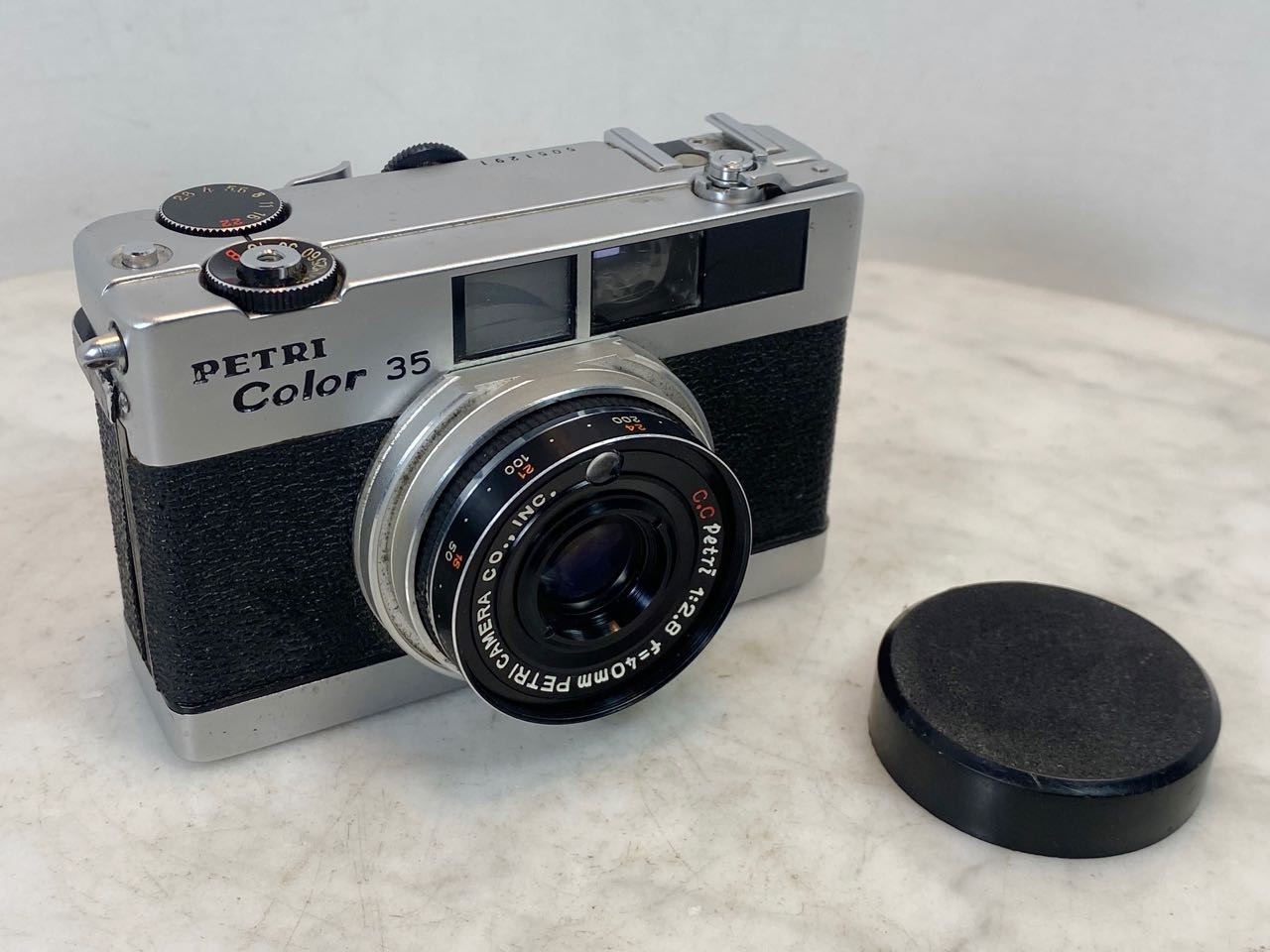
PETRI COLOR 35
The Petri Color 35 is a compact, lightweight 35mm camera produced by Kuribayashi Camera Company under the Petri brand starting in 1968. It is not a true 'point-and-shoot' as it requires manual focus and manual exposure settings. Designed for casual photography, it features a fixed 38mm f/2.8 Color Petri lens and zone focusing, making it an accessible and user-friendly option for amateur photographers during the late 1960s and early 1970s.
Overview
The Petri Color 35 was introduced as part of Petri’s "Color" series, a line of compact 35mm cameras aimed at the consumer market during a period of rapid growth in amateur photography. Released in 1968, the Color 35 distinguished itself with its sleek, minimalist design, all-metal body, and emphasis on ease of use. It was marketed toward casual photographers who desired a reliable, portable camera without the complexity of interchangeable lenses or manual exposure systems. Unlike Petri’s more advanced rangefinder or SLR models, the Color 35 was designed for simplicity, featuring fully manual controls with a focus on intuitive operation.
The camera was part of a broader trend in the late 1960s where Japanese manufacturers like Canon, Minolta, and Yashica were producing compact, fixed-lens 35mm cameras to compete with emerging point-and-shoot designs. Petri positioned the Color 35 as a stylish yet functional option, often available in distinctive color finishes such as chrome, black, or gold—an unusual feature for the time that contributed to its "Color" branding. Despite its modest specifications, the Color 35 offered solid build quality typical of Petri’s manufacturing standards, with a metal chassis and precision lens assembly.
Within Petri’s lineup, the Color 35 occupied the entry-level segment, sitting below the company’s rangefinder and SLR offerings like the Petri 7S or Petri TTL. However, its fixed 38mm f/2.8 Color Petri lens—coated for improved contrast and color fidelity—was a step above many plastic-bodied competitors. The camera’s zone focus system, combined with a coupled selenium light meter, allowed users to estimate subject distance and achieve acceptable sharpness in most daylight conditions. While not a professional tool, the Color 35 represented Petri’s effort to remain competitive in a market increasingly dominated by automation and miniaturization.
Specifications
| Specification | Value |
| Type | Compact 35mm camera |
| Film Format | 35mm (135 cartridge) |
| Years Produced | 1968–1975 |
| Lens Mount | Fixed lens (non-interchangeable) |
| Shutter | Leaf shutter, speeds 1/30 to 1/250 sec + B |
| Aperture Range | f/2.8 to f/16 |
| Metering | Selenium cell meter (no battery required), center-weighted |
| Exposure Modes | Manual only (shutter speed and aperture set manually) |
| Focus | Zone focus (3 settings: 1m, 2m, ∞) |
| Viewfinder | Optical direct-vision viewfinder with parallax correction marks |
| Film Speed Range | ASA 25–400 (set manually on lens ring) |
| Flash Sync | PC terminal only; no built-in hot shoe |
| Dimensions | Approx. 110 × 65 × 40 mm |
| Weight | Approx. 320 g (without battery) |
| Battery | None (selenium meter operates without power) |
Key Features
- Fixed 38mm f/2.8 Color Petri lens with multi-coating for improved contrast and reduced flare, offering sharp images for a compact camera of its era.
- Selenium-cell light meter integrated into the lens surround, providing exposure guidance without requiring batteries—ideal for long-term reliability.
- Zone focusing system with three preset distances (1m, 2m, ∞), enabling quick subject framing while maintaining acceptable depth of field.
- Compact all-metal body with a smooth top-plate wind lever and ergonomic film advance, contributing to durability and ease of use.
- Dual flash connectivity via both PC sync port and built-in hot shoe, supporting both studio and on-the-go flash photography.
Historical Context
The Petri Color 35 was launched at a time when the 35mm compact camera market was becoming increasingly competitive. By the late 1960s, companies like Olympus (with the Trip 35), Yashica (Electro 35), and Canon (Autoboy series precursors) were introducing models that blended automation with portability. Petri, historically known for rangefinders and precision shutters, adapted by focusing on build quality and optical performance in its consumer line. The Color 35 offered a straightforward design with solid build quality for its class.
Its main competitors included the Olympus 35RC and Yashica 35-F, both of which featured similar fixed lenses and manual controls. However, the Color 35 stood out for its use of a selenium meter—common at the time but prone to degradation over decades—and its distinctive styling. Despite favorable build quality, Petri struggled to maintain market share against larger brands with stronger distribution networks. The Color 35 was discontinued around 1975 as Petri shifted focus and eventually ceased camera production in the late 1970s due to financial difficulties.
Collectibility & Value
Today, the Petri Color 35 is a modestly collectible camera, appreciated by enthusiasts of vintage Japanese compact cameras. Its value typically ranges from $25 to $60 USD depending on condition. Prices above $100 are rare and likely reflect overpricing or unusual finishes. Models in chrome or gold plating are slightly more desirable, though not rare. The camera’s solid construction and attractive lens make it a functional choice for film shooters interested in lightweight, fully manual 35mm options.
When purchasing a Color 35, collectors should inspect the selenium meter cell for signs of deterioration—cracking, discoloration, or flaking—which can render the meter unusable. While the camera operates without battery power, a non-functional meter limits exposure assistance. Other common issues include stiff shutter speeds, lens fungus (rare due to tight seals), and wear on the focus selector dial. The film advance mechanism is generally reliable, but older examples may require cleaning or lubrication. Overall, the Color 35 is considered durable and repairable, though replacement parts are scarce.
Similar Cameras
- Olympus 35RC – Compact 35mm rangefinder with fixed 42mm f/1.8 lens, known for its minimalist design and excellent optics.
- Yashica 35-F – Fixed-lens 35mm camera with 45mm f/2.8 lens, manual focus, and built-in meter; similar target market.
- Canon Demi EE17 – Compact 35mm camera with fixed 40mm f/2.8 lens and automatic exposure, representing the shift toward automation.
- Minolta Hi-Matic 7S – Advanced compact with 45mm f/1.8 lens, aperture-priority metering, and superior low-light performance.
- Konica C35 Automatic – Fully automatic 35mm compact with 40mm f/1.8 lens, showcasing the next generation of point-and-shoot design.
Repair & Maintenance
The Petri Color 35 requires no battery for operation, as its selenium light meter generates its own current. However, this type of meter is prone to degradation over time, and once failed, cannot be easily repaired or recalibrated. While the camera functions without it, users must rely on external meters or sunny-16 rule for exposure. Shutter and aperture mechanisms are mechanical and generally robust, but may require CLA (clean, lubricate, adjust) service if sticky or inaccurate. Common issues include sluggish 1/30s shutter speed and misaligned aperture blades. The zone focus system is simple but can become loose with heavy use. Replacement parts are not commercially available, so repairs depend on donor cameras. Due to its mechanical simplicity and solid build, the Color 35 is considered moderately repairable by experienced technicians. Regular use and storage in dry conditions help preserve both the meter and internal mechanics.
eBay Listings


As an eBay Partner, we earn from qualifying purchases. This helps support our independent vintage technology research.