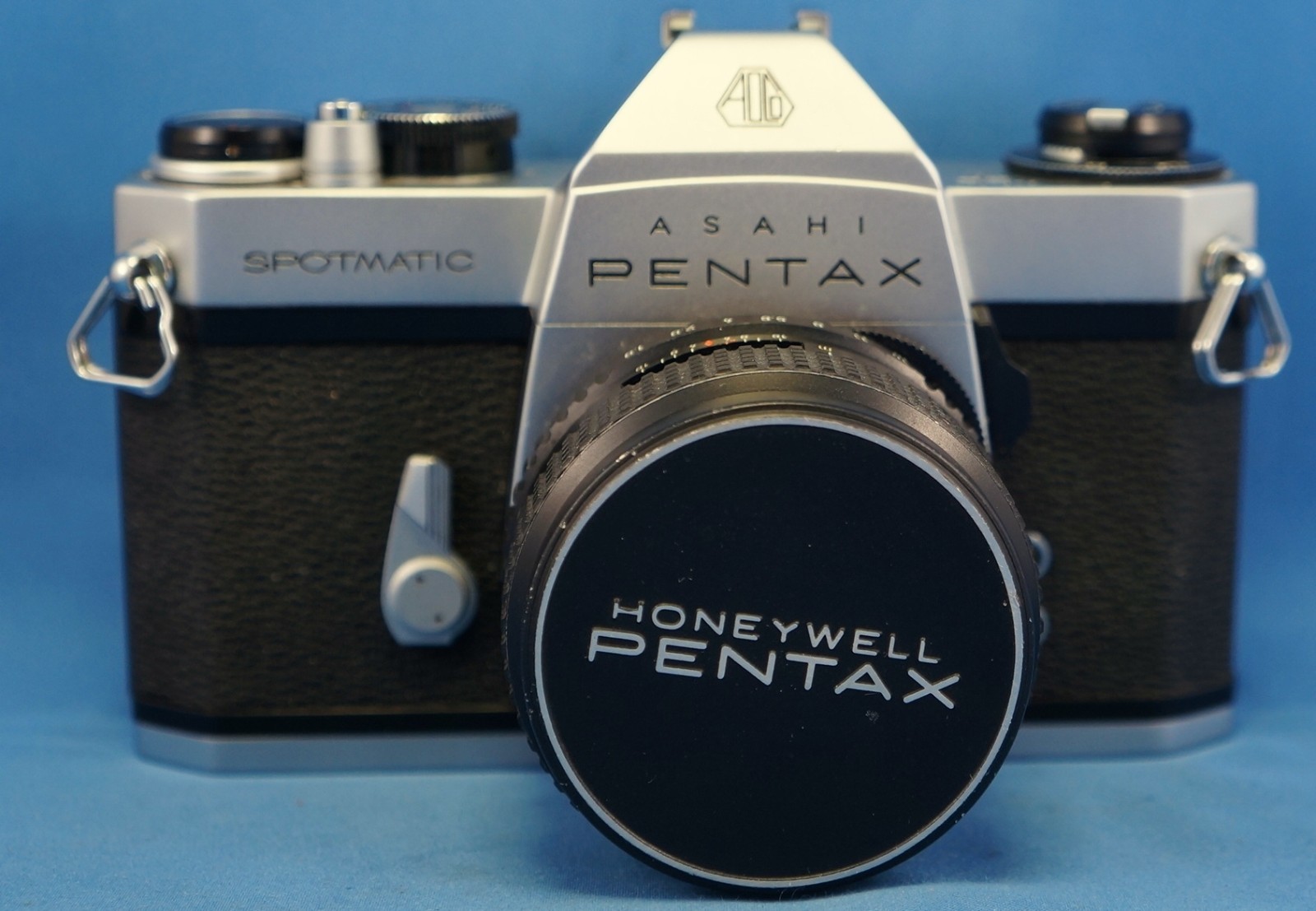
PENTAX SPOTMATIC II
The Pentax Spotmatic II is a 35mm single-lens reflex (SLR) camera introduced in 1971 as an upgraded version of the original Spotmatic. It features open-aperture TTL (through-the-lens) metering and an improved shutter mechanism, marking a significant refinement in Pentax’s line of manual-focus SLRs during the early 1970s.
Overview
Released in 1971 by Asahi Optical Co. (later known as Pentax), the Spotmatic II was positioned as a mid-to-high-end 35mm SLR aimed at serious amateur and semi-professional photographers. It succeeded the original Spotmatic (SP), which had been launched in 1964 and was among the first SLRs to offer through-the-lens (TTL) metering with standard lenses. The Spotmatic II addressed several limitations of its predecessor, most notably by introducing open-aperture metering—a feature that allowed users to compose and focus at full aperture while maintaining accurate exposure readings without stopping down manually. This advancement improved usability and speed in changing lighting conditions, particularly in low-light environments.
The Spotmatic II retained the M42 screw-mount (also known as the Pentax Universal or "Pentax Thread Mount"), ensuring compatibility with a vast array of lenses from Pentax and third-party manufacturers such as Super-Takumar, SMC Takumar, and lenses from Zeiss, Yashica, and others. While it did not introduce major aesthetic changes over the original Spotmatic, internal refinements—including a more durable shutter mechanism rated for 100,000 actuations—enhanced reliability and longevity. The camera also featured a redesigned film advance mechanism with a shorter throw and smoother operation, contributing to a more responsive shooting experience.
Historically, the Spotmatic II played a transitional role in Pentax’s evolution toward fully integrated electronic SLRs. It bridged the gap between purely mechanical designs and the upcoming generation of aperture-priority and electronic-shutter models like the ES series. Despite being succeeded by the Spotmatic F in 1973 (which offered semi-automatic exposure), the Spotmatic II remained in production until 1976, indicating its strong market acceptance and durability.
Specifications
| Specification | Value |
| Type | 35mm SLR |
| Film Format | 35mm (135 cartridge) |
| Years Produced | 1971–1976 |
| Lens Mount | M42 × 1 screw mount (Pentax Universal) |
| Shutter | Horizontal cloth focal-plane shutter; speeds 1 sec to 1/1000 sec + B |
| Metering | TTL full-aperture CdS (Cadmium Sulfide) metering |
| Exposure Modes | Manual exposure only |
| Viewfinder | Fixed pentaprism with microprism collar and split-image rangefinder spot |
| Dimensions | 148 × 90 × 51 mm; ~640 g (body only, no battery) |
Key Features
- Open-aperture TTL metering: Eliminates need to stop down for metering, enabling brighter viewing and faster exposure assessment.
- Improved shutter mechanism: Rated for 100,000 cycles, offering greater reliability than earlier Spotmatic models.
- M42 lens compatibility: Supports a wide range of manual-focus prime and zoom lenses with automatic diaphragm coupling.
- Center-weighted metering: CdS cell measures light through the lens with emphasis on the central area of the frame.
- Hot shoe and PC sync terminal: Supports flash photography with both modern and vintage flash units.
Historical Context
The Spotmatic II was introduced at a time of rapid technological advancement in the SLR market. The early 1970s saw increasing competition from Japanese manufacturers such as Nikon, Canon, Minolta, and Olympus, all pushing innovations in metering, ergonomics, and automation. Pentax, having pioneered TTL metering with the original Spotmatic, sought to refine its offering rather than leap into automation immediately. The Spotmatic II represented a mature evolution of that platform—retaining mechanical reliability while improving user experience through open-aperture metering.
This feature placed the Spotmatic II in direct competition with models like the Nikon F (with Photomic finder) and the Canon FTb, both of which also offered full-aperture metering. However, unlike those systems, the Spotmatic II remained fully mechanical except for the meter circuit, relying on a single PX625 (1.35V mercury) battery to power the CdS meter. Its lack of electronic shutter control meant it could function without batteries for shooting, albeit without metering. This mechanical resilience contributed to its popularity among photographers seeking dependable performance in diverse conditions.
Collectibility & Value
Today, the Pentax Spotmatic II is a sought-after model among film photography enthusiasts and collectors of vintage SLRs. While not as rare as some limited-production variants (such as the Spotmatic SP500), it is less common than the original Spotmatic or the later Spotmatic F, making it a desirable upgrade path for M42 system users. In good working condition, prices typically range from $150 to $300 USD, depending on shutter accuracy, meter functionality, and lens inclusion.
When purchasing a Spotmatic II, buyers should verify the shutter operation across all speeds, particularly 1/1000 sec, which can become inconsistent in aged units. The CdS meter requires a 1.35V mercury battery (now obsolete), though modern adapters with zinc-air or WeinCell substitutes can restore functionality. A common issue is meter inaccuracy due to aging CdS cells or corroded battery contacts—cleaning or recalibration may be necessary. Additionally, light seals should be replaced to prevent light leaks, and the mirror bumper foam should be checked, as degraded foam can cause mirror slap or damage.
Cameras with original leatherette, clean viewfinders, and sharp focus screens command higher prices. Units paired with Super-Takumar or SMC Takumar lenses—especially the 50mm f/1.4 or 85mm f/1.8—are particularly valuable due to the optical quality and collector demand.
Similar Cameras
- Nikon Photomic FTn (1968–1974): M42-compatible Nikon F variant with TTL metering, targeted at professionals.
- Canon FTb (1971–1978): Rugged Canon F-series SLR with full-aperture metering and interchangeable finders.
- Minolta SRT-101 (1966–1972): Known for Color Metering System (CLC) and robust build quality.
- Yashica TL Electro-X (1973–1977): Electronic M42 camera with aperture-priority mode, representing a different technological path.
- Praktica LLC2 (1972–1977): East German M42 SLR with through-the-lens metering and solid construction.
Repair & Maintenance
The Spotmatic II uses a PX625 (1.35V) mercury battery to power its CdS exposure meter. Since mercury batteries are no longer produced, users typically substitute with 1.35V zinc-air batteries (e.g., WeinCell) or use adapters with 1.5V silver oxide batteries, though the latter may cause slight overexposure if not compensated. Battery leakage is a common issue in stored units, often requiring contact cleaning or replacement of the battery holder.
Shutter servicing is occasionally needed, particularly if the 1/1000 sec speed is inconsistent or if the shutter curtains show signs of wear. The cloth shutter is sensitive to humidity and age; replacement is complex and best handled by experienced technicians. The film transport system is generally robust, but worn advance levers or worn gears can develop play over decades of use.
Regular maintenance includes checking and replacing light seals, cleaning the mirror and focusing screen, and ensuring the lens mount’s automatic diaphragm pin moves freely. Lubrication of internal mechanisms should only be performed during full CLA (Clean, Lubricate, Adjust) services by qualified repair specialists. Due to the mechanical nature of the camera, with minimal electronics, the Spotmatic II remains highly repairable and suitable for continued use with proper care.
eBay Listings



As an eBay Partner, we earn from qualifying purchases. This helps support our independent vintage technology research.
Related Models
- Pentax K1000 (1976-1997)
- Pentax KM (1975-1977)
- Pentax KX (1975-1977)
- Pentax LX (1980-2001)
- Pentax ME-F (1981–1984)
- Alpa 6 (1948-1953)
- Agfa Agfaflex
- Agfa Ambiflex
- Agfa Easy
- Agfa Futura Af zoom