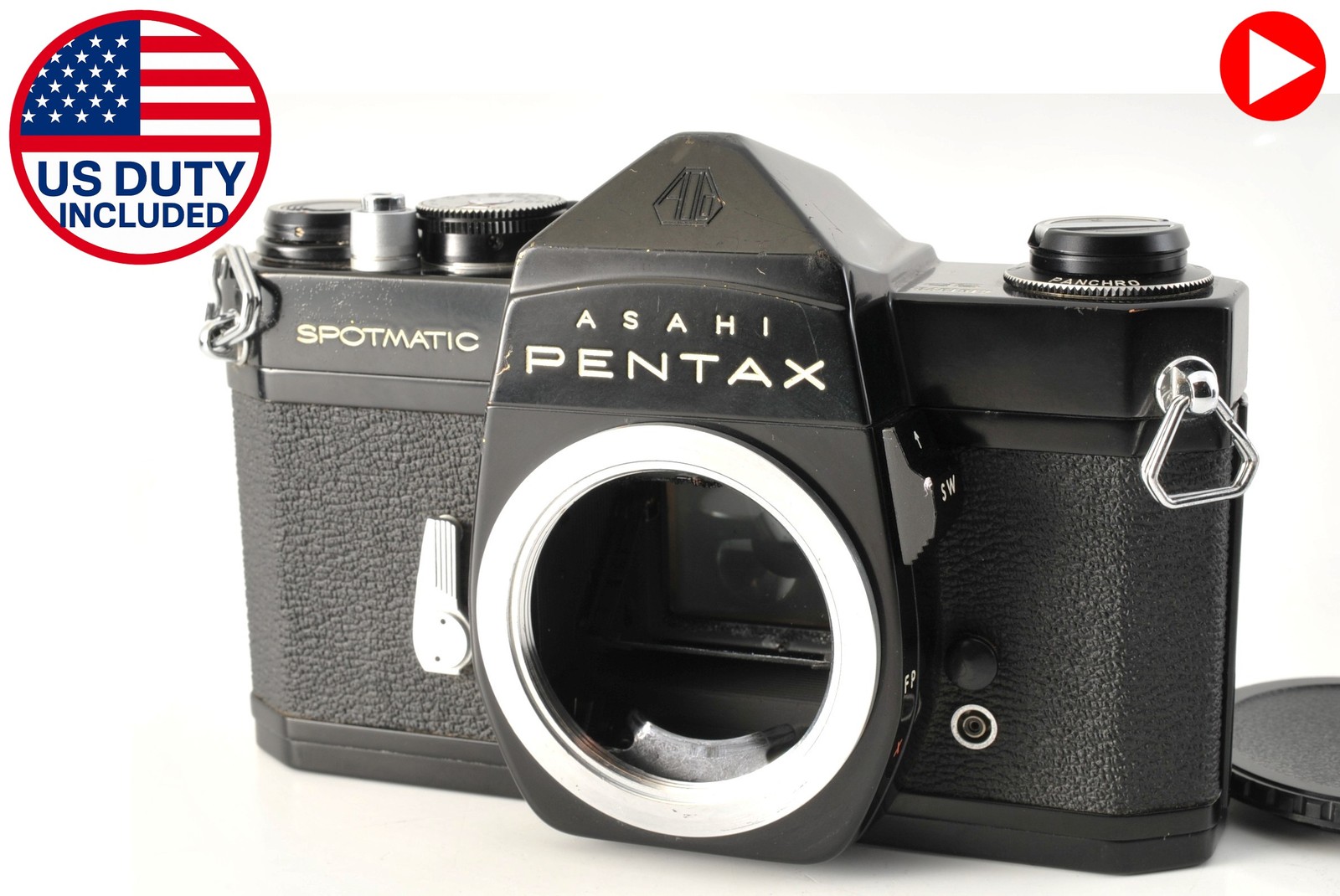
PENTAX SPOTMATIC
The Pentax Spotmatic is a 35mm film single-lens reflex (SLR) camera introduced by Asahi Optical Co. (later known as Pentax) in 1964. It was the first SLR to offer through-the-lens (TTL) metering as a standard, reliable feature, marking a pivotal advancement in photographic technology and setting a new benchmark for exposure accuracy in consumer and professional photography.
Overview
The Pentax Spotmatic was launched at a transformative time in the evolution of 35mm photography, when photographers were transitioning from rangefinder systems to SLRs for greater compositional accuracy and lens interchangeability. Released in 1964, the Spotmatic was designed to appeal to serious amateur and professional photographers who demanded precise exposure control. Its defining innovation was the integration of a TTL CdS (cadmium sulfide) light meter that measured light through the camera’s lens, allowing for accurate exposure readings regardless of lens focal length or aperture, a significant improvement over external or built-in non-TTL meters.
The Spotmatic utilized the M42 screw mount, a widely adopted standard at the time, enabling compatibility with a vast array of lenses from various manufacturers, including Pentax’s own Takumar series. The camera featured stop-down TTL metering: the photographer had to manually stop the lens down to the shooting aperture to obtain a meter reading, which was displayed via a split-field meter visible in the viewfinder. This system, while not fully automatic, provided real-time feedback via two needles—matching them ensured correct exposure. The Spotmatic was produced in several variants (Spotmatic, Spotmatic II, Spotmatic F, ES, and ESII), with incremental improvements in metering circuitry, shutter reliability, and user interface.
As the flagship SLR from Pentax throughout the late 1960s and early 1970s, the Spotmatic played a crucial role in establishing the company as a leader in SLR innovation. It bridged the gap between mechanical precision and electronic assistance, laying the groundwork for future generations of metered and eventually automated cameras.
Specifications
| Specification | Value |
| Type | 35mm SLR |
| Film Format | 35mm (135 film) |
| Years Produced | 1964–1976 |
| Lens Mount | M42 × 1 screw mount (Pentax Universal) |
| Shutter | Horizontal-travel, cloth focal-plane shutter; speeds from 1 sec to 1/1000 sec, plus B (bulb) |
| Metering | TTL CdS metering with stop-down activation |
| Exposure Modes | Manual exposure only; stop-down metering |
| Viewfinder | Fixed pentaprism with split-image rangefinder, microprism collar, and match-needle exposure indicator |
| Dimensions | 148 × 90 × 55 mm; weight approximately 640 g (body only, without battery or lens) |
Key Features
- First production SLR with reliable TTL metering: The Spotmatic was the first commercially successful SLR to implement through-the-lens CdS metering, allowing photographers to meter directly through the taking lens for unmatched exposure accuracy.
- M42 screw mount compatibility: Supported a vast ecosystem of lenses from Pentax and third-party manufacturers, including the highly regarded Super- and S-M-C Takumar lenses.
- Stop-down metering with visual needle match: The viewfinder displayed two needles—one for metered exposure and one linked to the selected shutter speed—requiring the user to stop down the lens and match the needles for correct exposure.
- Mechanical reliability: Fully mechanical shutter (except for meter) allowed operation without batteries for all shutter speeds except flash sync at 1/60 sec.
- Interchangeable focusing screens: Later models (Spotmatic F and successors) allowed screen replacement for specialized focusing needs.
Historical Context
The Pentax Spotmatic was introduced in 1964, a period of rapid innovation in SLR design. Prior to its release, most SLRs either lacked built-in meters or used external or non-TTL systems that required recalibration when changing lenses. The Spotmatic’s TTL metering system, developed in collaboration with Japanese electronics firms, solved this issue by measuring light after it passed through the lens, accounting for filters, extension tubes, and variable apertures automatically. While the Topcon RE Super (1963) technically preceded it with TTL metering, the Spotmatic was more widely distributed, reliable, and affordable, making it the first truly successful TTL SLR.
Competitors at the time included the Nikon F (1959), which dominated the professional market but lacked built-in metering until later models, and the Canon FX (1964), which featured a non-TTL meter. The Spotmatic carved a niche by combining professional-grade build quality with advanced metering in a relatively compact body. It was especially popular among photojournalists, portrait photographers, and advanced amateurs. Over one million units were produced during its 12-year production run, a testament to its market acceptance.
Collectibility & Value
The Pentax Spotmatic remains a highly collectible camera, particularly models with original Takumar lenses, which are prized for their optical quality and build. In today’s vintage camera market, a clean Spotmatic body typically sells for $150–$300, with values increasing significantly for models like the Spotmatic F or ESII, especially when paired with Super- or S-M-C Takumar lenses. Fully functional cameras with clear viewfinders, smooth shutter operation, and accurate metering command premium prices.
When purchasing a Spotmatic, collectors should inspect for common issues: yellowed or cloudy viewfinder prisms, shutter speed inaccuracies (particularly at extremes), and CdS cell degradation. The meter relies on a single 1.35V mercury battery (PX625), now obsolete; modern replacements (e.g., Wein Cell or adapter with 1.5V alkaline) can affect meter accuracy due to voltage differences. Additionally, the leatherette may crack or peel, and the film advance lever can develop play over time. Despite these issues, the Spotmatic is generally robust and repairable by experienced technicians.
Similar Cameras
- Topcon RE Super (1963) – Early TTL metering SLR, technically first with through-the-lens metering but less commercially widespread.
- Nikon F with Photomic Finder (1965 onwards) – Professional-grade SLR with interchangeable metered prisms, but TTL metering was optional.
- Canon FTb (1971) – Competing M42-based SLR with TTL metering and full-aperture readout.
- Praktica LLC (1972) – East German M42 SLR with TTL metering, popular in Europe.
- Yashica TL Electro-X (1973) – M42 camera with semi-automatic aperture and CdS metering.
Repair & Maintenance
The Spotmatic uses a 1.35V mercury PX625 battery to power its CdS meter. Due to the discontinuation of mercury batteries, users often substitute with zinc-air alternatives (e.g., Wein Cell) or use adapters with 1.5V alkaline batteries, though the latter may require recalibration for accurate metering. The camera’s mechanical shutter operates without batteries, but flash sync at 1/60 sec depends on battery-powered timing.
Common maintenance issues include sluggish shutter speeds, often due to dried lubricants in the shutter mechanism, and inaccurate metering from aged CdS cells. The stop-down metering linkage can also become sticky or misaligned. Professional CLA (Clean, Lubricate, Adjust) services are recommended every 5–10 years for regular users. Replacement focusing screens and light seals are available from specialty vintage camera suppliers. Overall, the Spotmatic is considered repairable and durable, with a strong community of technicians and enthusiasts supporting its continued use.
eBay Listings



As an eBay Partner, we earn from qualifying purchases. This helps support our independent vintage technology research.
Related Models
- Pentax K1000 (1976-1997)
- Pentax KM (1975-1977)
- Pentax KX (1975-1977)
- Pentax LX (1980-2001)
- Pentax ME-F (1981–1984)
- Alpa 6 (1948-1953)
- Agfa Agfaflex
- Agfa Ambiflex
- Agfa Easy
- Agfa Futura Af zoom