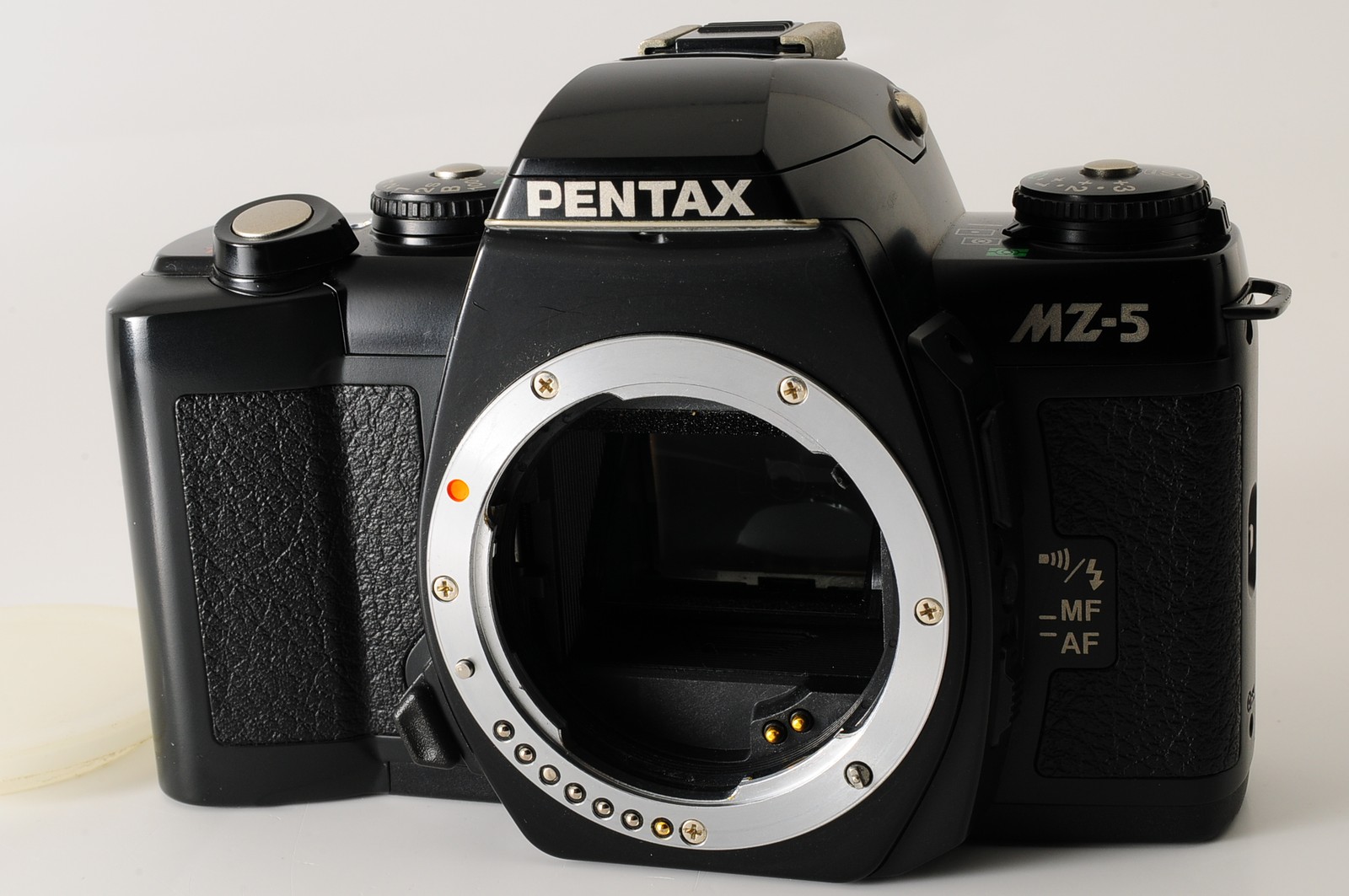
PENTAX MZ-5
The Pentax MZ-5 is a 35mm autofocus single-lens reflex (SLR) camera introduced in 1999 as part of Pentax’s mid-tier MZ series. Designed for advanced amateur photographers, it combines compact ergonomics with professional-grade controls, offering a balanced blend of automation and manual override capabilities in a lightweight, weather-resistant body.
Overview
Released in late 1996, the Pentax MZ-5 (known as the Pentax Z5 in North America) was positioned between the entry-level MZ-M and the higher-end MZ-7 and MZ-S models in Pentax’s autofocus SLR lineup. It was developed during a transitional period in the mid-to-late 1990s when film SLRs were reaching peak refinement before the digital revolution. The MZ-5 targeted photography enthusiasts who desired greater control than point-and-shoot models offered but did not require the full professional feature set of flagship cameras like the Pentax Z1 (MZ-S).
The MZ-5 features a compact, polycarbonate-bodied design with a magnesium alloy chassis for durability and reduced weight. Despite its smaller size, it retains dual control dials—front and rear—for intuitive exposure adjustment, a hallmark of higher-end SLRs. It supports Pentax’s KAF2 lens mount, enabling full compatibility with AF lenses featuring built-in focus motors (SDM), as well as older K, KA, KAF, and KAF2 lenses with aperture coupling and electronic communication. The camera integrates TTL phase-detection autofocus with a six-point AF sensor array, which was advanced for its class at the time, allowing reliable subject acquisition under varied lighting conditions.
One of the MZ-5’s distinguishing characteristics is its hybrid control philosophy: it supports fully automatic modes (including Program, Aperture Priority, Shutter Priority, and Manual) while also providing scene modes such as Portrait, Landscape, Close-up, and Sports—catering to both learning photographers and experienced users seeking quick setup. Its metering system uses TTL 6-segment multi-pattern metering with center-weighted and spot options, ensuring accurate exposure in complex lighting. The MZ-5 was also among the first Pentax models to feature an LCD panel on the top plate, displaying key shooting parameters without requiring the user to look through the viewfinder.
Specifications
| Specification | Value |
| Type | Autofocus 35mm SLR |
| Film Format | 35mm (135 film) |
| Years Produced | 1996–1999 |
| Lens Mount | Pentax KAF2 (compatible with K, KA, KAF, KAF2 lenses) |
| Shutter | Vertical-travel focal-plane shutter, 1/2000s to 30 seconds, plus X-sync at 1/125s |
| Metering | TTL 6-segment multi-pattern, center-weighted average, spot metering |
| Exposure Modes | Program AE, Aperture Priority, Shutter Priority, Manual, Auto Picture (scene modes), Flash Sync modes |
| Viewfinder | Fixed pentamirror, 0.85x magnification, 92% coverage |
| Dimensions | 135 × 85 × 60 mm (5.3 × 3.3 × 2.4 in), ~510 g (body only, with battery) |
Key Features
- Six-point autofocus system with selectable focus points and low-light assist beam for improved accuracy in dim conditions.
- Dual control dials (front and rear) for direct shutter speed and aperture adjustment in manual and semi-automatic modes.
- Compact, ergonomic design with weather-resistant seals at seams and dials—unusual for its class—providing protection against dust and moisture.
- TTL flash metering with support for Pentax’s P-TTL (Programmed TTL) flash system, enabling balanced fill-flash and automatic exposure with compatible flashes.
- Built-in motor drive with continuous shooting up to 2.5 frames per second and automatic film advance/rewind.
Historical Context
The Pentax MZ-5 was launched during a competitive era dominated by Canon EOS and Nikon F-mount systems, both of which were aggressively expanding their autofocus SLR lines. While Pentax lagged slightly in market share, the MZ series represented a focused effort to differentiate through thoughtful ergonomics and value-oriented feature sets. The MZ-5 preceded the MZ-S (released in 2001), and the MZ-S was not known as the Z1. The flagship model before the MZ-S was the Z1p (not MZ-S). The MZ-S was a separate, advanced model and not called the Z1. It competed directly with models like the Canon EOS Rebel G (EOS 500n) and Nikon N6006, offering superior build quality and more advanced metering and AF systems than many rivals in the enthusiast segment.
Market reception of the MZ-5 was positive, particularly among photographers who appreciated Pentax’s tradition of manual control and compact body design. It was praised in contemporary reviews for its intuitive interface, solid construction, and excellent viewfinder clarity. However, Pentax’s limited marketing presence in North America compared to Canon and Nikon limited its visibility. Despite this, the MZ-5 developed a loyal following and is often cited as one of the best-handling mid-range film SLRs of the late 1990s.
Collectibility & Value
Today, the Pentax MZ-5 is regarded as a well-engineered, underappreciated film SLR with strong appeal to collectors and film photographers seeking a compact, capable camera. While not rare, it is less common than its Canon or Nikon equivalents, contributing to moderate collector interest. In used condition, working examples typically sell for $100–$180 USD, depending on cosmetic condition and included accessories. Fully functional units with original boxes and manuals may command a slight premium, particularly among collectors.
When purchasing an MZ-5, buyers should verify the functionality of the autofocus system, shutter operation, and light seals—common failure points in aging film cameras. The camera uses a single 2CR5 lithium battery (equivalent to two CR123As), which powers both the electronics and light meter. Battery corrosion in the compartment is a known issue, particularly in older units stored in humid environments. Additionally, the rubberized grip may degrade over time and can be replaced with aftermarket options. Light seals and foam light traps should be replaced if the camera is to be used regularly, as deteriorated seals can cause light leaks and fogging.
Similar Cameras
- Canon EOS Rebel G (EOS 500n)
- Nikon N6006 (Nikon F-601)
- Minolta Maxxum 5 (Dynax 5)
- Olympus OM-2000
- Contax AX (manual focus hybrid)
Repair & Maintenance
The Pentax MZ-5 uses a 2CR5 6V lithium battery, which typically lasts 1–2 years with moderate use. Replacement is straightforward but requires careful handling to avoid terminal corrosion. Common mechanical issues include sticky shutter curtains (often due to dried lubricant) and AF inaccuracies from misaligned sensors. The camera’s autofocus relies on a screw-drive mechanism compatible with KAF and KAF2 lenses; newer SDM lenses are physically compatible but will not autofocus, as the body lacks SDM support. Repair requires specialized tools and knowledge, particularly for shutter or meter calibration. While Pentax service manuals are available, qualified technicians familiar with late-1990s SLRs are increasingly scarce. Routine maintenance includes cleaning the mirror and focusing screen, checking the film advance mechanism, and replacing deteriorated light seals every 10–15 years.
eBay Listings



As an eBay Partner, we earn from qualifying purchases. This helps support our independent vintage technology research.
Related Models
- Pentax K1000 (1976-1997)
- Pentax KM (1975-1977)
- Pentax KX (1975-1977)
- Pentax LX (1980-2001)
- Pentax ME-F (1981–1984)
- Alpa 6 (1948-1953)
- Agfa Agfaflex
- Agfa Ambiflex
- Agfa Easy
- Agfa Futura Af zoom