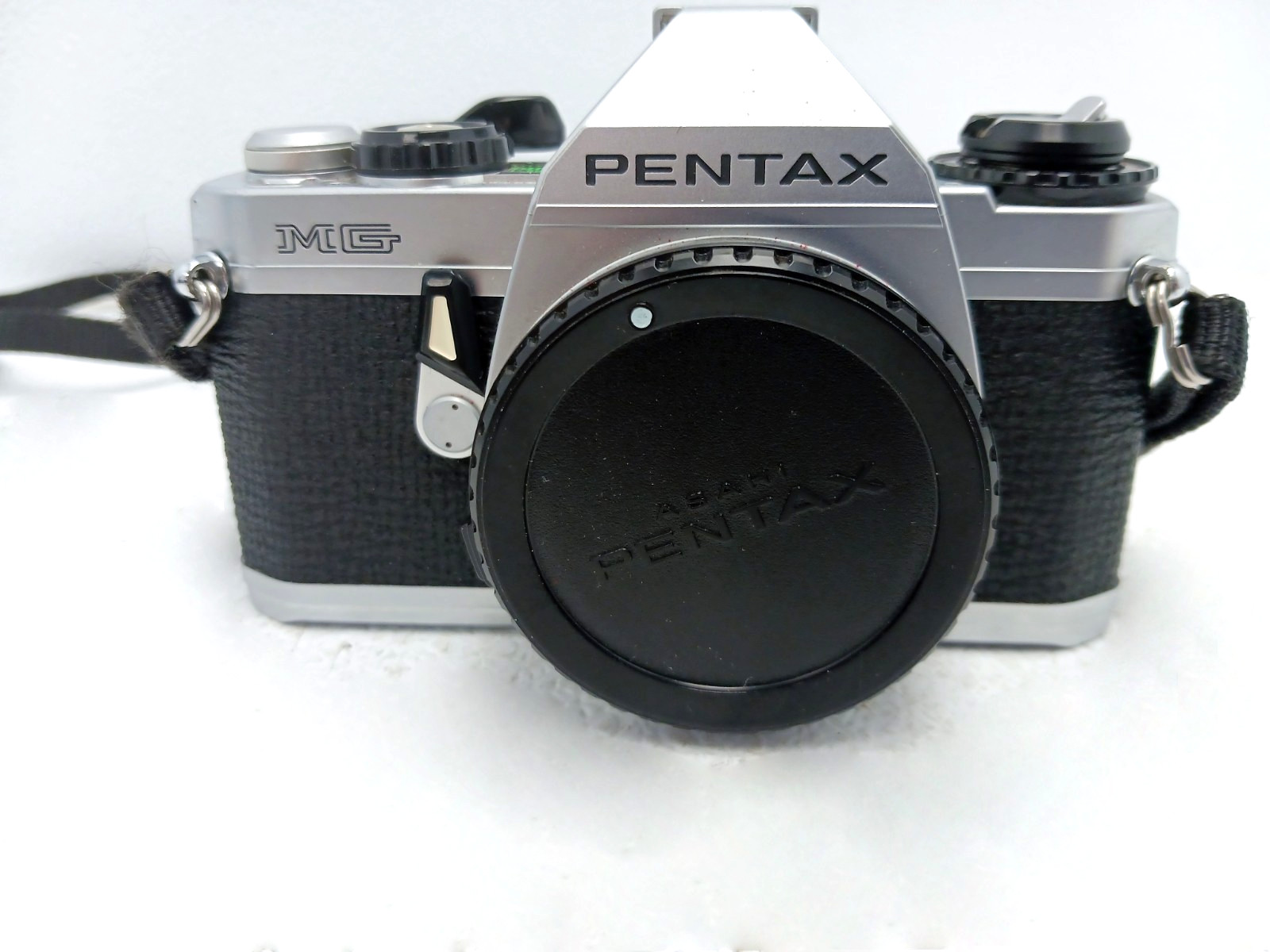
PENTAX MG
The Pentax MG hits that sweet spot where simplicity meets sophistication—a compact, no-frills 35mm SLR that slipped onto the scene in 1981 with quiet confidence. Built for photographers who wanted automation without complexity, it delivered sharp metering, a bright viewfinder, and that unmistakable Pentax solidity in a body light enough to toss in a bag. No manual mode, no gimmicks—just aperture-priority intelligence wrapped in a magnesium alloy shell. For a generation stepping up from point-and-shoots, the MG was a trustworthy guide into the world of creative exposure.
Overview
Launched in 1981, the Pentax MG carved its niche as the accessible face of the M-series, sitting between the fully manual ME and the flagship LX. It arrived when electronics were reshaping SLRs, and Pentax answered with a camera that automated the tricky parts without sacrificing build quality. Sharing its DNA with the ME Super, the MG traded shutter-priority flexibility for a cleaner, aperture-priority experience—ideal for learners, less so for tinkerers. This was automation with intent: set your f-stop, frame your shot, and let the camera pick the shutter speed. No dials to memorize, no charts to consult.
Despite its entry-level badge, the MG didn’t skimp. It packed a vertically traveling metal-bladed shutter, a refined six-segment metering system, and a crisp pentaprism viewfinder—all in a chassis that felt far more premium than its price tag suggested. It was one of the final M-series models before Pentax pivoted to the P-series and, eventually, autofocus. In hindsight, the MG stands as a quiet swan song: a compact, K-mount SLR built for real-world use, not specs on a box.
Specifications
| Specification | Value |
| Type | 35mm Single-Lens Reflex (SLR) |
| Film Format | 35mm (135) |
| Years Produced | 1981–1985 |
| Lens Mount | Pentax K-mount (K bayonet) |
| Shutter | Vertical-travel, metal-bladed focal-plane shutter; speeds from 4 sec to 1/1000 sec, plus Bulb (B) |
| Metering | TTL (Through-The-Lens) open-aperture metering with six-segment silicon photodiode (SPD) sensor |
| Exposure Modes | Aperture-priority automatic only; no manual mode |
| Viewfinder | Fixed pentaprism with 0.95x magnification, 92% vertical and 94% horizontal coverage; displays shutter speed via dual LED (up/down arrows) |
| Dimensions | 135 × 81 × 50 mm (5.3 × 3.2 × 2.0 in); weight: 490 g (17.3 oz) body only (without battery or lens) |
Key Features
- Aperture-Priority Automation: Perfect for learning the exposure triangle—just choose your depth of field, and the MG picks the shutter speed.
- LED Shutter Speed Display: Two simple arrows in the viewfinder tell you everything: point up for slower, down for faster. No guessing, no second-guessing.
- Six-Segment Metering: Ahead of its time, this system analyzed multiple zones to nail exposure—even in tricky backlit scenes.
- Compact K-Mount Design: Lightweight yet tough, with full compatibility across the vast universe of Pentax K-mount lenses.
- Battery-Independent Shutter: Lose your battery? No problem. The 1/100 sec mechanical speed keeps you shooting in a pinch.
Historical Context
The early '80s were all about making SLRs approachable. Canon had the AE-1, Nikon rolled out the EM, and Pentax responded with the M-series—cameras that balanced electronics with elegance. The MG entered this fray as the thoughtful alternative: smaller than the LX, smarter than the ME, and more intuitive than most. It wasn’t trying to be everything—just the right tool for someone ready to grow beyond auto-everything compacts.
Still, its lack of manual controls drew side-eye from seasoned shooters. Enthusiasts flocked to the ME Super for its shutter-priority and manual override, while the MG quietly won over students, travelers, and second-body users. By 1985, Pentax had moved on, retiring the M-series for the more refined P-line. The MG didn’t make headlines, but it made photographs—thousands of them—across living rooms, landscapes, and street corners, all with a humility that aged gracefully.
Collectibility & Value
Today, the MG isn’t a trophy camera, but it’s far from forgotten. Pentax loyalists and film shooters appreciate its compact size, solid build, and seamless compatibility with modern K-mount glass. Finding a working unit takes patience—these cameras spent decades in drawers, and aging electronics, dim LEDs, or battery corrosion can lurk beneath the surface. Clean, tested bodies with responsive shutters typically sell for $50 to $120, with higher prices for bundles featuring sharp primes like the 50mm f/1.7.
For buyers, the checklist is straightforward: test the meter, confirm the LED arrows blink with exposure changes, and inspect the battery compartment for leakage. Slow shutter speeds (1–4 sec) are common weak points, so verify accuracy if you plan to shoot in low light. Used right, the MG still earns its keep—not as a museum piece, but as a capable film body for weekend rolls or lens testing on a digital Pentax DSLR.
Similar Cameras
- Canon AE-1 Program (1981) – Aperture and shutter-priority modes, widely popular, strong aftermarket support.
- Nikon EM (1979) – Compact Nikon SLR with aperture-priority automation, targeted at beginners.
- Minolta X-370 (1981) – Manual and aperture-priority modes, robust build, excellent viewfinder.
- Olympus OM-2N (1984) – Advanced aperture-priority SLR with center-weighted metering, part of the compact OM series.
- Pentax ME Super (1979) – Close sibling with shutter-priority and manual modes, more versatile but less automated.
Repair & Maintenance
The MG runs on a single 3V CR1/3N lithium battery—or two SR44/SR43 cells as a workaround. That power keeps the meter and electronic shutter alive, but even without it, the 1/100 sec mechanical speed remains functional. Common issues? Flickering or dead LEDs, sluggish slow speeds, and corroded battery contacts—often the legacy of old cells left to leak. Cleaning the contacts and recapping the shutter circuit can revive a sluggish unit. Repairs are moderately accessible: service manuals exist, and the design is straightforward, though parts like the battery holder may require scavenging from donor bodies. The best preservation tip? Remove the battery when storing.
eBay Listings


As an eBay Partner, we earn from qualifying purchases. This helps support our independent vintage technology research.
Related Models
- Pentax K1000 (1976-1997)
- Pentax KM (1975-1977)
- Pentax KX (1975-1977)
- Pentax LX (1980-2001)
- Pentax ME-F (1981–1984)
- Alpa 6 (1948-1953)
- Agfa Agfaflex
- Agfa Ambiflex
- Agfa Easy
- Agfa Futura Af zoom