PENTAX ME-F
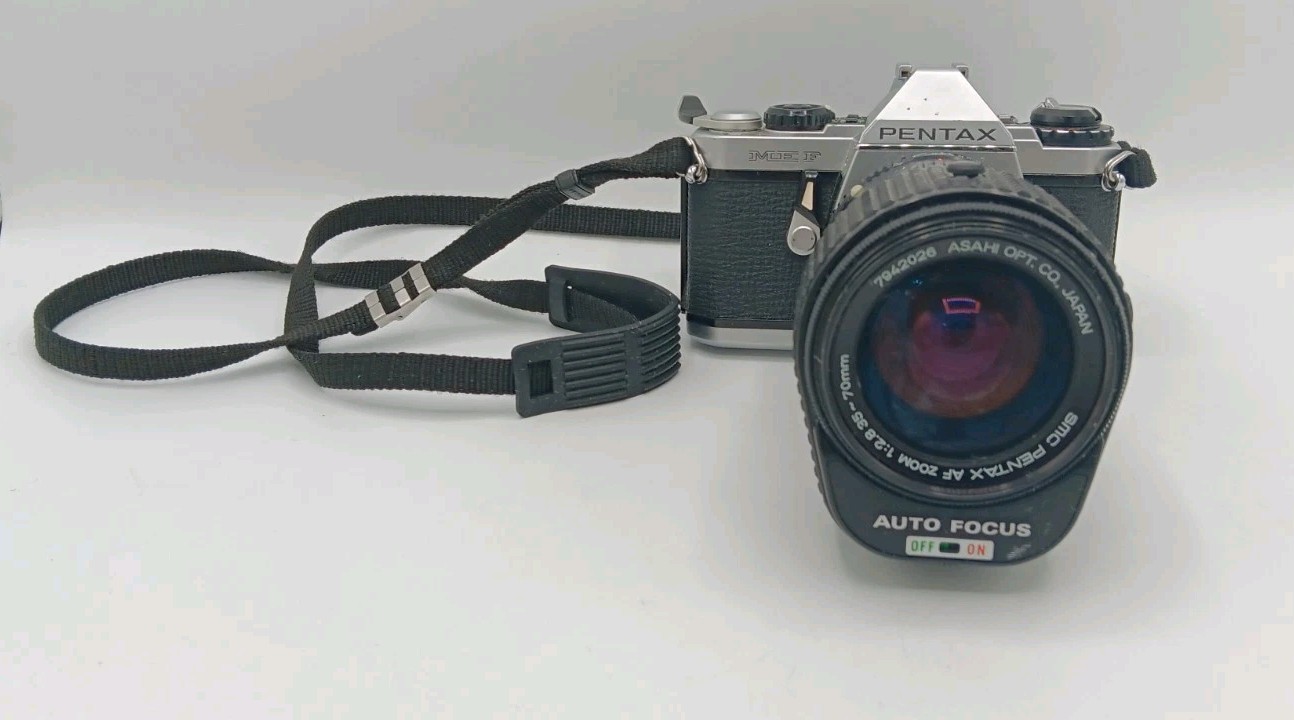
The Pentax ME-F was Pentax’s pioneering foray into autofocus SLR technology, introduced in 1981 as the company’s first camera to feature automatic focusing. While retaining the compact design language of the ME series, the ME-F combined manual focus lenses with a revolutionary (for Pentax) autofocus system that relied on a dedicated motorized lens.
Overview
Released in October 1981, the Pentax ME-F marked a pivotal moment in Asahi Optical Co.’s evolution, positioning the company at the threshold of the autofocus era. Designed as a technologically advanced successor to the popular Pentax ME and ME Super models, the ME-F targeted enthusiast photographers seeking cutting-edge automation without sacrificing the brand’s reputation for compact, well-engineered 35mm SLRs. It was positioned between the entry-level ME Super and the more professional LX in Pentax’s lineup, offering aperture-priority autoexposure with the notable addition of autofocus—albeit limited to a single, specially designed lens.
The ME-F’s most defining characteristic was its hybrid approach to autofocus: the camera body contained the AF sensor and processing circuitry, but the focusing motor was housed within the lens, making it one of the first SLRs to use a lens-integrated motor for autofocus. This design choice was both innovative and restrictive, as it necessitated the use of the proprietary SMC Pentax AF 35–70mm f/2.8 lens, the only autofocus lens ever produced for the system. Despite its limitations, the ME-F demonstrated Pentax’s early commitment to autofocus technology, predating the fully integrated autofocus systems that would dominate the late 1980s.
Historically, the ME-F served as a technological testbed rather than a commercial breakthrough. Its complex design, high cost, and limited lens compatibility hindered widespread adoption. Nevertheless, it laid the groundwork for Pentax’s later autofocus efforts, including the Pentax SFX (SF1 in North America) of 1987, which featured in-body autofocus drive and broader lens support. The ME-F remains a significant footnote in the transition from manual to automated photography, representing Pentax’s first step into the future of SLR design.
Specifications
| Specification | Value |
| Type | 35mm Single-Lens Reflex (SLR) |
| Film Format | 35mm (135 film), full-frame (24 x 36mm) |
| Years Produced | 1981–1984 |
| Lens Mount | Pentax K-mount (with electrical contacts for AF) |
| Shutter | Vertical-travel, focal-plane shutter; speeds from 4 sec to 1/1000 sec, plus Bulb (B), and flash sync at 1/60 sec |
| Metering | TTL open-aperture center-weighted averaging metering with silicon photodiode (SPD) sensor |
| Exposure Modes | Aperture-priority autoexposure, manual exposure (set via lens aperture ring), stop-down metering for off-brand lenses |
| Viewfinder | Fixed pentaprism with interchangeable focusing screens; standard screen includes microprism collar and split-image rangefinder; 92% coverage, 0.95x magnification (with 50mm f/1.4 at infinity) |
| Dimensions | 135 × 81 × 50 mm (5.3 × 3.2 × 2.0 in); weight approximately 580 g (20.5 oz) body only (with battery) |
Key Features
- World’s First TTL Phase-Detection AF in an SLR (via lens motor): The ME-F featured an integrated autofocus system using a phase-detection sensor in the camera body, with focusing driven by a motor in the SMC Pentax AF 35–70mm f/2.8 lens—the first such implementation in a production SLR.
- Aperture-Priority Automation with Manual Override: Allowed photographers to set the aperture on the lens while the camera automatically selected the correct shutter speed; manual exposure possible via stop-down metering.
- Dedicated AF Lens with Integrated Motor: The SMC Pentax AF 35–70mm f/2.8 included a built-in DC motor, battery compartment, and AF/MF switch, making it the only lens capable of autofocus on the ME-F.
- Compact, Lightweight Chassis: Built on the proven ME Super platform, the ME-F retained a compact metal-and-polycarbonate body ideal for travel and street photography.
- LED Exposure Display in Viewfinder: Used a three-segment LED (under, correct, over) to indicate exposure status, a hallmark of Pentax’s electronic SLRs of the era.
Historical Context
The early 1980s marked a period of rapid innovation in SLR technology, driven by the race to implement practical autofocus. While Konica’s C35 AF (1977) and Polaroid’s SX-70 Sonar (1978) had demonstrated autofocus in rangefinder and instant cameras, SLRs lagged due to mechanical complexity. The Pentax ME-F emerged in this competitive climate, just months before Nikon’s manual-focus FM2 and prior to Minolta’s groundbreaking Maxxum 7000 (1985), which would revolutionize the industry with in-body AF drive and integrated lens motors.
Despite its innovation, the ME-F faced immediate challenges. The sole AF lens was expensive, heavy, and suffered from slow, noisy focusing—limitations of early motor and battery technology. Competitors like Canon and Nikon remained focused on refining manual-focus systems, while Minolta was secretly developing a fully electronic mount. The ME-F was thus a technological island: advanced in concept but isolated by lack of ecosystem support. Market reception was lukewarm; enthusiasts appreciated its engineering, but most consumers found it impractical. Production ceased by 1984, with .
Collectibility & Value
Today, the Pentax ME-F is a sought-after collector’s item, valued for its historical significance as Pentax’s first autofocus camera and its rarity. Complete sets with the SMC Pentax AF 35–70mm f/2.8 lens command premium prices, typically ranging from $400 to $800 depending on condition, with fully functional autofocus systems being particularly prized. Due to the limited production run and the fragility of the lens’s motor and circuitry, finding a working ME-F is increasingly difficult.
Collectors should inspect the lens’s battery compartment (prone to corrosion from old PX27 batteries), test the autofocus mechanism (which often seizes or loses calibration), and verify the integrity of the camera’s silver oxide battery (SR44 or equivalent). The ME-F uses a single 6V 4LR44 battery for camera functions and a separate 6V PX27 for the lens motor—both now obsolete and requiring adapters or modern equivalents. Common issues include degraded rubber seals, shutter timing inaccuracies, and worn mirror dampers. Despite these challenges, well-maintained examples are prized as museum-quality artifacts of photographic innovation.
Similar Cameras
- Minolta Maxxum 7000 (1985) – The first fully integrated autofocus SLR with in-body motor drive and electronic mount.
- Nikon F3AF (1983) – A variant of the F3 with autofocus capability using two specialized lenses containing focus motors.
- Canon A-1 (1978) – Featured advanced automation including shutter-priority and program modes, though manual focus only.
- Olympus OM-2N (1980) – Competitor in the compact SLR segment with aperture-priority and TTL flash.
- Yashica FX-3 (1982) – Budget-friendly aperture-priority SLR with similar size and targeting similar users.
Repair & Maintenance
The Pentax ME-F uses a 6V 4SR44 battery (or equivalent) for camera functions. The 4LR44 is alkaline and not recommended due to voltage drop and leakage risk; the original specification calls for 4SR44 (silver oxide). The SMC Pentax AF 35–70mm f/2.8 lens requires a separate 6V PX27 battery to power the focusing motor—now obsolete, though modern equivalents like the Wein Cell (zinc-air) or 4SR44 can be used with caution. Battery leakage is a common issue, particularly in the lens compartment, leading to corrosion on contacts and circuit boards.
The autofocus system is prone to failure due to motor wear, dried lubricants, or degraded wiring in the lens’s flexible ribbon cables. Shutter reliability is generally good but may require CLA (clean, lubricate, adjust) service after decades of dormancy. The camera’s electronics are relatively simple by modern standards, but replacement parts are scarce. Repair is feasible for experienced technicians familiar with vintage Pentax systems, but full restoration—especially of the AF lens—can be costly and time-intensive. Regular use, proper storage, and battery removal when not in use are essential for long-term preservation.
eBay Listings


As an eBay Partner, we earn from qualifying purchases. This helps support our independent vintage technology research.
Related Models
- Pentax K1000 (1976-1997)
- Pentax KM (1975-1977)
- Pentax KX (1975-1977)
- Pentax LX (1980-2001)
- Pentax ME Super (1979-1984)
- Alpa 6 (1948-1953)
- Agfa Agfaflex
- Agfa Ambiflex
- Agfa Easy
- Agfa Futura Af zoom