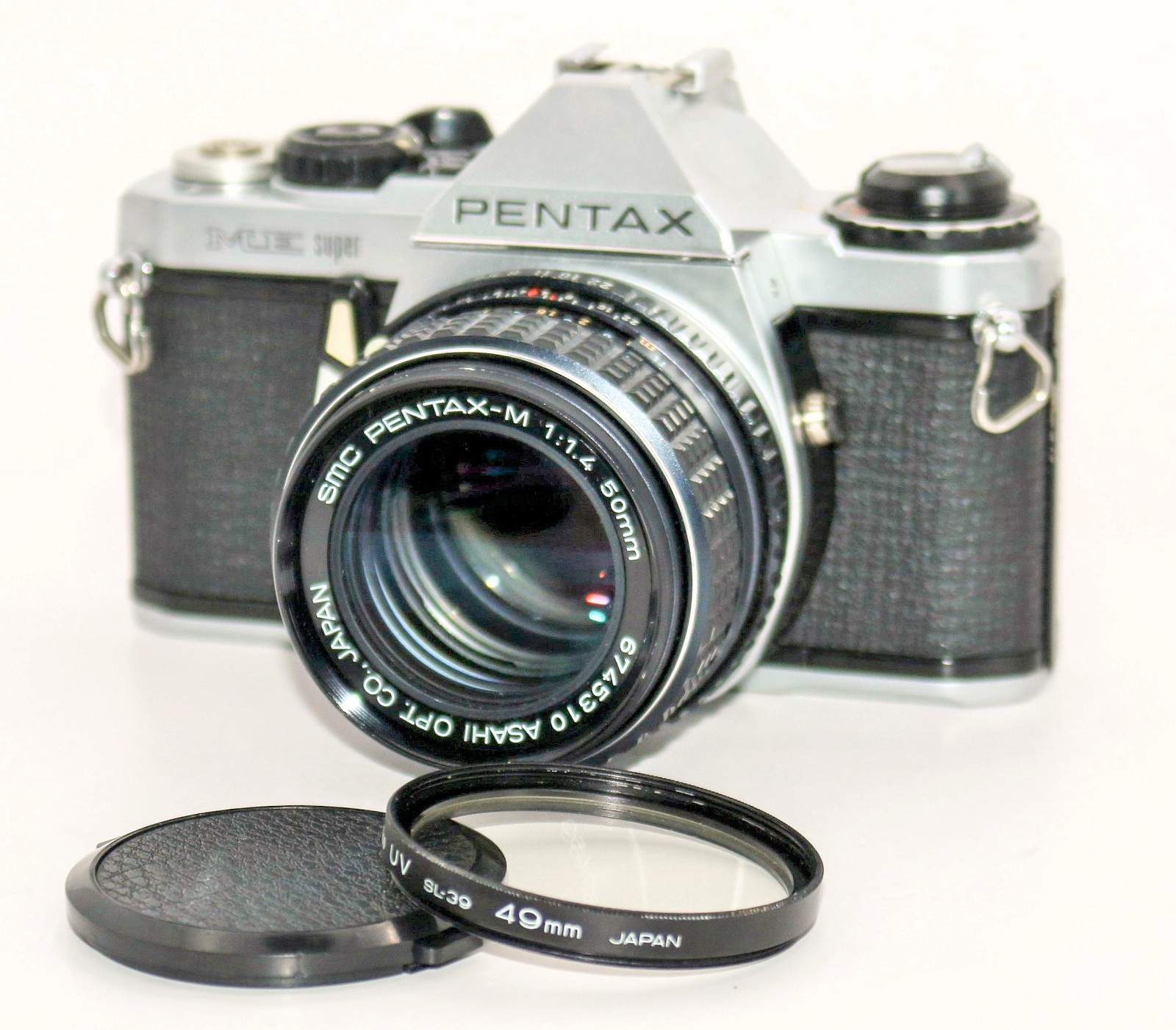
PENTAX ME
The Pentax ME is a compact, aperture-priority 35mm film SLR camera introduced by Asahi Optical Co. (later Pentax Corporation) in 1976. Designed as an advanced amateur and enthusiast camera, it combined automated exposure control with a lightweight, user-friendly body, marking a shift toward smaller, more accessible SLRs during the late 1970s.
Overview
Released in 1976, the Pentax ME was developed during a transformative period in 35mm photography, when electronics were beginning to replace fully mechanical systems in SLR design. Positioned between the fully manual Pentax MX and the more advanced Pentax ES series, the ME targeted photographers seeking automation without sacrificing image quality or build integrity. It was part of Pentax’s strategy to offer a range of compact, electronically controlled SLRs that emphasized ease of use and portability.
The ME was notable for its diminutive size—unusual for SLRs of the era—achieved through a vertically traveling, electronically controlled metal-blade focal-plane shutter and a simplified internal layout. Despite its small stature, it retained full compatibility with the Pentax K-mount (introduced in 1975), giving users access to a broad range of high-quality Pentax SMC lenses. The camera featured through-the-lens (TTL) aperture-priority autoexposure, with shutter speeds from 4 seconds to 1/1000th of a second, controlled by an integrated silicon photodiode metering system.
One of the ME’s defining characteristics was its LED exposure display in the viewfinder, which used a simple up/down arrow system to guide correct exposure settings—a user-centric innovation for its time. While it lacked manual exposure mode, its automation was precise and reliable under most lighting conditions. The ME was succeeded in 1980 by the ME Super, which added shutter-priority mode and a broader shutter speed range, signaling Pentax’s continued push into electronic automation.
Specifications
| Specification | Value |
| Type | 35mm Single-Lens Reflex (SLR) |
| Film Format | 35mm (135 film), interchangeable |
| Years Produced | 1976–1980 |
| Lens Mount | Pentax K-mount (K-bayonet) |
| Shutter | Vertical-travel, metal-blade focal-plane shutter; speeds 4 sec to 1/1000 sec, plus Bulb |
| Metering | TTL open-aperture metering via silicon photodiode (SPD) |
| Exposure Modes | Aperture-priority autoexposure only |
| Viewfinder | Fixed pentaprism, 0.92x magnification, 92% coverage; LED exposure indicator (±2 EV) |
| Dimensions | 134 × 82 × 50 mm (5.3 × 3.2 × 2.0 in); ~590 g (21 oz) with battery |
Key Features
- Aperture-priority autoexposure: Allows user to set desired aperture while camera selects correct shutter speed automatically from 4 sec to 1/1000 sec.
- Compact and lightweight design: One of the smallest and lightest SLRs of its generation, ideal for travel and everyday use.
- LED viewfinder display: Dual-arrow LED system indicates under/overexposure, simplifying exposure correction without complex readouts.
- K-mount compatibility: Full support for Pentax K-series lenses, including SMC Takumar and later SMC Pentax lenses with automatic aperture coupling.
- Electronic shutter control: Precise timing via integrated circuitry, powered by a single 1.5V SR44 or equivalent battery.
Historical Context
The Pentax ME emerged during a pivotal shift in SLR technology—the transition from mechanical to electronic control systems. In the mid-1970s, manufacturers like Olympus, Minolta, and Canon were introducing compact, electronically automated SLRs aimed at intermediate photographers. The Olympus OM-1 (1972) had already proven that small SLRs could deliver professional performance, and Pentax responded with the ME to remain competitive in this growing segment.
The ME was designed to appeal to amateur photographers who wanted automation and portability without the complexity of full manual operation. It competed directly with models like the Olympus OM-10 and Minolta X-370, offering a balance of simplicity, build quality, and optical compatibility. While lacking manual exposure mode—a limitation criticized by some enthusiasts—its reliability and compact form made it popular among students and casual shooters.
Despite its automation, the ME retained mechanical film advance and manual rewind, preserving a tactile shooting experience. Its release also coincided with the broader adoption of multi-coated lenses and improved metering systems, reinforcing Pentax’s reputation for optical excellence. The ME helped solidify the K-mount as a long-term standard, ensuring backward and forward lens compatibility across decades of Pentax SLRs.
Collectibility & Value
Today, the Pentax ME is a sought-after model among film photography enthusiasts and collectors of vintage SLRs. Its compact size, clean design, and compatibility with high-quality SMC lenses make it a favorite for those building lightweight film kits. In good working condition, the ME typically sells for $100–$200 USD, depending on lens inclusion and cosmetic state. Fully functional units with original leather and clear viewfinders command higher prices, especially when paired with fast prime lenses like the SMC Pentax 50mm f/1.7 or 55mm f/1.8.
When purchasing a used ME, buyers should verify the functionality of the shutter across all speeds and confirm that the metering system responds accurately to light changes. A common issue is degraded rubber light seals, which can lead to light leaks on film; these should be replaced during servicing. The camera uses a 1.5V SR44 (or equivalent, such as A76 or LR44) battery, which powers both the meter and shutter control—failure here renders the camera inoperable. While repair parts are still available, the electronics are sensitive, and professional servicing is recommended for shutter or circuit issues.
Due to its electronic shutter, the ME cannot function without a battery, unlike fully mechanical SLRs. This dependency, combined with aging capacitors and circuit boards, means many units on the used market may require refurbishment. However, well-maintained examples remain reliable and are prized for their blend of vintage charm and functional automation.
Similar Cameras
- Olympus OM-10 (1979) – Compact aperture-priority SLR with TTL metering, part of the OM series.
- Minolta X-370 (1981) – Aperture-priority SLR with manual override, part of Minolta’s X-series.
- Canon AE-1 (1976) – Iconic aperture-priority SLR with shutter speeds to 1/1000 sec, highly popular and widely available.
- Nikon EM (1979) – Compact Nikon SLR aimed at beginners, aperture-priority with limited shutter range.
- Yashica FR-I (1977) – K-mount SLR with aperture-priority automation, similar in concept and function.
Repair & Maintenance
The Pentax ME requires a single 1.5V SR44 (or equivalent alkaline LR44 or silver-oxide SR44) battery to power its electronic shutter and metering system. Without a functioning battery, the camera cannot operate. Over time, leaking batteries can damage the battery compartment and adjacent circuitry, so regular inspection is advised.
Common issues include erratic shutter behavior, non-responsive metering, and sticky shutter blades due to dried lubricants. The LED display may also fail due to aging components. The camera’s electronics, while robust for their era, are sensitive to moisture and corrosion. Cleaning the contacts, replacing the light seals, and ensuring proper battery voltage are essential maintenance steps.
Repair difficulty is moderate: while experienced technicians can service the shutter and replace capacitors, the compact design and integrated circuitry make DIY repairs challenging. Replacement PCBs and shutter assemblies are occasionally available from specialty suppliers, but sourcing original parts may require donor bodies. Regular use and proper storage in a dry environment significantly extend the ME’s operational life.
eBay Listings
![[MINT] Pentax ME Super Black 35mm SLR Film Camera 50mm f/2 L](https://i.ebayimg.com/images/g/R88AAeSwz6ppyRw2/s-l1600.jpg)

![[Near MINT w/Box] Pentax ME SLR 35mm Film Camera SMC-M 50mm](https://i.ebayimg.com/images/g/r9EAAeSwtrppk3OV/s-l1600.jpg)
As an eBay Partner, we earn from qualifying purchases. This helps support our independent vintage technology research.
Related Models
- Pentax K1000 (1976-1997)
- Pentax KM (1975-1977)
- Pentax KX (1975-1977)
- Pentax LX (1980-2001)
- Pentax ME-F (1981–1984)
- Alpa 6 (1948-1953)
- Agfa Agfaflex
- Agfa Ambiflex
- Agfa Easy
- Agfa Futura Af zoom