PENTAX KM
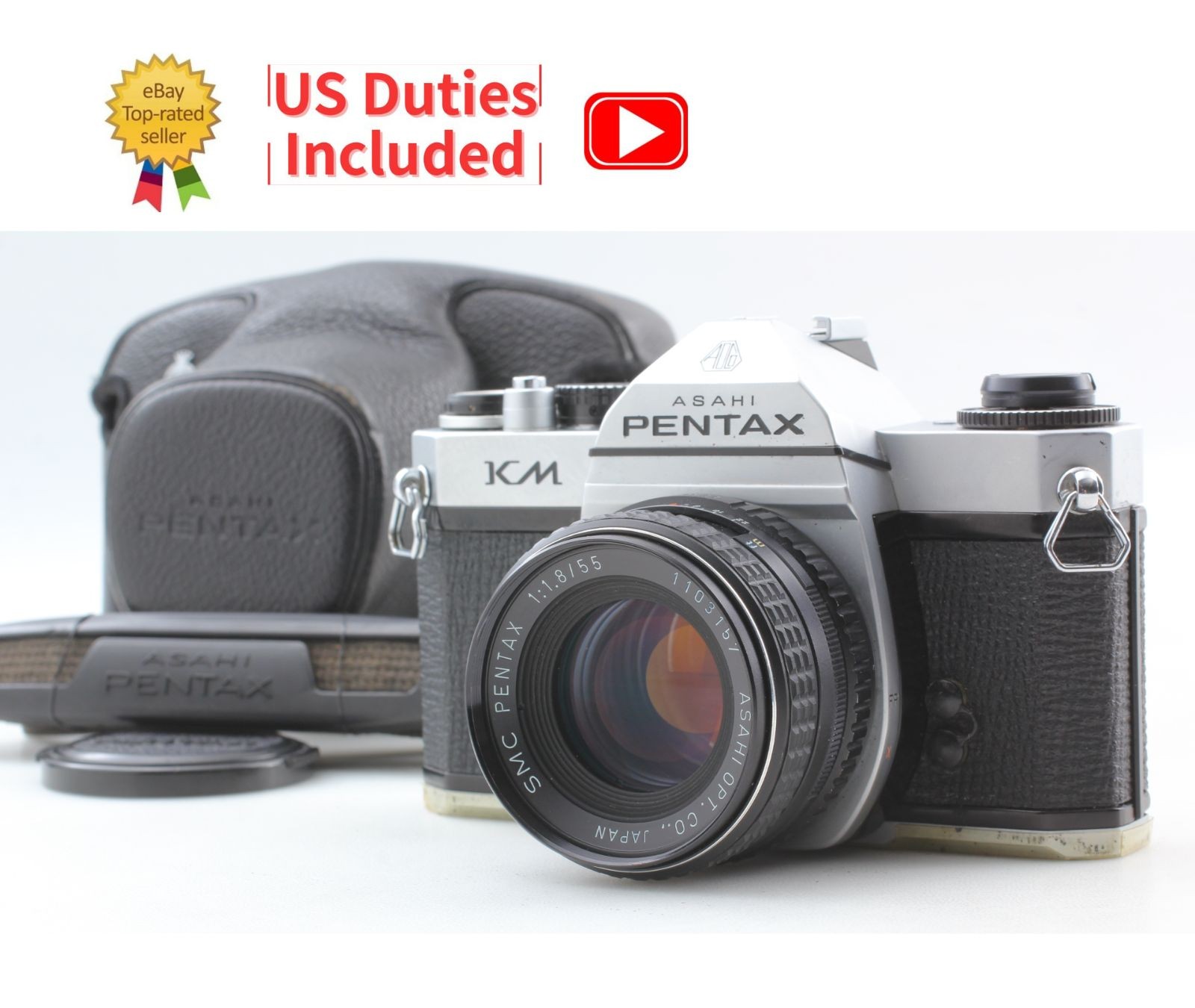
The Pentax KM is a 35mm film single-lens reflex (SLR) camera produced by Asahi Optical Co. (later known as Pentax) from 1975 to 1977. Positioned as a slightly enhanced version of the iconic Pentax K1000, the KM offered beginner and amateur photographers a robust, mechanical SLR with the addition of two practical features absent on its sibling model: a self-timer and a depth-of-field (DOF) preview lever.
Overview
Released during a period of intense competition in the 35mm SLR market, the Pentax KM was designed to bridge the gap between the ultra-minimalist K1000 and more advanced models like the KX and K2. While mechanically nearly identical to the K1000, the KM distinguished itself by incorporating user-friendly enhancements that improved compositional control and usability without increasing mechanical complexity. It was marketed primarily to photography students and enthusiasts who desired a reliable, fully manual SLR with expanded functionality for creative control.
The KM shared the K1000’s reputation for durability, simplicity, and ease of use, built around a rugged all-metal chassis and a vertically traveling focal-plane shutter. Unlike higher-end Pentax models of the era, it lacked aperture-priority automation or built-in motor drive compatibility, maintaining a focus on manual exposure control and mechanical reliability. The addition of the DOF preview allowed users to stop down the lens manually to assess the actual depth of field in the viewfinder—a critical tool for precise focusing in macro or landscape photography. The self-timer enabled delayed shutter release, useful for self-portraits or reducing camera shake during long exposures.
Despite its short production run, the KM played a role in Pentax’s strategy to offer tiered options within its K-series lineup, catering to different levels of user expertise. It was sold primarily in North America and select international markets, often bundled with a 50mm f/2 or f/1.7 prime lens. Though overshadowed by the legendary status of the K1000, the KM remains a competent and historically interesting variant for collectors and users seeking a slightly more functional version of the classic Pentax student SLR.
Specifications
| Specification | Value |
| Type | 35mm manual focus SLR |
| Film Format | 35mm (135 film) |
| Years Produced | 1975–1977 |
| Lens Mount | Pentax K-mount (bayonet) |
| Shutter | Focal-plane, vertically traveling metal blades; speeds from 1 sec to 1/1000 sec, plus Bulb (B) |
| Metering | Center-weighted average TTL metering via CdS cell |
| Exposure Modes | Manual exposure only |
| Viewfinder | Fixed pentaprism, 0.85x magnification, 92% coverage |
| Dimensions | 142 mm × 90 mm × 55 mm (5.6 × 3.5 × 2.2 in); ~640 g (body only, no battery) |
Key Features
- Depth-of-Field Preview Lever: Allows stopping down the lens to the selected aperture for accurate depth-of-field assessment in the viewfinder.
- Self-Timer Mechanism: Mechanical self-timer with a 10-second delay, activated via a lever on the front of the camera.
- TTL Center-Weighted Metering: Through-the-lens exposure metering with a match-needle display in the viewfinder, compatible with Pentax K-series lenses.
- Fully Mechanical Shutter at 1/100 sec and Below: Operable without battery; battery only required for metering.
- Interchangeable Pentax K-Mount Lenses: Compatible with all Pentax K, M, A series lenses and many third-party variants.
Historical Context
The Pentax KM was introduced in 1975 at a pivotal time in the evolution of 35mm SLR cameras. The mid-1970s saw rapid advancements in automation, with brands like Minolta (introducing the XD-11), Canon (AE-1 development underway), and Nikon (FM series) pushing the boundaries of electronic integration. In contrast, Pentax maintained a dual strategy: offering advanced electronic models for professionals while preserving mechanically simple, durable cameras for education and entry-level use.
The KM emerged as a niche variant within this strategy. While the K1000—launched the same year—became the definitive "student camera" due to its stripped-down design, the KM provided modest upgrades aimed at users wanting greater creative control without complexity. Its DOF preview and self-timer were features commonly found on mid-tier SLRs but absent on the K1000, making the KM a subtle upgrade for those willing to pay slightly more.
Despite its practical additions, the KM did not achieve the same longevity or recognition as the K1000, which remained in production until 1997. The KM was discontinued by 1977, likely due to limited demand and Pentax’s focus on consolidating its lineup. Nevertheless, it reflects Pentax’s responsiveness to user feedback and its commitment to offering differentiated tools within a standardized mechanical platform.
Collectibility & Value
Today, the Pentax KM is considered a moderately rare variant among Pentax K-series cameras, primarily due to its short production span and lower production volume compared to the K1000. It holds particular interest for collectors seeking completeness in the Pentax manual SLR lineage or those who appreciate subtle mechanical variations in otherwise identical models. In the used market, KM bodies typically sell for $100–$200 in working condition, with prices increasing for units with clean viewfinders, smooth shutter operation, and original accessories.
When purchasing a KM, buyers should verify the functionality of the self-timer and DOF preview—mechanisms that can become sticky or seized over time due to lubricant degradation. The meter should also be tested, as the CdS cell can fail or become inaccurate, though the camera operates mechanically without it. Common issues include light seals deterioration (leading to light leaks), shutter curtain wear, and mirror slap noise, all typical of 1970s-era SLRs. A well-maintained KM with a clean interior and calibrated meter is a solid performer for film shooters seeking a tactile, fully manual experience.
Similar Cameras
- Canon FTb – Mechanically robust 35mm SLR with TTL metering, manual exposure, and strong build quality.
- Nikon FM – Compact, durable manual focus SLR introduced in 1977, featuring aperture-priority capability and excellent Nikkor lens compatibility.
- Olympus OM-1 – Lightweight, precision-engineered SLR with a high-quality viewfinder and compact design.
- Minolta SRT-101 – Renowned for its bright viewfinder and robust build, featuring TTL metering and fully manual controls.
- Yashica FX-3 – Budget-friendly manual SLR with TTL metering, similar target market and functionality.
Repair & Maintenance
The Pentax KM uses a single 1.35V mercury PX625 battery (or modern equivalents like Wein Cell MRB625 or alkaline/hearing aid adapters) to power the CdS meter. The camera’s shutter operates mechanically at all speeds when the battery is dead or removed, but metering will be unavailable. Common maintenance issues include degraded light seals, which should be replaced to prevent light leaks, and stiff self-timer or DOF preview mechanisms, which may require cleaning and lubrication by a qualified technician. Shutter timing should be checked periodically, especially if speeds appear inconsistent. Overall, the KM is relatively straightforward to service, benefiting from widespread parts availability and a simple mechanical design shared with the K1000. Regular use and storage in a dry environment help preserve long-term functionality.
eBay Listings


As an eBay Partner, we earn from qualifying purchases. This helps support our independent vintage technology research.
Related Models
- Pentax K1000 (1976-1997)
- Pentax KX (1975-1977)
- Pentax LX (1980-2001)
- Pentax ME-F (1981–1984)
- Pentax ME Super (1979-1984)
- Alpa 6 (1948-1953)
- Agfa Agfaflex
- Agfa Ambiflex
- Agfa Easy
- Agfa Futura Af zoom