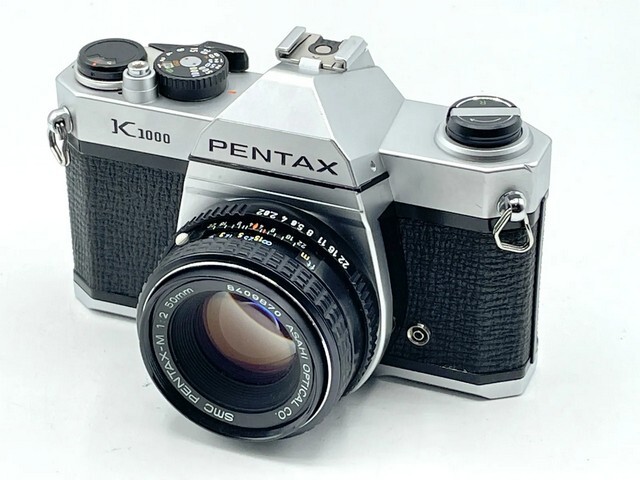
PENTAX K1000
The Pentax K1000 is a fully mechanical 35mm film single-lens reflex (SLR) camera introduced in 1976 as an entry-level manual focus SLR. Renowned for its durability, simplicity, and reliability, the K1000 became one of the most widely used student cameras in photography education throughout the late 20th century.
Overview
The Pentax K1000 was developed during a pivotal era in photography when SLR cameras were transitioning from fully mechanical systems to electronically controlled bodies with automated exposure features. In contrast to this trend, the K1000 was deliberately designed as a stripped-down, all-mechanical camera to serve as a teaching tool for photography students. It replaced the earlier Pentax KX and Pentax KM models in the entry-level segment and was marketed as a no-frills, dependable camera that emphasized manual control and mechanical precision. Built around the robust Pentax K-mount, it offered compatibility with a vast range of manual and later auto-exposure lenses.
Manufactured from 1976 to 1997—though some sources cite limited production into the early 2000s—the K1000 was produced primarily at Asahi Optical Co.’s factory in Japan. Its long production run is a testament to its enduring design and utility. The camera features a horizontal cloth focal-plane shutter, through-the-lens (TTL) metering via a cadmium sulfide (CdS) meter, and a fixed pentaprism viewfinder with a microprism focusing aid. Despite lacking features such as aperture-priority automation or motorized film advance, the K1000’s straightforward operation made it ideal for learning the fundamentals of exposure, focus, and composition.
Within Pentax’s lineup, the K1000 occupied the base position, sitting below more advanced models like the K2, KM, and KX. It was never intended to compete with professional-grade cameras but instead served as a gateway into SLR photography. Its rugged metal chassis, simple internal mechanics, and lack of dependency on electronic components contributed to its reputation for longevity and ease of repair. Even decades after its discontinuation, the K1000 remains a popular choice among film photography enthusiasts, educators, and beginners seeking a reliable mechanical SLR.
Specifications
| Specification | Value |
| Type | 35mm Film SLR |
| Film Format | 35mm (135) |
| Years Produced | 1976–1997 |
| Lens Mount | Pentax K-mount (also compatible with M42 via adapter) |
| Shutter | Horizontal-travel cloth focal-plane; speeds from 1 sec to 1/1000 sec, plus B (Bulb) |
| Metering | TTL open-aperture CdS meter with center-weighted averaging |
| Exposure Modes | Manual only; no aperture priority or shutter priority |
| Viewfinder | Fixed pentaprism with 0.85x magnification, 92% frame coverage; split-image/microprism focusing screen |
| Dimensions | 141 mm (W) × 91 mm (H) × 54 mm (D); ~670 g (body only, no battery or film) |
Key Features
- Fully mechanical operation: The shutter and film advance are entirely mechanical, requiring no battery for basic function—except for the light meter.
- TTL center-weighted metering: Utilizes a CdS cell for accurate exposure readings through the lens, displayed via a match-needle system in the viewfinder.
- K-mount compatibility: Supports Pentax K, M, A series manual lenses, and later lenses with electronic aperture control (when used in stop-down metering mode).
- Robust build quality: Die-cast metal chassis with leatherette covering and mechanical shutter tested for over 100,000 cycles.
- Simple user interface: Designed for manual exposure only, encouraging users to learn shutter speed, aperture, and ISO relationships without automation.
Historical Context
The Pentax K1000 was released in 1976 at a time when the 35mm SLR market was rapidly expanding, and camera manufacturers were introducing increasingly sophisticated electronic models. Competitors such as Nikon (with the FM series), Canon (AE-1), and Minolta (XD-11) were pushing automation and electronic integration. In contrast, Pentax positioned the K1000 as a back-to-basics tool, explicitly targeting photography schools and beginners. Its design philosophy prioritized mechanical reliability and ease of repair over convenience features.
The K1000 succeeded the Pentax KM (introduced in 1975) and incorporated minor refinements, including a redesigned shutter release button and improved metering circuitry. It was often bundled with a 50mm f/2 or f/1.7 Takumar or SMC Pentax lens and marketed through educational channels. Despite its simplicity, it gained a loyal following not only among students but also among working photographers in developing regions and war correspondents who valued its durability in harsh conditions. Its long production life—over two decades—reflects both its utility and the slow phase-out of mechanical SLRs in the face of autofocus digital dominance.
Collectibility & Value
Today, the Pentax K1000 is one of the most commonly available vintage SLRs on the used market, with thousands still in circulation. Its widespread production and popularity mean it is not considered rare, but well-maintained examples in good working condition remain highly sought after by film photographers and educators. As of 2024, a functional K1000 typically sells for $75–$150 USD, depending on condition, included lens, and seller location. Fully operational units with original boxes and manuals may command slightly higher prices, particularly among collectors of photographic history.
When purchasing a K1000, buyers should test the shutter speeds across all settings (especially 1/1000 sec and 1 sec) for accuracy, inspect the mirror movement for smoothness, and verify that the light meter responds to changing light conditions. Common issues include sticky shutters due to dried lubricants, inaccurate metering from aging CdS cells, and light seals degradation. While repairable, these issues require skilled servicing. The camera uses a single 1.35V mercury battery (PX625), now obsolete; modern substitutes such as Wein Cell MRB625 or alkaline adapters are recommended, though they may affect meter accuracy due to voltage differences.
Similar Cameras
- Nikon FM2 – A more advanced mechanical SLR with faster 1/4000 sec shutter and titanium curtain; popular among professionals.
- Canon FTb – Fully mechanical Canon SLR with TTL metering, similar in purpose and era.
- Olympus OM-1 – Compact, fully mechanical OM-series SLR with excellent optics and high build quality.
- Yashica FR-I – Budget-friendly mechanical SLR with Copal Square shutter and reliable performance.
- Minolta SRT-101 – Earlier generation SLR with advanced metering for its time and robust mechanical design.
Repair & Maintenance
The Pentax K1000 requires a 1.35V mercury battery (PX625) for its light meter; however, due to environmental regulations, these are no longer manufactured. Modern alternatives include the Wein Cell MRB625 (zinc-air, 1.35V) or alkaline PX625A (1.5V), though the latter may cause overexposure if not compensated. The camera body itself operates mechanically and does not require batteries for shutter or film advance functions.
Common maintenance issues include sluggish or inaccurate shutter speeds, often due to dried lubricants in the shutter mechanism or timing gears. The CdS meter cell can degrade over time, leading to dim or non-responsive meter needles. Regular cleaning, lubrication, and calibration (CLA) by a qualified technician are recommended every 5–10 years for frequent users. The camera’s modular design allows for relatively straightforward disassembly and repair, making it a favorite among camera technicians. Light seals should be replaced if deteriorated to prevent light leaks, and the film pressure plate should be inspected for flatness. With proper care, a K1000 can remain functional for decades.
eBay Listings



As an eBay Partner, we earn from qualifying purchases. This helps support our independent vintage technology research.
Related Models
- Pentax KM (1975-1977)
- Pentax KX (1975-1977)
- Pentax LX (1980-2001)
- Pentax ME-F (1981–1984)
- Pentax ME Super (1979-1984)
- Alpa 6 (1948-1953)
- Agfa Agfaflex
- Agfa Ambiflex
- Agfa Easy
- Agfa Futura Af zoom