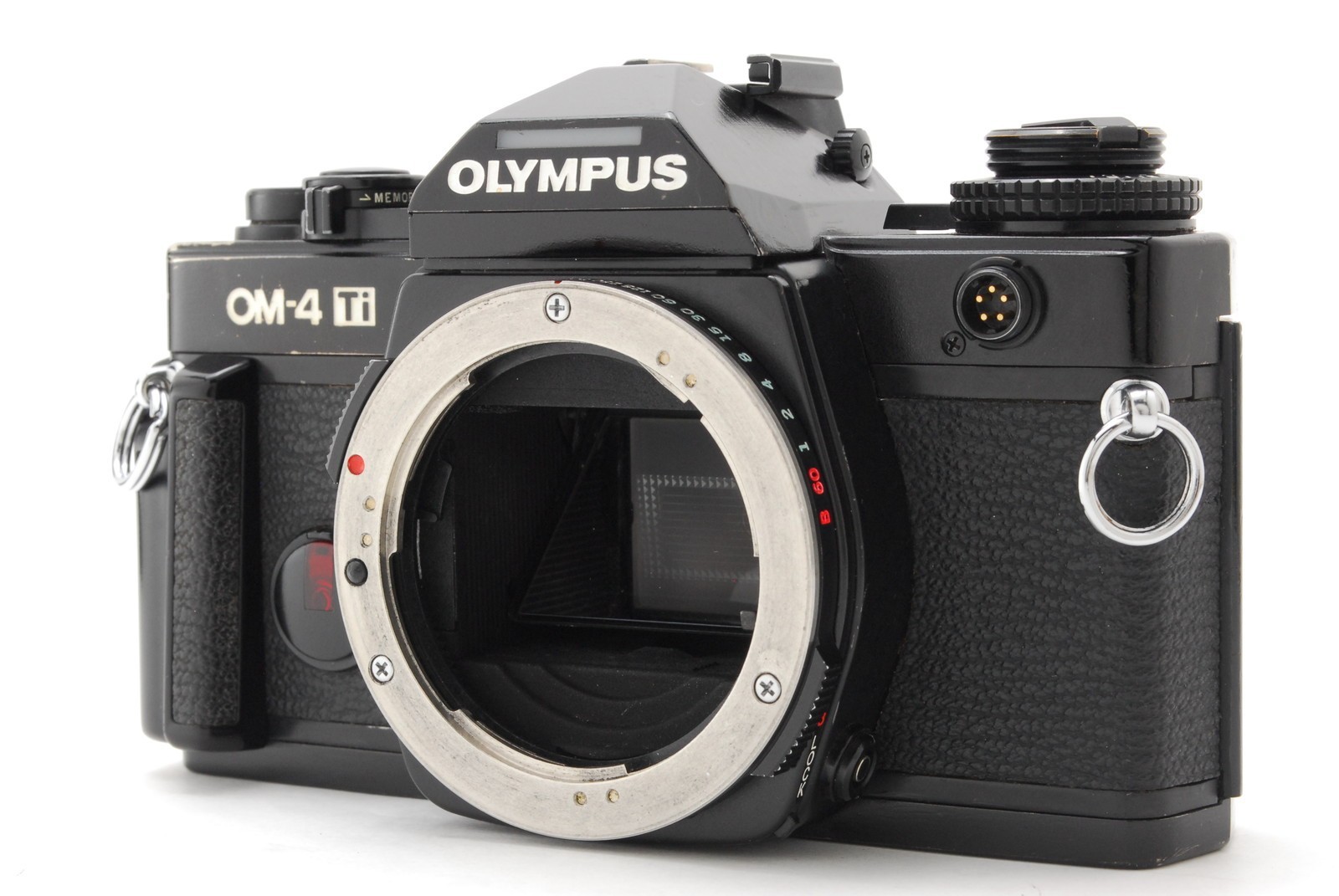
OLYMPUS OM-4TI
The Olympus OM-4Ti is the final and most advanced evolution of the Olympus OM series of 35mm manual focus SLR cameras. Released in 1987 as an upgraded version of the OM-4, it combined professional-grade build quality, precision optics compatibility, and sophisticated through-the-lens (TTL) metering with a rugged titanium top plate, making it a benchmark for film photographers seeking reliability and optical excellence.
Overview
The OM-4Ti was introduced by Olympus in 1987 as the pinnacle of its long-running OM system, which began in 1972 with the groundbreaking OM-1. Designed explicitly for professional photographers and advanced amateurs, the OM-4Ti represented the culmination of over 15 years of refinement in compact, high-performance 35mm SLR design. It succeeded the OM-4 (1983) and incorporated several critical improvements, most notably enhanced multi-spot metering, improved viewfinder optics, and a titanium-clad top and bottom plate for increased durability and reduced weight compared to all-steel competitors.
Targeted at photojournalists, studio professionals, and serious enthusiasts, the OM-4Ti offered full manual control with aperture-priority autoexposure and advanced metering capabilities unmatched in its class. Its compact size—engineered during the 1970s to compete with bulkier contemporaries like the Nikon F2 and Canon F-1—remained a defining feature, allowing for discreet, portable operation without sacrificing robustness. The OM-4Ti maintained full compatibility with the extensive OM Zuiko lens lineup, spanning from ultra-wide 18mm to super-telephoto 1000mm, as well as motor drives, data backs, and other accessories.
Despite the rise of autofocus SLRs in the late 1980s and early 1990s, Olympus continued production of the OM-4Ti into the early 2000s, with final units reportedly assembled from existing parts stock until 2002. This extended production run underscores its enduring reputation for reliability and precision, particularly among users who valued manual focus accuracy, optical quality, and mechanical resilience over automated features.
Specifications
| Specification | Value |
| Type | 35mm manual focus SLR |
| Film Format | 35mm (135) |
| Years Produced | 1987–2002 |
| Lens Mount | Olympus OM bayonet mount |
| Shutter | Vertical-travel focal-plane shutter, 1–1/2000 sec (mechanical), 1–1/2000 sec + B (electronic), flash sync at 1/60 sec |
| Metering | TTL full-aperture multi-spot, center-weighted average, and 1–8 spot metering via viewfinder |
| Exposure Modes | Aperture-priority autoexposure, manual exposure |
| Viewfinder | Interchangeable focusing screens; fixed pentaprism with 0.92x magnification, 100% coverage; LED display for shutter speed, exposure compensation, and metering mode |
| Dimensions | 136 × 86 × 50 mm (5.4 × 3.4 × 2.0 in); ~570 g (body only, without battery) |
Key Features
- Multi-spot metering system: The OM-4Ti could take up to eight individual spot meter readings within the frame, automatically calculating an average exposure value—ideal for high-contrast scenes and studio work.
- TTL OTF (Off-the-Film) metering: Enabled accurate full-aperture metering without stopping down, improving viewfinder brightness and exposure precision.
- Titanium top and bottom plates: Provided exceptional durability while reducing weight compared to all-metal bodies; a rare feature in 35mm SLRs.
- Interchangeable focusing screens: Allowed customization for different shooting disciplines (e.g., split-image for manual focus, grid for architecture).
- High-precision viewfinder readout: Integrated LED display showing shutter speed, exposure compensation, and active metering mode without obstructing the view.
Historical Context
The OM-4Ti was launched at a pivotal moment in photographic history—the late 1980s—when autofocus and electronic automation were rapidly transforming the SLR market. Competitors like the Canon EOS 650 (1987) and Nikon F4 (1988) embraced autofocus and microprocessor-driven systems, signaling a shift toward computerized photography. In contrast, the OM-4Ti was a deliberate reaffirmation of the manual focus philosophy, emphasizing optical precision, mechanical reliability, and user control.
Olympus positioned the OM-4Ti not as a technological disruptor but as the ultimate refinement of an established system. It appealed to photographers who prioritized lens quality, compact handling, and metering sophistication over autofocus speed. Its multi-spot metering system, derived from the OM-2S and refined in the OM-4, remained one of the most advanced manual exposure tools available, particularly valued in studio, landscape, and scientific photography.
Despite limited marketing outside Japan and Europe, the OM-4Ti gained a loyal following among professionals who used it alongside motor drives like the OM-2000 and data backs for time-stamping images. Its production longevity—extending past the discontinuation of most manual focus flagships—reflects both its robust design and Olympus’s commitment to its OM user base even as the company transitioned to autofocus OM-2000 and later digital systems.
Collectibility & Value
Today, the Olympus OM-4Ti is highly regarded among film photography enthusiasts and collectors, particularly those focused on professional-grade manual SLRs. Units in excellent working condition typically sell for $500–$900 USD, with mint examples exceeding $1,000, especially if accompanied by original packaging, manuals, or rare accessories. The titanium construction, limited global distribution, and long production run contribute to its desirability, though availability of fully functional units can vary.
When purchasing an OM-4Ti, buyers should verify the functionality of the metering system, which relies on a single 6V 4SR44 or PX28 battery (now obsolete; modern equivalents like MR-9 or adapters are used). Common issues include degraded light seals, shutter curtain wear, and aging capacitors in the meter circuit. The LED display may flicker or fail due to battery leakage or circuit corrosion. Because the camera uses mechanical linkages for aperture coupling, lenses must be OM-series with automatic aperture indexing (AI) compatibility; non-OM lenses require stop-down metering.
Due to its professional build, many OM-4Ti bodies remain operational decades after manufacture, but regular CLA (clean, lubricate, adjust) servicing by a technician experienced with OM cameras is recommended for consistent performance. The interchangeable screens and modular design enhance repairability, though spare parts are becoming scarcer.
Similar Cameras
- Nikon F3HP (1980–2002): Rugged, professional SLR with manual focus, 100% viewfinder, and long production life; favored by photojournalists.
- Canon F-1 (New F-1) (1981–1994): Fully mechanical, modular SLR with interchangeable finders and screens; Canon’s answer to the Nikon F3.
- Pentax LX (1980–2001): Precision-engineered manual focus SLR with multi-pattern metering, interchangeable viewfinders, and exceptional build quality.
- Minolta X-1 (XE in North America) (1975–1981): High-end manual SLR with aperture-priority and manual modes, known for its quiet shutter and advanced metering.
- Leica R4 (1980–1987): Electronic manual focus SLR with aperture-priority automation and Leica’s optical pedigree, targeting professional photographers.
Repair & Maintenance
The OM-4Ti operates on a single 6V 4SR44 (or PX28) battery to power its TTL metering system and LED display. Due to the high voltage and potential for leakage, it is strongly recommended to remove the battery when the camera is not in use. Modern alternatives include MR-9 batteries or step-up adapters using LR44 cells, though voltage regulation must be verified to avoid meter damage.
Common maintenance issues include degraded foam light seals (leading to light leaks), sticky shutter curtains (especially at slow speeds), and oxidation on battery contacts. The meter prism and LED display are sensitive to moisture and corrosion; cleaning the battery compartment regularly is essential. Shutter timing should be checked periodically, particularly if the mechanical speeds (1 sec and B) become inaccurate.
Repair difficulty is moderate to high due to the camera’s compact design and dense internal layout. Technicians require specialized tools and experience with OM-series mechanics, particularly for shutter and meter calibration. While some parts are still available through Olympus heritage channels or third-party suppliers, others—such as replacement titanium plates or meter prisms—are effectively obsolete. As a result, well-maintained original units are increasingly prized.
eBay Listings



As an eBay Partner, we earn from qualifying purchases. This helps support our independent vintage technology research.
Related Models
- Olympus OM-1 (1972-1988)
- Olympus OM-10 (1979-1987)
- Olympus OM-1n (1979-1988)
- Olympus OM-2 SP (1984-1988)
- Olympus OM-2 (1975-1987)
- Alpa 6 (1948-1953)
- Agfa Agfaflex
- Agfa Ambiflex
- Agfa Easy
- Agfa Futura Af zoom