OLYMPUS OM-3
The Olympus OM-3 is a fully mechanical 35mm single-lens reflex (SLR) camera introduced in 1983 as the ultimate evolution of Olympus’ compact professional OM series. Designed for reliability and precision, it combines manual mechanical operation with advanced multi-spot metering, making it a favorite among photojournalists and enthusiasts who demanded robust performance in challenging conditions.
Overview
The Olympus OM-3 was developed as the pinnacle of Olympus’ mechanical SLR lineage, succeeding the OM-2 and positioned above the OM-2N. Though visually similar to earlier OM-series models, the OM-3 represented a significant internal refinement, particularly in its metering system and build quality. It was engineered for professional use, emphasizing durability, precision, and metering accuracy in a compact body that retained the OM series’ signature portability. The OM-3 was marketed as a no-compromise mechanical camera for photographers who required shutter reliability without dependency on batteries for core functions—though batteries were necessary for metering.
One of the OM-3’s most notable advancements was its multi-spot metering system, a sophisticated feature for its time. This allowed photographers to take multiple spot readings through the viewfinder and average them for optimal exposure, a capability previously unseen in mechanical SLRs. The camera’s shutter and film transport remained fully mechanical, operating without batteries at all shutter speeds, including the bulb setting. This made the OM-3 exceptionally reliable in extreme environments where electronic failures could occur.
The OM-3 was part of Olympus’ long-running OM system, which began in 1972 with the OM-1. It shared the same compact M42-compatible OM bayonet mount, enabling full compatibility with the extensive range of Zuiko lenses. However, due to its niche positioning and high production cost, the OM-3 had a relatively short production run from 1983 to 1986. It was succeeded by the OM-3Ti, a minor revision with a titanium top plate, but the original OM-3 remains highly regarded for its engineering and balance of features.
Specifications
| Specification | Value |
| Type | 35mm Mechanical SLR |
| Film Format | 35mm (135 film) |
| Years Produced | 1983–1986 |
| Lens Mount | Olympus OM bayonet mount |
| Shutter | Vertical-travel metal focal-plane shutter; 1 sec to 1/1000 sec, B (fully mechanical) |
| Metering | TTL multi-spot and center-weighted average metering (switchable) |
| Exposure Modes | Manual only (shutter-priority auto exposure not available) |
| Viewfinder | Fixed pentaprism with 97% coverage, 0.92x magnification; interchangeable focusing screens |
| Dimensions | 136 × 83 × 50 mm (5.35 × 3.27 × 1.97 in); ~550 g (body only, without battery) |
| Battery | Two 1.5V SR44 or one 3V DL/CR1/3N lithium battery (for metering only) |
| Flash Sync | PC terminal and hot shoe; X-sync at 1/60 sec |
| Frame Rate | Manual advance (approx. 2 fps with motor drive) |
| Self-Timer | Mechanical self-timer with 6–12 second delay |
| Accessories | Compatible with Olympus OM motor drives, data backs, and remote controls |
Key Features
- Fully mechanical shutter operates without batteries from 1 sec to 1/1000 sec and B, ensuring reliability in extreme conditions.
- Multi-spot TTL metering allows up to six spot readings to be averaged, a groundbreaking feature for professional exposure control.
- Interchangeable focusing screens support various shooting needs, including split-image, microprism, and grid options.
- Compact titanium-alloy body with high durability and reduced weight compared to all-metal predecessors.
- Silent, smooth film advance with a refined lever mechanism, optimized for discreet shooting.
Historical Context
The OM-3 was introduced at a transitional moment in SLR development. By the early 1980s, the market was shifting toward electronic automation, with cameras like the Nikon FA (1983) and Canon AE-1 Program (1981) emphasizing aperture-priority and program modes. Olympus, however, recognized a niche for photographers who valued mechanical reliability and manual precision—particularly in photojournalism, documentary, and field photography. The OM-3 was engineered as a response to this demand, refining the OM-2’s electronics while retaining mechanical shutter operation.
Despite its advanced metering and rugged build, the OM-3 was overshadowed by the rise of autofocus and electronic SLRs. Its high price and limited production volume made it a rare sight compared to mass-market models. Nevertheless, it was critically acclaimed for its engineering, winning respect from professionals who appreciated its metering sophistication and mechanical dependability. The OM-3 was succeeded in 1986 by the OM-3Ti, which featured a titanium top and bottom plate for increased durability and a slight weight reduction, but retained the same core mechanics.
Collectibility & Value
The Olympus OM-3 is a sought-after model among film camera collectors and working photographers due to its rarity, mechanical integrity, and advanced metering system. Fewer than 20,000 units were produced during its three-year run, contributing to its status as a collector’s item. In today’s market (as of 2024), a fully functional OM-3 in good condition typically sells for $600–$900 USD, with higher prices for models verified to have accurate metering and clean viewfinders.
When purchasing an OM-3, buyers should test the shutter at all speeds, check for mirror slap noise or misalignment, and verify the meter’s responsiveness (especially the multi-spot function). Common issues include degraded light seals, dim or cloudy viewfinders, and sticky meter switches. Because the camera relies on mercury-free batteries (SR44 or 3V lithium), the meter circuit may require adjustment for accurate readings with modern power sources. Original boxes, manuals, and accessories can significantly increase value, especially for collectors seeking complete sets.
Similar Cameras
- Nikon FM2n – A durable mechanical SLR with a 1/4000 sec shutter and reliable TTL metering, popular among professionals.
- Canon FTb – A fully mechanical 35mm SLR with stop-down metering, known for its rugged build and lens compatibility.
- Pentax MX – A compact mechanical SLR with a high top shutter speed (1/1000 sec) and excellent viewfinder clarity.
- Leica R3 – A hybrid electro-mechanical SLR with professional build quality and advanced metering, aimed at Leica’s system users.
- Minolta XE-7 – A refined mechanical SLR with aperture-priority automation and a smooth shutter mechanism.
Repair & Maintenance
The OM-3 requires two SR44 (or one 3V DL/CR1/3N) battery solely for the light meter; the shutter and film advance operate mechanically and do not depend on power. The most common maintenance issues include worn shutter curtains, inaccurate metering due to aging CdS cells, and degraded light seals that can lead to light leaks. The multi-spot metering system is complex and may require specialized calibration if malfunctioning.
Repair difficulty is moderate to high due to the camera’s compact design and precision mechanics. Technicians familiar with OM-series cameras are recommended, as disassembly requires care to avoid damaging the meter coupling and shutter linkage. Regular use, cleaning of contacts, and timely light seal replacement are essential for long-term reliability. Given its mechanical nature, the OM-3 is more repairable than electronic contemporaries, contributing to its enduring appeal among film photographers.
eBay Listings
![Rare Meter Works [N MINT++ w/ Strap] Olympus OM-3 Black Film](https://i.ebayimg.com/images/g/gmQAAeSwdDdpqit4/s-l1600.jpg)
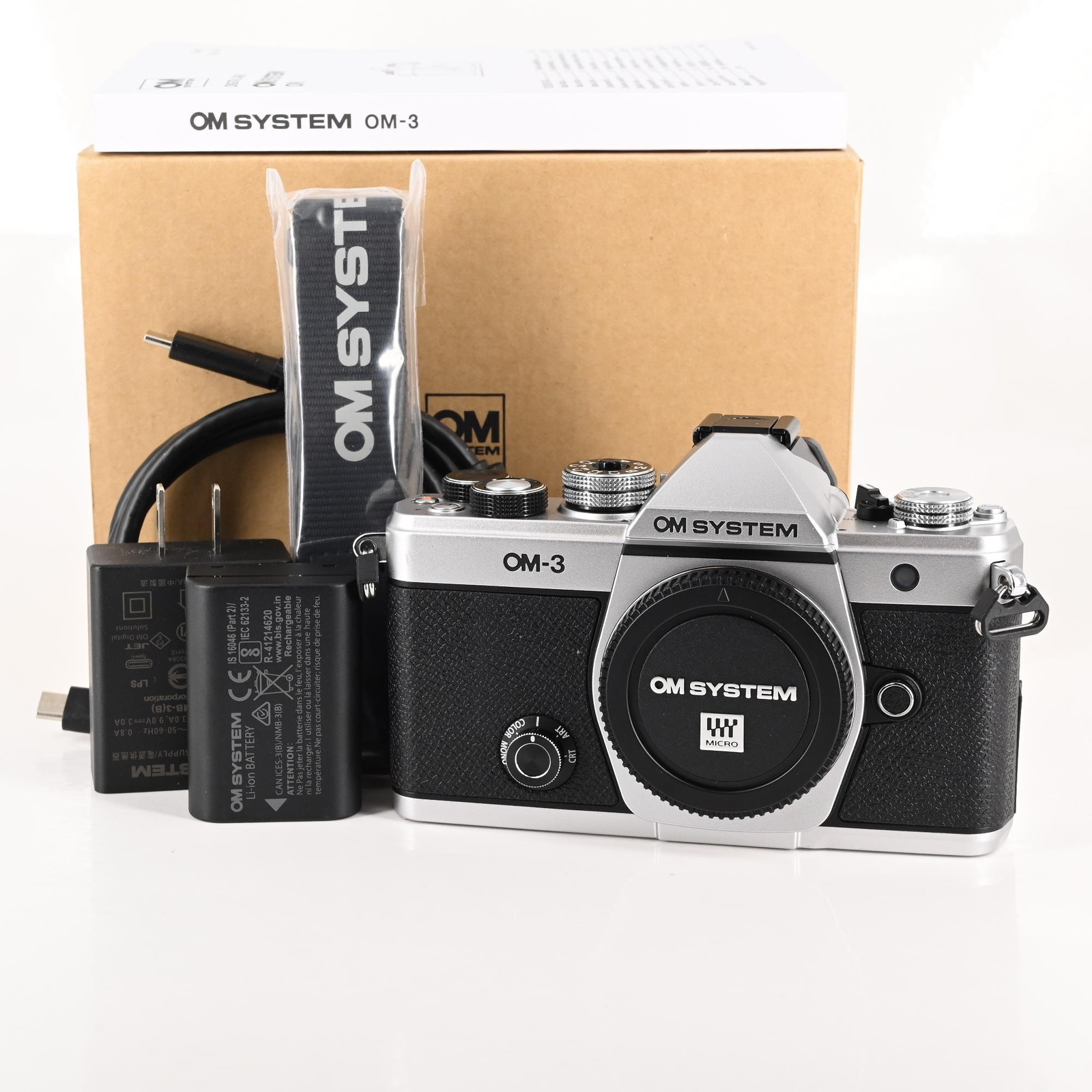
![[NEAR MINT+] Olympus OM-3 Ti 35mm Film Camera Titanium Black](https://i.ebayimg.com/images/g/Le0AAeSwGf9o-ZOL/s-l1600.jpg)
![READ [NEAR MINT] Olympus OM-3 Ti 35mm SLR Film Camera body T](https://i.ebayimg.com/images/g/u2YAAeSwUfFpmevJ/s-l1600.jpg)
As an eBay Partner, we earn from qualifying purchases. This helps support our independent vintage technology research.
Related Models
- Olympus OM-1 (1972-1988)
- Olympus OM-10 (1979-1987)
- Olympus OM-1n (1979-1988)
- Olympus OM-2 SP (1984-1988)
- Olympus OM-2 (1975-1987)
- Alpa 6 (1948-1953)
- Agfa Agfaflex
- Agfa Ambiflex
- Agfa Easy
- Agfa Futura Af zoom