OLYMPUS OM-20
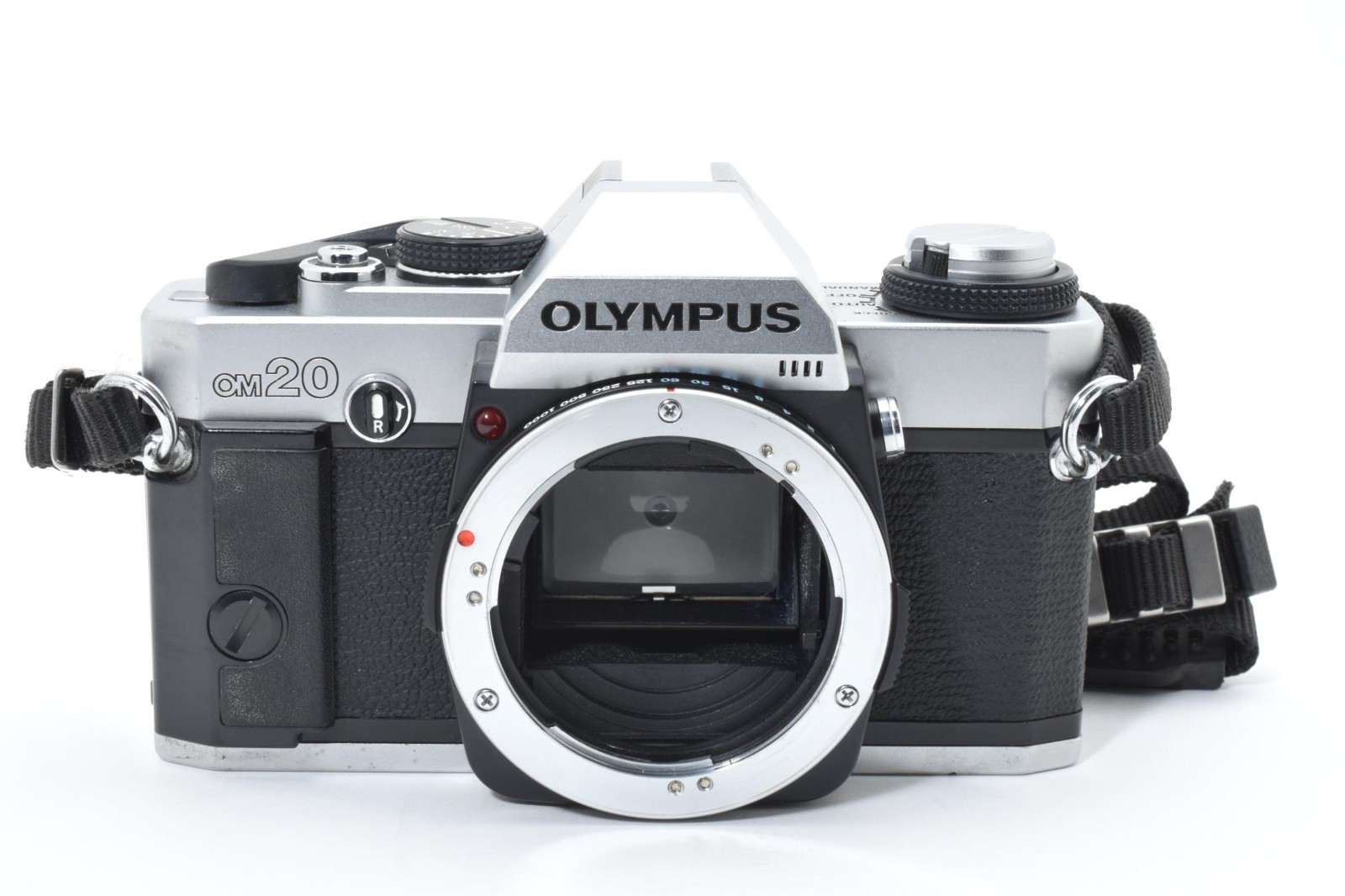
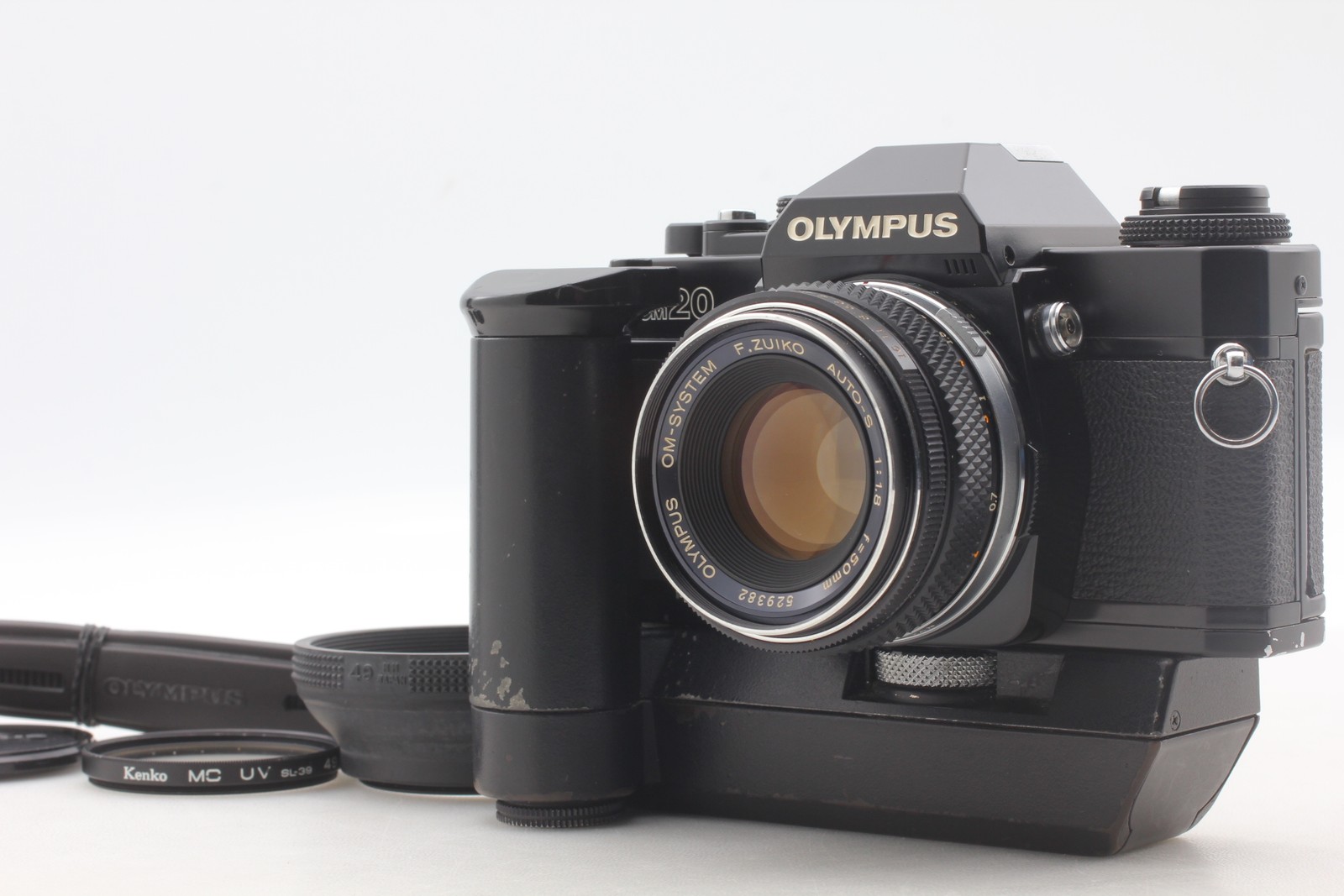
The Olympus OM-20 is a 35mm film single-lens reflex (SLR) camera introduced in 1983 as an updated version of the OM-10. Designed for amateur photographers seeking a compact, lightweight, and user-friendly SLR system, the OM-20 combines aperture-priority automatic exposure with manual override capability and features an basic operating instructions printed on the rewind knob.
Overview
Released during a transitional period in the evolution of 35mm SLRs—when electronics were increasingly integrated into traditionally mechanical designs—the Olympus OM-20 represented Olympus’s effort to refine its entry-level OM series. Positioned between the fully manual OM-1 and the sophisticated OM-2, the OM-20 was a successor to the OM-10, offering modest but meaningful improvements aimed at enhancing usability and reliability. While retaining the compact OM-series chassis and renowned Zuiko lens compatibility, the OM-20 introduced a redesigned shutter mechanism, improved metering circuitry, and a more durable film advance system.
The OM-20 was marketed primarily to novice photographers and casual shooters who desired the flexibility of interchangeable lenses without the complexity of full manual operation. Its aperture-priority auto-exposure mode allowed users to set the desired f-stop while the camera automatically calculated the correct shutter speed, displayed via an LED in the viewfinder. Despite its automation, the OM-20 maintained a degree of manual control, allowing experienced users to override auto settings in specific lighting conditions. It was part of Olympus’s broader OM system, which emphasized portability and optical excellence, and it shared the same OM mount as all OM-series bodies, granting access to a wide range of high-quality Zuiko lenses.
Specifications
| Specification | Value |
| Type | 35mm Single-Lens Reflex (SLR) |
| Film Format | 35mm (135 film) |
| Years Produced | 1983–1986 |
| Lens Mount | Olympus OM mount |
| Shutter | Vertical-travel, metal-blade focal-plane shutter; speeds from 4 sec to 1/1000 sec, plus Bulb (B) mode |
| Metering | TTL (Through-The-Lens) center-weighted average metering using a silicon photodiode (SPD) sensor |
| Exposure Modes | Aperture-priority auto-exposure with manual override; manual exposure possible via stop-down metering |
| Viewfinder | Fixed pentaprism with 92% frame coverage and 0.92x magnification (with 50mm f/1.8 lens at infinity); includes LED shutter speed display and exposure warning indicators |
| Dimensions | 136 × 83 × 50 mm (5.35 × 3.27 × 1.97 in); weight approximately 550 g (19.4 oz) body only (with battery, without lens) |
Key Features
- Integrated Instruction Manual: The top of the rewind crank is printed with basic operating instructions, including film loading, exposure settings, and battery replacement—a unique feature aimed at novice users.
- Aperture-Priority Automation: Users set the aperture on the lens, and the camera selects the appropriate shutter speed from 1 to 1/1000 sec, displayed via LED in the viewfinder.
- Stop-Down Manual Exposure: By pressing the AE lock button, users can stop down the lens manually and use the meter for precise exposure readings in challenging lighting.
- Compact OM Chassis: Inherits the OM system’s signature small size and balanced ergonomics, making it one of the most portable full-featured 35mm SLRs of its era.
- TTL Center-Weighted Metering: Accurate exposure calculation based on light measured through the lens, with emphasis on the central area of the frame.
Historical Context
The Olympus OM-20 was released in 1984, not 1983. It replaced the OM-10, which had been introduced in 1979, and addressed several of its predecessor’s limitations, including a more robust shutter mechanism and improved battery efficiency. The OM-20 arrived at a time when electronics were rapidly transforming SLR design—competitors like Canon, Nikon, and Pentax were introducing cameras with increasingly advanced automation, multi-mode exposure, and even early autofocus systems.
Despite these trends, Olympus maintained a minimalist philosophy with the OM-20, focusing on simplicity, reliability, and system compatibility. It competed directly with cameras such as the Canon AE-8, Nikon EM, and Pentax ME Super—entry-level SLRs that balanced automation with manual control. However, unlike some of its rivals, the OM-20 avoided overcomplication, retaining a clean interface and intuitive operation. While it lacked shutter-priority or program modes, its aperture-priority system was well-suited to the OM-series’ lens-centric design, encouraging photographers to think in terms of depth of field and composition.
Collectibility & Value
Today, the Olympus OM-20 is considered a niche collectible, valued more for its usability and design elegance than for rarity. It is not as sought-after as the fully mechanical OM-1 or the advanced OM-2N, but it remains a favorite among film photography enthusiasts who appreciate its compact size, solid build quality, and seamless integration with Zuiko lenses. In the current market (as of 2024), working OM-20 bodies typically sell for $100–$180, depending on condition and included accessories.
When purchasing an OM-20, collectors should verify that the shutter operates smoothly across all speeds and that the meter responds accurately to light changes. The camera uses a single 6V PX28 or 4SR44 battery to power the meter and exposure circuitry; while modern equivalents are available, corrosion in the battery compartment is a common issue in older units. Other potential problems include stiff film advance levers, light seals degradation, and viewfinder dimming due to aging prism coatings. However, the OM-20 is generally reliable and repairable, with many components interchangeable with other OM-series models.
Similar Cameras
- Canon AE-8 – A compact aperture-priority SLR with similar target audience and feature set.
- Nikon EM – Entry-level Nikon SLR with aperture-priority mode and compact design.
- Pentax ME Super – Offers both aperture- and shutter-priority modes, with a slightly more advanced feature set.
- Yashica FX-3 Super 200 – A budget-friendly SLR with aperture-priority automation and TTL metering.
- Minolta X-370 – A versatile beginner SLR with manual and aperture-priority modes, widely used in photography education.
Repair & Maintenance
The Olympus OM-20 operates on a single 6V PX28 (or equivalent 4SR44) battery, which powers the TTL metering system and exposure logic. Battery leakage is a common issue, particularly in cameras that have been stored for long periods, so inspection of the battery compartment is essential. The shutter is electronically timed but mechanically actuated. With a dead battery, the camera can still fire at all speeds, but without metering or accurate timing. The mechanical shutter will operate, but exposure timing is unreliable.
Common maintenance concerns include worn light seals (which should be replaced to prevent light leaks), stiff mirror movement, and degraded foam around the film pressure plate. The film advance mechanism is generally robust but may require lubrication after decades of use. Repair parts are still available through specialty camera technicians and OM-series restoration specialists, and the OM-20 shares many internal components with the OM-10 and OM-2, simplifying servicing. Due to its electronic shutter, professional calibration is recommended when adjusting timing or replacing circuitry.
eBay Listings

As an eBay Partner, we earn from qualifying purchases. This helps support our independent vintage technology research.
Related Models
- Olympus OM-1 (1972-1988)
- Olympus OM-10 (1979-1987)
- Olympus OM-1n (1979-1988)
- Olympus OM-2 SP (1984-1988)
- Olympus OM-2 (1975-1987)
- Alpa 6 (1948-1953)
- Agfa Agfaflex
- Agfa Ambiflex
- Agfa Easy
- Agfa Futura Af zoom