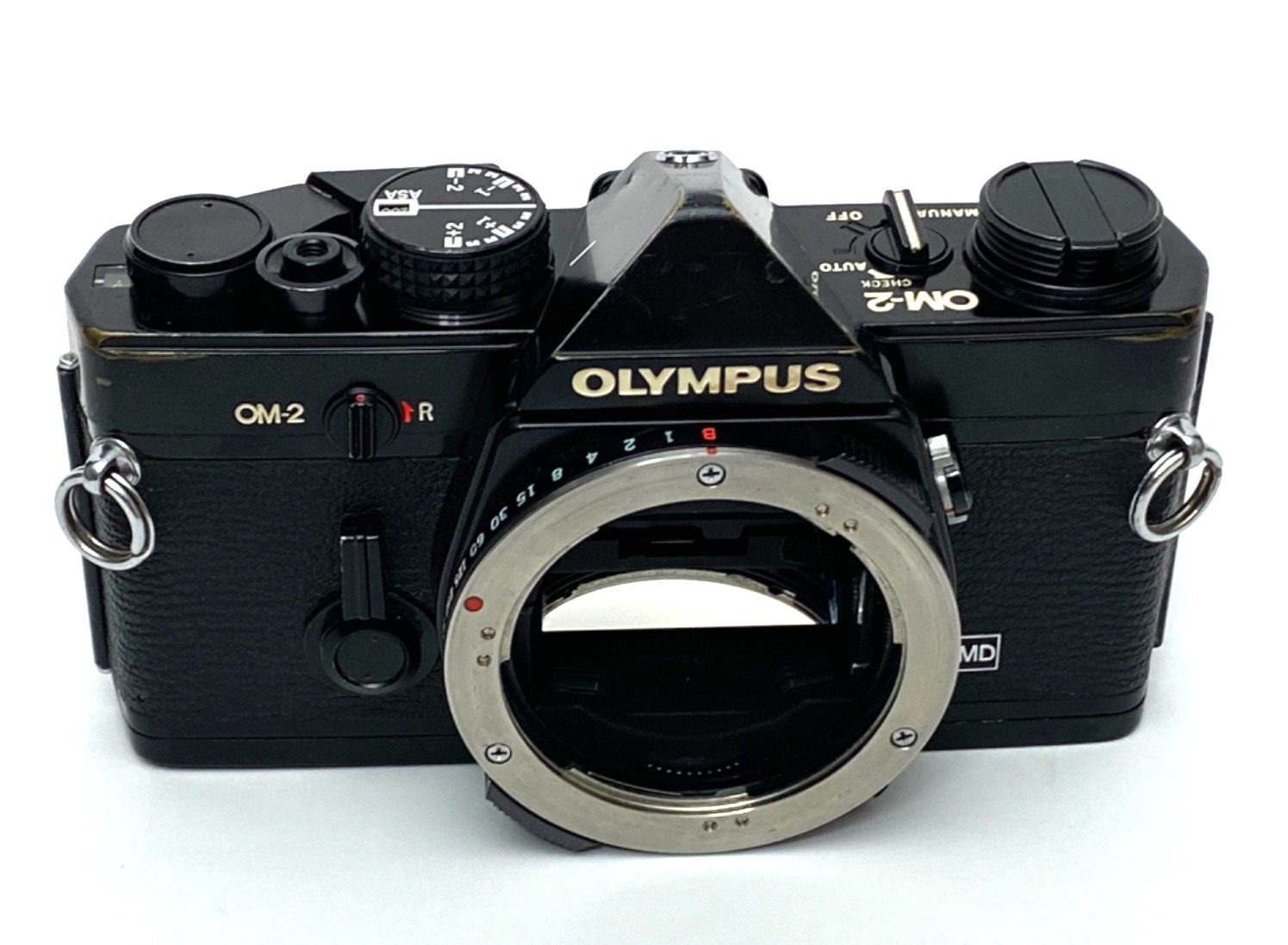
OLYMPUS OM-2
The Olympus OM-2 is a 35mm film single-lens reflex (SLR) camera introduced in 1975 as the successor to the groundbreaking OM-1. It was the first production SLR to feature off-the-film (OTF) metering, a revolutionary advancement that measured light reflected from the film plane during exposure, enabling highly accurate exposure control in aperture-priority auto mode.
Overview
Released at the height of the 35mm SLR boom, the OM-2 was designed to combine compact mechanical elegance with cutting-edge exposure automation. While the OM-1 was celebrated for its all-mechanical operation and compact size, the OM-2 expanded on that foundation by introducing electronic metering and aperture-priority autoexposure—without sacrificing the OM system’s signature portability. Targeted at advanced amateurs and professional photographers seeking automation without bulk, the OM-2 retained the OM-series’ 116mm height and 415g weight, making it one of the smallest professional-grade SLRs of its era.
The OM-2’s most significant innovation was its dual-cell silicon photodiode (SPD) metering system, which sampled light directly off the film surface via sensors mounted in the pentaprism housing. This allowed real-time exposure monitoring during the exposure itself—a feature known as "OTF" (Off-The-Film) metering. Unlike through-the-lens (TTL) averaging systems that measured light before the shutter opened, OTF metering could detect changes in reflectance and adjust shutter speed mid-exposure if necessary, greatly improving exposure accuracy, particularly in backlit or high-contrast scenes.
Positioned above the OM-1 and below the later OM-2N and OM-2S variants, the OM-2 formed the core of Olympus’s professional lineup throughout the late 1970s and early 1980s. It was compatible with the full range of Zuiko lenses via the OM mount and supported TTL flash metering, making it a versatile tool for both studio and field use. The OM-2 was eventually succeeded by the OM-2N (1979) and OM-2S/OM-2 Spot (1984), which refined the metering algorithm and added spot metering capability.
Specifications
| Specification | Value |
| Type | 35mm Film SLR |
| Film Format | 35mm (135) |
| Years Produced | 1975–1987 |
| Lens Mount | Olympus OM Mount |
| Shutter | Vertical-travel, metal-bladed focal-plane shutter; speeds 1–1/1000 sec (mechanical), 4 sec–1/1000 sec (electronic), Bulb |
| Metering | Off-the-film (OTF) TTL silicon photodiode (SPD) center-weighted averaging |
| Exposure Modes | Aperture-priority auto, Manual (with meter assistance) |
| Viewfinder | Fixed pentaprism, 97% coverage, 0.92x magnification (with 50mm f/1.8 lens), with integrated LED exposure display |
| Dimensions | 136 mm (W) × 83 mm (H) × 46 mm (D); 490 g (with battery and strap lug) |
Key Features
- Off-the-Film (OTF) Metering: First SLR to measure exposure via light reflected from the film plane during exposure, enabling precise aperture-priority autoexposure.
- Aperture-Priority Automation: Select lens aperture manually; camera sets shutter speed automatically from 4 sec to 1/1000 sec.
- Dual SPD Sensors: Two silicon photodiodes in the pentaprism monitor exposure in real time, allowing for mid-exposure correction.
- LED Viewfinder Display: Three vertically aligned LEDs indicate underexposure (bottom), correct exposure (center), and overexposure (top).
- TTL Flash Compatibility: Supports auto and manual flash units with TTL OTF metering for accurate flash exposure.
Historical Context
The OM-2 was launched in 1975 at a time when SLR manufacturers were racing to integrate electronics into traditionally mechanical cameras. Olympus had already disrupted the market with the OM-1 in 1972, proving that a compact, precision-engineered SLR could compete with bulkier offerings from Nikon and Canon. The OM-2 built on that success by embracing automation while maintaining mechanical reliability.
It entered a competitive landscape dominated by the Nikon F2, Canon FTb, and Pentax K1000. While those models emphasized mechanical durability or manual control, the OM-2 carved a niche by offering intelligent automation in a small body. Its OTF metering system was a major technical leap—Minolta would not introduce a similar system until the XD-11 (XD-7) in 1977. The OM-2’s ability to meter during exposure made it particularly effective in challenging lighting, giving it an edge in photojournalism and documentary work.
Market reception was strong among photographers who valued both portability and automation. Professional adoption was bolstered by its robust build quality, quiet shutter, and compatibility with the extensive Zuiko lens lineup. Over time, Olympus refined the OM-2 with updated versions, but the original OM-2 remained in production in various forms until 1987, a testament to its enduring design.
Collectibility & Value
The Olympus OM-2 is a sought-after model among film photography enthusiasts and OM system collectors. In good working condition, prices typically range from $150 to $300 USD, depending on cosmetic condition, functionality, and inclusion of original accessories. Fully functional units with clean viewfinders, accurate metering, and smooth shutter operation command premium prices, especially if paired with a Zuiko lens.
When purchasing an OM-2, buyers should verify the functionality of the OTF metering system, which requires a functioning battery (1x 1.35V PX625 mercury cell or modern equivalent such as Wein Cell or adapter with 1.5V hearing aid battery). A common issue is degraded light seals, which can lead to light leaks; these should be replaced. Other potential problems include stiff or inaccurate shutter speeds (especially at slower speeds), cloudy or scratched viewfinders, and worn shutter curtains. The LED exposure display may also fail due to aging circuitry, though the camera remains usable in manual mode with external metering.
While not rare, fully serviced OM-2 bodies in excellent condition are increasingly scarce. Its status as the first OTF-metering SLR gives it historical significance, enhancing its collectibility. Models with original boxes and manuals are uncommon and add value.
Similar Cameras
- Minolta XD-11 (XD-7) – Introduced in 1977, featured both aperture- and shutter-priority modes, with TTL metering (though not OTF during exposure).
- Pentax LX – Professional-grade 1980 SLR with modular design and TTL metering, but larger and heavier than the OM-2.
- Canon AE-1 – Popular 1978 aperture-priority SLR with electronic shutter and LED display, but lacked OTF metering and had a less robust build.
- Nikon FE – Released in 1978, offered aperture-priority and manual modes with TTL center-weighted metering, known for durability.
- Yashica FR-I – 1978 SLR with aperture-priority and TTL metering, OM-mount compatible via adapter, but without OTF exposure control.
Repair & Maintenance
The OM-2 requires a 1.35V mercury PX625 battery for accurate metering, though modern substitutes like the Wein Cell (zinc-air) or alkaline PX625 adapters are commonly used. Voltage-sensitive users should note that 1.5V alkaline replacements may cause overexposure; compensation of -1/3 to -2/3 EV is recommended. The camera will function mechanically without a battery at 1/60 sec (X-sync) and Bulb mode.
Common maintenance issues include deteriorated light seals (replace every 10–15 years), shutter timing inaccuracies at slow speeds, and sticky mirror mechanisms due to dried lubricants. The OTF metering system relies on clean internal mirrors and sensors—dust or oil can impair accuracy. Professional CLA (Clean, Lubricate, Adjust) services are recommended for heavily used bodies. Repair parts are still available through specialized camera technicians, though the OM-2’s dense internal layout makes servicing challenging for beginners. Overall, the OM-2 is considered reliable with proper care and is a durable representative of the early electronic SLR era.
eBay Listings


As an eBay Partner, we earn from qualifying purchases. This helps support our independent vintage technology research.
Related Models
- Olympus OM-1 (1972-1988)
- Olympus OM-10 (1979-1987)
- Olympus OM-1n (1979-1988)
- Olympus OM-2 SP (1984-1988)
- Olympus OM-20 (1983–1986)
- Alpa 6 (1948-1953)
- Agfa Agfaflex
- Agfa Ambiflex
- Agfa Easy
- Agfa Futura Af zoom