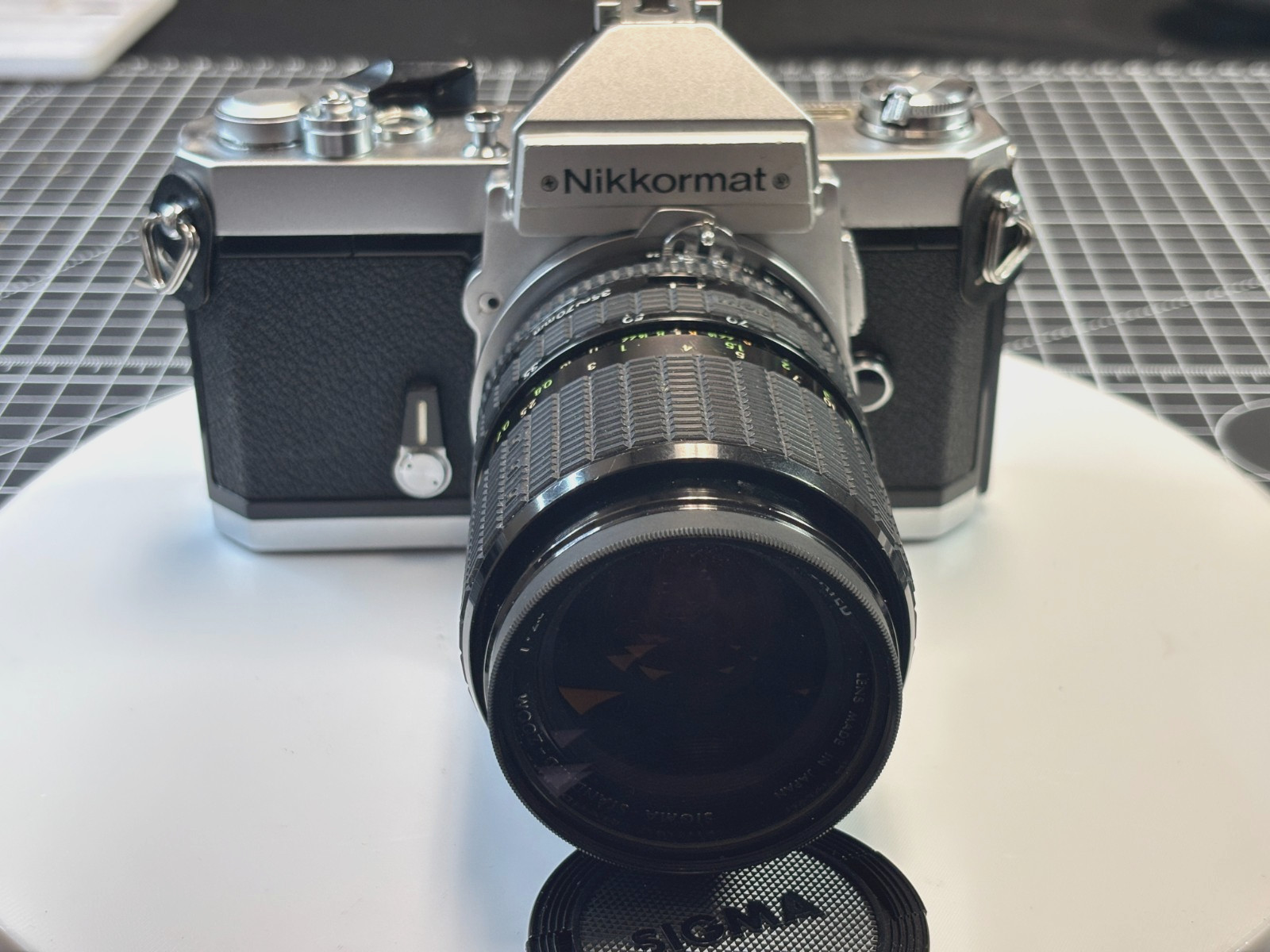
NIKON NIKKORMAT FT2
The Nikon Nikkormat FT2 is a 35mm film single-lens reflex (SLR) camera produced by Nikon from 1975 to 1977. It represents a refined iteration of the earlier Nikkormat FT series, incorporating user-requested improvements such as a dedicated hot shoe and enhanced metering circuitry, while retaining the robust mechanical construction and F-mount compatibility that defined its predecessors.
Overview
Introduced in 1975, the Nikkormat FT2 was part of Nikon’s mid-tier line of SLR cameras, positioned beneath the professional-grade Nikon F and F2 models. Marketed under the "Nikkormat" brand in North America and select regions (while bearing the "Nikomat" name in Japan), the FT2 was designed for advanced amateur photographers and semi-professionals seeking reliable, fully mechanical operation with improved exposure metering. The camera succeeded the Nikkormat FTn and shared its core mechanical architecture, including a horizontally traveling cloth focal-plane shutter and Nikon’s renowned F-mount, ensuring compatibility with a vast array of Nikkor lenses.
One of the most significant updates in the FT2 was the replacement of the accessory shoe with a built-in ISO 518-compatible hot shoe, enabling direct connection of electronic flash units without the need for external sync cables. This change reflected the growing popularity of through-the-lens (TTL) flash metering and the shift toward integrated flash systems in the mid-1970s. Additionally, the FT2 featured an improved silicon photodiode (SPD) light meter with a slightly expanded sensitivity range and more stable performance under varying temperature and battery conditions compared to earlier models. The metering system utilized center-weighted average metering via a metering prism with a split-image rangefinder and microprism collar, providing accurate manual focusing and exposure guidance.
Despite its mechanical nature—lacking aperture-priority or shutter-priority automation—the FT2 offered a robust, dependable platform for photographers who valued manual control and mechanical redundancy. It was constructed with a die-cast brass top and bottom plate, a rugged chrome or black leatherette body covering, and featured a self-timer lever, depth-of-field preview, and mirror lock-up—features typically reserved for higher-end models. The FT2 was ultimately discontinued in 1977, succeeded by the Nikkormat EL series and later the Nikon FM, which began the transition toward more compact, lightweight mechanical SLRs.
Specifications
| Specification | Value |
| Type | 35mm SLR |
| Film Format | 35mm (135 cartridge) |
| Years Produced | 1975–1977 |
| Lens Mount | Nikon F-mount (with aperture lever; compatible with AI and pre-AI lenses) |
| Shutter | Horizontal-travel cloth focal-plane shutter; speeds 1 sec to 1/1000 sec, plus B (bulb) |
| Metering | Center-weighted average metering via silicon photodiode (SPD) |
| Exposure Modes | Manual exposure only (stop-down TTL metering) |
| Viewfinder | Fixed pentaprism with split-image rangefinder, microprism collar, and 0.90x magnification (50mm at infinity) |
| Dimensions | 148 × 91 × 50 mm; weight approx. 700 g (body only, no battery) |
Key Features
- Integrated Hot Shoe: First in the FT series to feature a built-in ISO 518 hot shoe for direct flash attachment, eliminating reliance on PC sync cables.
- Improved Metering Circuit: Utilized a more stable silicon photodiode (SPD) sensor with better low-light performance and reduced drift compared to earlier CdS meters.
- Fully Mechanical Shutter: Operable without batteries for all speeds except metering, ensuring functionality even with dead or missing batteries.
- Compatibility with AI and Pre-AI Lenses: Works with both pre-AI (meter coupling via aperture lever) and AI (Automatic Indexing) Nikkor lenses, though AI lenses require manual indexing on the FT2.
- Depth-of-Field Preview and Mirror Lock-Up: Professional-grade features enhancing focusing accuracy and reducing vibration during long exposures.
Historical Context
The Nikkormat FT2 was released during a transitional period in SLR development, as manufacturers began integrating electronic automation while maintaining mechanical reliability. Nikon faced increasing competition from Japanese rivals such as Canon (with the AE-1 on the horizon), Minolta (introducing the XD series), and Pentax (with the K1000 and ME), all of which were moving toward aperture-priority and eventually program modes. The FT2, however, remained steadfastly manual, appealing to photographers who preferred tactile control and mechanical simplicity.
Its release followed the success of the Nikkormat FTn and addressed one of the most common user complaints: the lack of a built-in flash sync terminal. By adding a hot shoe, Nikon brought the FT2 in line with contemporary expectations for mid-range SLRs. Despite its conservative design, the FT2 was well-received for its durability, accurate metering, and compatibility with Nikon’s extensive lens ecosystem. It served as a bridge between the fully mechanical Nikkormats and the upcoming generation of compact manual-focus cameras like the Nikon FM and FE, which would incorporate more modern features while retaining mechanical shutters.
Collectibility & Value
Today, the Nikkormat FT2 is regarded as a solid, collectible mechanical SLR, particularly among enthusiasts of vintage Nikon gear and those seeking a reliable, repairable film camera. While not as rare or highly sought after as the Nikon F2, the FT2 holds a niche appeal due to its robust build, manual operation, and historical significance as one of the last fully mechanical Nikkormats. In excellent working condition, prices typically range from $150 to $300 USD, depending on shutter accuracy, meter functionality, and cosmetic condition.
When purchasing an FT2, collectors should verify that the shutter fires consistently across all speeds, the light meter responds to light changes (requires a 1.35V PX625 or modern 1.5V 625A/SR625SW with compensation), and the film advance and rewind mechanisms operate smoothly. Common issues include degraded light seals, sticky shutter curtains (especially at 1/1000 sec), and worn leatherette. The meter’s reliance on mercury batteries (now obsolete) can lead to inaccurate readings if modern substitutes are used without voltage adjustment. However, due to the camera’s mechanical simplicity and widespread parts availability, repairs are generally straightforward for experienced technicians.
Similar Cameras
- Pentax K1000 – A fully mechanical 35mm SLR with similar manual operation and rugged build, popular among students and hobbyists.
- Canon FTb – A mechanical Canon SLR with stop-down metering and interchangeable viewfinders, competing directly in the same market segment.
- Minolta SRT-101 – Known for its advanced CLC (Contrast Light Compensation) metering and robust construction.
- Olympus OM-1 – A compact, fully mechanical SLR with excellent Zuiko lenses, offering a more portable alternative.
- Yashica FR-I – A Nikon F-mount-compatible SLR built under license, featuring similar mechanical controls and metering.
Repair & Maintenance
The Nikkormat FT2 uses a single 1.35V mercury PX625 battery (now obsolete) to power its silicon photodiode meter; modern replacements include the 1.5V alkaline 625A or silver oxide SR625SW, though the higher voltage may cause slight overexposure (adjustable via camera modification or exposure compensation). The shutter is fully mechanical and does not require batteries for operation. Common maintenance issues include deteriorated light seals (which should be replaced to prevent film fogging), sluggish shutter speeds due to dried lubricants, and inaccurate metering from aging components. The camera benefits from periodic CLA (clean, lubricate, adjust) servicing by a technician experienced in vintage Nikon equipment. Due to its modular design and parts commonality with other Nikkormat and Nikon F-series cameras, sourcing replacements is relatively straightforward.
eBay Listings



As an eBay Partner, we earn from qualifying purchases. This helps support our independent vintage technology research.
Service Manuals & Schematics
- Manual (1976) — archive.org
Related Models
- Nikon F-301 (1985-1990)
- Nikon F-401 (1987-1989)
- Nikon F-501 (1986-1986–1989)
- Nikon F (1959-1973)
- Nikon F100 (1999-2006)
- Alpa 6 (1948-1953)
- Agfa Agfaflex
- Agfa Ambiflex
- Agfa Easy
- Agfa Futura Af zoom