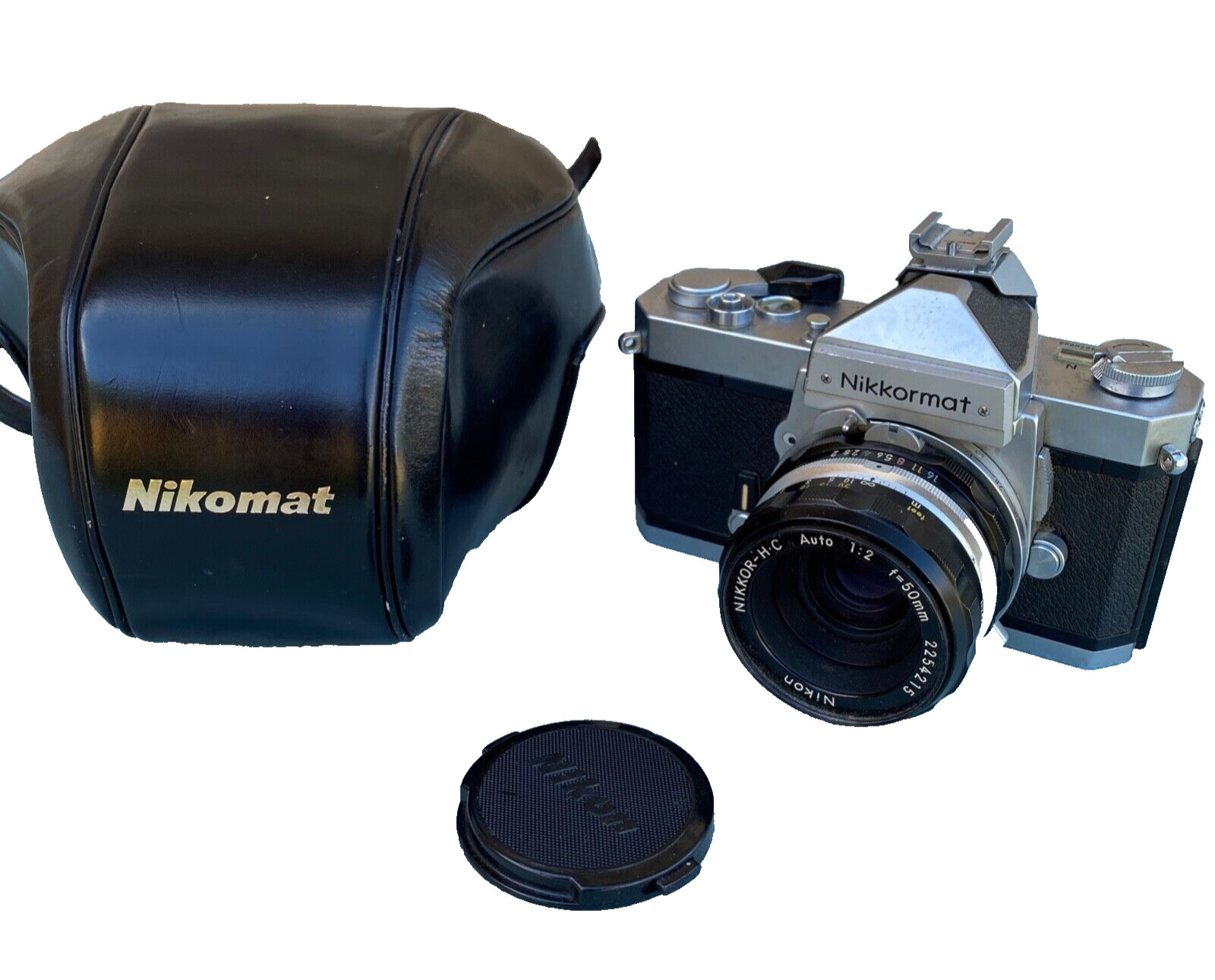
NIKON NIKKORMAT FT
The Nikon Nikkormat FT is a 35mm film single-lens reflex (SLR) camera introduced in 1965 as part of Nikon’s strategy to expand its market reach beyond the professional-grade Nikon F. Designed as a robust, all-mechanical SLR with built-in TTL metering, the FT offered advanced photographers a more affordable alternative to the flagship model while retaining many core features essential for precision photography.
Overview
Launched in October 1965, the Nikkormat FT was Nikon’s first serious foray into the mid-range 35mm SLR market, targeting advanced amateurs and semi-professional photographers who desired Nikon-quality optics and build but at a reduced cost compared to the Nikon F. Manufactured by Nippon Kogaku K.K. (the parent company of Nikon), the "Nikkormat" branding was used to distinguish these models from the flagship Nikon F series, although they shared the same F-mount lens compatibility. The FT was among the first Nikkormats and laid the foundation for a successful line of mechanical SLRs that would include the FTN, FT2, and EL series.
The Nikkormat FT featured a completely mechanical shutter and film transport system, requiring no batteries for operation except for the light meter. Its most notable innovation was the inclusion of through-the-lens (TTL) center-weighted metering using a Cadmium Sulfide (CdS) cell, which was relatively advanced for its time. However, metering required stop-down operation—lens aperture had to be manually closed to the shooting setting before metering could occur—meaning the viewfinder would darken during exposure evaluation. This was a trade-off for accurate metering across different lenses without the need for mechanical coupling found in later models.
Built with a rugged brass-top, die-cast aluminum chassis and leatherette covering, the FT exuded durability and precision engineering. It accepted the full range of Nikon F-mount lenses, including Nikkor AI and non-AI types (with stop-down metering), making it highly versatile. The camera featured a fixed pentaprism eye-level viewfinder with a split-image rangefinder focus aid and microprism collar, providing reliable manual focusing. With its combination of mechanical reliability, lens compatibility, and integrated metering, the Nikkormat FT played a pivotal role in democratizing high-quality SLR photography during the mid-1960s.
Specifications
| Specification | Value |
| Type | 35mm Single-Lens Reflex (SLR) |
| Film Format | 35mm (135 film), interchangeable frames via removable back |
| Years Produced | 1965–1967 |
| Lens Mount | Nikon F-mount (non-AI, requires stop-down metering) |
| Shutter | Horizontal-travel, cloth focal-plane shutter; speeds from 1 sec to 1/1000 sec, plus Bulb |
| Metering | TTL center-weighted CdS meter with stop-down operation |
| Exposure Modes | Manual only (shutter speed and aperture set manually) |
| Viewfinder | Fixed pentaprism with split-image rangefinder and microprism collar, 0.92x magnification, 94% coverage |
| Dimensions | 148 × 92 × 57 mm (5.8 × 3.6 × 2.2 in); ~705 g (24.9 oz) body only |
Key Features
- Stop-down TTL CdS metering: Enabled accurate exposure readings through the lens, though required manual aperture closure prior to metering.
- Fully mechanical operation: Shutter and film advance functioned without batteries; only the light meter required power (one 1.35V mercury PX625 battery).
- Nikon F-mount compatibility: Supported a wide array of Nikkor lenses, including pre-AI types, enhancing system flexibility.
- Durable construction: Brass-top housing with aluminum chassis and reinforced lens mount ensured longevity and resistance to wear.
- Flash sync at all speeds: X-sync available at 1/125 sec (marked "X"), with PC sync terminal and hot shoe for flash connectivity.
Historical Context
The Nikkormat FT was introduced during a period of rapid growth in the 35mm SLR market, driven by increasing consumer demand for interchangeable-lens cameras with built-in metering. Nikon, having established its reputation with the professional Nikon F (1959), sought to capture a broader audience without diluting its engineering standards. The FT was thus engineered to deliver core Nikon performance—precision optics, rugged build, and reliable mechanics—at a more accessible price point. It competed directly with models like the Pentax Spotmatic and Canon FX, both of which also featured TTL metering and M42 screw mounts.
Despite its mechanical sophistication, the FT's reliance on stop-down metering placed it a step behind some contemporaries that offered open-aperture metering. However, its F-mount compatibility gave it a significant advantage in lens ecosystem, particularly as Nikon’s Nikkor line gained acclaim for optical excellence. The FT was succeeded in 1967 by the Nikkormat FTN, which added instant-return mirror and improved meter coupling (allowing for AI-sensored lenses with modifications), signaling Nikon’s ongoing refinement of the mid-tier line. The FT itself was discontinued after only two years of production, contributing to its relative rarity today.
Collectibility & Value
The Nikkormat FT is a sought-after model among vintage camera collectors, particularly those interested in the evolution of Nikon’s SLR systems. Due to its short production run (1965–1967) and mechanical complexity, surviving examples in working condition are increasingly rare. Units with clean viewfinders, smooth shutter operation, and functional meters command premium prices, typically ranging from $250 to $500 USD depending on condition and provenance. Cameras with haze-free prisms, intact leatherette, and original accessories (such as the DK-2 eyepiece cup or case) are especially desirable.
When purchasing a Nikkormat FT, collectors should verify shutter accuracy across all speeds, check for mirror slap noise or sticking, and inspect the CdS meter cell for responsiveness. Common issues include degraded light seals (leading to light leaks), stiff film advance levers, and failed meter cells due to age or corrosion. The original PX625 mercury battery is no longer manufactured, so users must substitute with modern alkaline or silver-oxide equivalents (e.g., Wein Cell) or use adapters with voltage regulation to ensure accurate meter readings. Given the mechanical nature of the camera, regular cleaning and lubrication by a qualified technician are recommended for long-term reliability.
Similar Cameras
- Pentax Spotmatic (1964–1976)
- Canon FX (1964)
- Topcon RE Super (1963)
- Minolta SRT-101 (1966)
- Yashica TL Electro (1968)
Repair & Maintenance
The Nikkormat FT requires a 1.35V mercury PX625 battery for its CdS light meter; modern replacements include the Wein Cell (zinc-air) or MR-9/SR-625SW silver-oxide battery, though voltage differences may affect meter accuracy. The camera itself operates mechanically and does not require power for shutter or film advance. Common maintenance issues include sticky shutter curtains (especially at intermediate speeds), worn light seals, and degraded foam light traps around the film chamber. The stop-down metering linkage can become stiff or misaligned, requiring professional adjustment. Repair difficulty is moderate to high due to the precision mechanics and scarcity of replacement parts; however, experienced camera technicians familiar with vintage Nikon systems can typically service these units with proper tools and documentation. Regular CLA (Clean, Lubricate, Adjust) servicing every 5–10 years is recommended for consistent performance.
eBay Listings



As an eBay Partner, we earn from qualifying purchases. This helps support our independent vintage technology research.
Service Manuals & Schematics
- Manual (1976) — archive.org
Related Models
- Nikon F-301 (1985-1990)
- Nikon F-401 (1987-1989)
- Nikon F-501 (1986-1986–1989)
- Nikon F (1959-1973)
- Nikon F100 (1999-2006)
- Alpa 6 (1948-1953)
- Agfa Agfaflex
- Agfa Ambiflex
- Agfa Easy
- Agfa Futura Af zoom