NIKON NIKKORMAT ELW
The Nikon Nikkormat ELW is a 35mm single-lens reflex (SLR) camera introduced in 1976 as a minor but functionally significant update to the Nikkormat EL. Designed for advanced amateur and semi-professional photographers, the ELW added motor drive compatibility to the existing aperture-priority automatic exposure system, enhancing its utility for action and reportage photography.
Overview
The Nikkormat ELW was released during a transitional period for Nikon, as the company consolidated its professional F-series branding while continuing to market consumer-oriented SLRs under the Nikkormat name in select regions. The ELW was essentially a refined version of the Nikkormat EL, first introduced in 1972, and shared its core electronic aperture-priority autoexposure system and compact chassis. However, the "W" in ELW stood for winder, indicating its newly added compatibility with the Nikon MD-110 motor drive unit—a feature absent in the original EL. This enhancement allowed continuous shooting at approximately 2.5 frames per second, a notable improvement for its class.
Targeted at photographers seeking automation without sacrificing mechanical reliability, the ELW occupied a mid-tier position in Nikon’s lineup, bridging the gap between fully manual models like the Nikkormat FT3 and more advanced electronic bodies such as the Nikkormat EL2. It retained the robust all-metal chassis, horizontal cloth-curtain focal-plane shutter, and Nikon F-mount compatibility with AI (Automatic Indexing) lenses introduced in 1977. Despite its short production run, the ELW represented a final evolution of the Nikkormat series before Nikon phased out the brand in favor of unified Nikon-badged models.
Specifications
| Specification | Value |
| Type | 35mm Single-Lens Reflex (SLR) |
| Film Format | 35mm (135 cartridge) |
| Years Produced | 1976–1977 |
| Lens Mount | Nikon F-mount with AI coupling (supports pre-AI and AI lenses) |
| Shutter | Horizontal-travel cloth focal-plane shutter; speeds 1–1/1000 sec, B, X-sync at 1/125 sec |
| Metering | TTL full-aperture center-weighted metering via silicon photodiode |
| Exposure Modes | Aperture-priority autoexposure; stop-down manual mode via AE lock |
| Viewfinder | Fixed pentaprism with 0.92x magnification, 94% coverage; split-image rangefinder spot with microprism collar |
| Dimensions | 144 mm (W) × 93 mm (H) × 48 mm (D); approx. 610 g (body only, no battery) |
Key Features
- Motor Drive Compatibility: First Nikkormat model equipped with MD-110 motor drive coupling, enabling 2.5 fps continuous shooting.
- Aperture-Priority Automation: Simplified exposure control with automatic shutter speed selection based on user-set aperture.
- AI Lens Support: Fully compatible with Nikon’s AI-spec lenses for automatic maximum aperture indexing and stop-down metering.
- Electronic Shutter Control: Precision timing via cadmium-sulfide (CdS) meter cell and integrated circuitry, powered by two 1.5V SR44 batteries.
- Stop-Down Metering: Manual exposure possible via AE lock button, allowing use with non-AI lenses and precise depth-of-field preview.
Historical Context
The Nikkormat ELW was introduced in 1976, a year before Nikon officially discontinued the Nikkormat brand in most markets. Its release coincided with the broader industry shift toward automation and electronic integration in SLR design. While Nikon’s professional F2 series remained fully mechanical, consumer models increasingly adopted electronic shutters and aperture-priority systems to appeal to advanced amateurs. The ELW’s addition of motor drive support reflected growing demand for faster shooting capabilities, particularly in photojournalism and sports photography, where rapid frame advancement was becoming essential.
Competitors at the time included the Canon AE-1 (released in 1976), which featured shutter-priority automation and a built-in exposure meter but lacked motor drive options in its base configuration. The Minolta XE and Pentax ESII offered similar aperture-priority functionality but did not integrate motor winders as seamlessly. Despite its technical merits, the ELW had limited market impact due to its brief production span and the concurrent rebranding of Nikon’s consumer line. By 1978, the Nikkormat name was retired, and models like the Nikon EM and FE assumed its market position.
Collectibility & Value
The Nikkormat ELW is a relatively rare model due to its short two-year production run and limited geographical distribution, particularly outside North America and Europe. As of 2024, working examples in good condition typically sell for $200–$350 USD, with higher prices for units accompanied by the original MD-110 motor drive or in mint cosmetic condition. Collectors value the ELW for its historical significance as the final evolution of the Nikkormat EL series and its unique winder capability, which distinguishes it from earlier EL models.
When purchasing an ELW, buyers should verify the functionality of the electronic shutter across all speeds, as aging capacitors and corroded battery compartments are common failure points. The CdS meter cell may also degrade over time, leading to inaccurate exposure readings. A functional battery compartment (originally using two 1.5V SR44 or equivalent PX625 batteries) is essential, and conversion kits to modern battery types are recommended. Additionally, ensure the motor drive coupling engages smoothly and that the shutter fires reliably when connected to an MD-110 unit. Lenses with AI modifications or native AI compatibility are advised for optimal metering performance.
Similar Cameras
- Canon AE-1 (1976): Shutter-priority SLR with TTL metering, programmable exposure (via optional AE-1 Program), and extensive lens ecosystem.
- Minolta XE-7 (1975): Aperture-priority and manual SLR with electronically controlled shutter and high build quality; known as XE in North America.
- Pentax ESII (1977): Aperture-priority SLR with silicon blue cell metering and support for K-mount lenses; offered stop-down manual mode.
- Olympus OM-2 (1975): Advanced aperture-priority OM-series SLR with off-the-film (OTF) metering and robust compact design.
- Nikon Nikkormat EL2 (1977): Immediate successor with improved electronics, LED exposure display, and better battery efficiency.
Repair & Maintenance
The Nikkormat ELW uses two 1.5V SR44 (or equivalent PX625) batteries housed in the base plate to power its electronic shutter and metering system. Due to the age of these cameras, original mercury batteries are obsolete, and modern alkaline or silver-oxide substitutes may cause voltage discrepancies. Battery adapters to 1.35V zinc-air or regulated 1.35V modules are recommended for accurate metering. Common issues include capacitor leakage in the circuit board, intermittent shutter firing, and worn shutter contacts. Cleaning the battery compartment and replacing degraded seals around the film door are essential maintenance steps. The motor drive coupling mechanism should be inspected for wear if used frequently. Repair requires intermediate-to-advanced skill due to the integration of electronic components and precision shutter timing; servicing by a technician experienced with vintage Nikon electronics is strongly advised.
eBay Listings
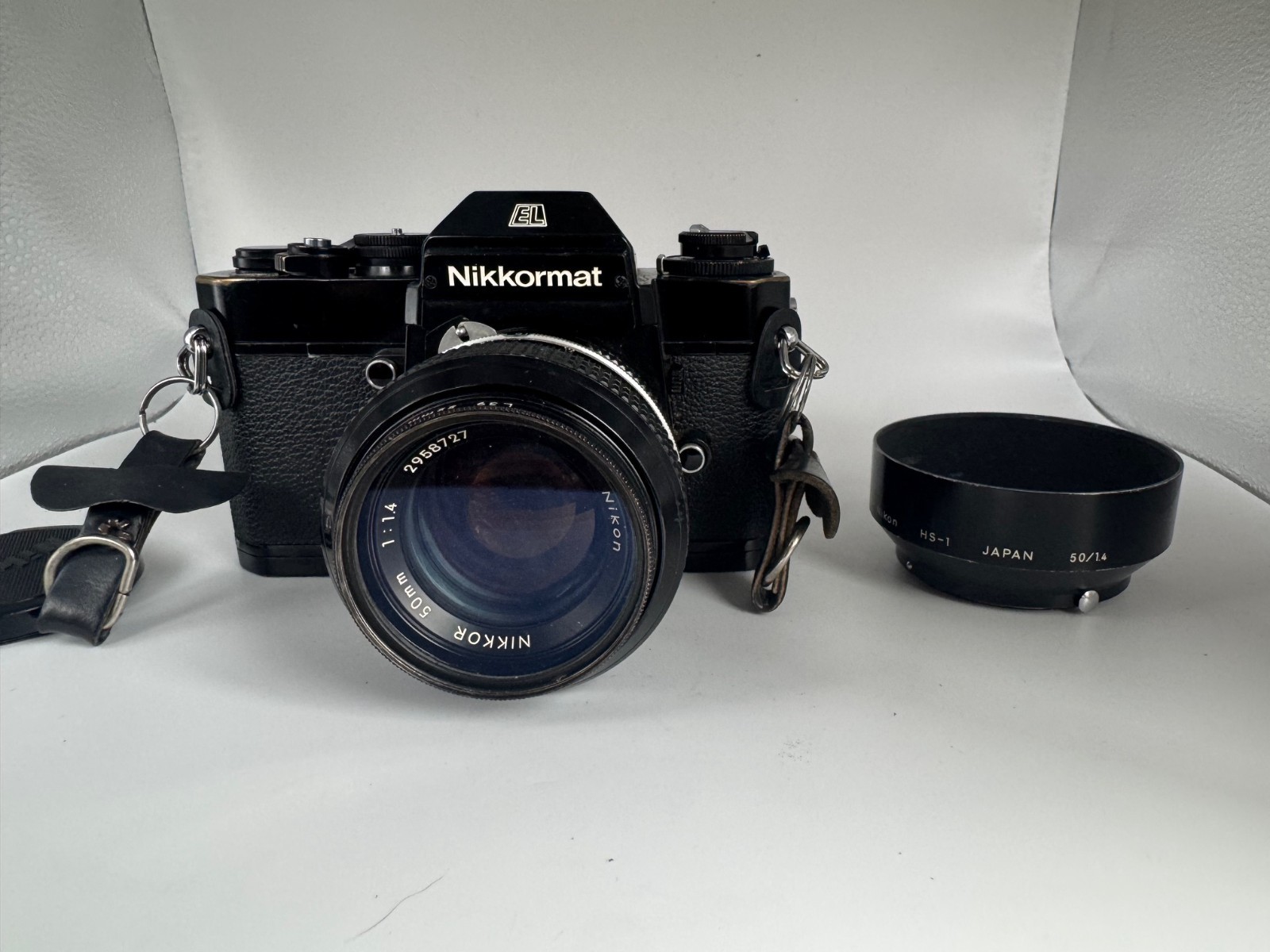
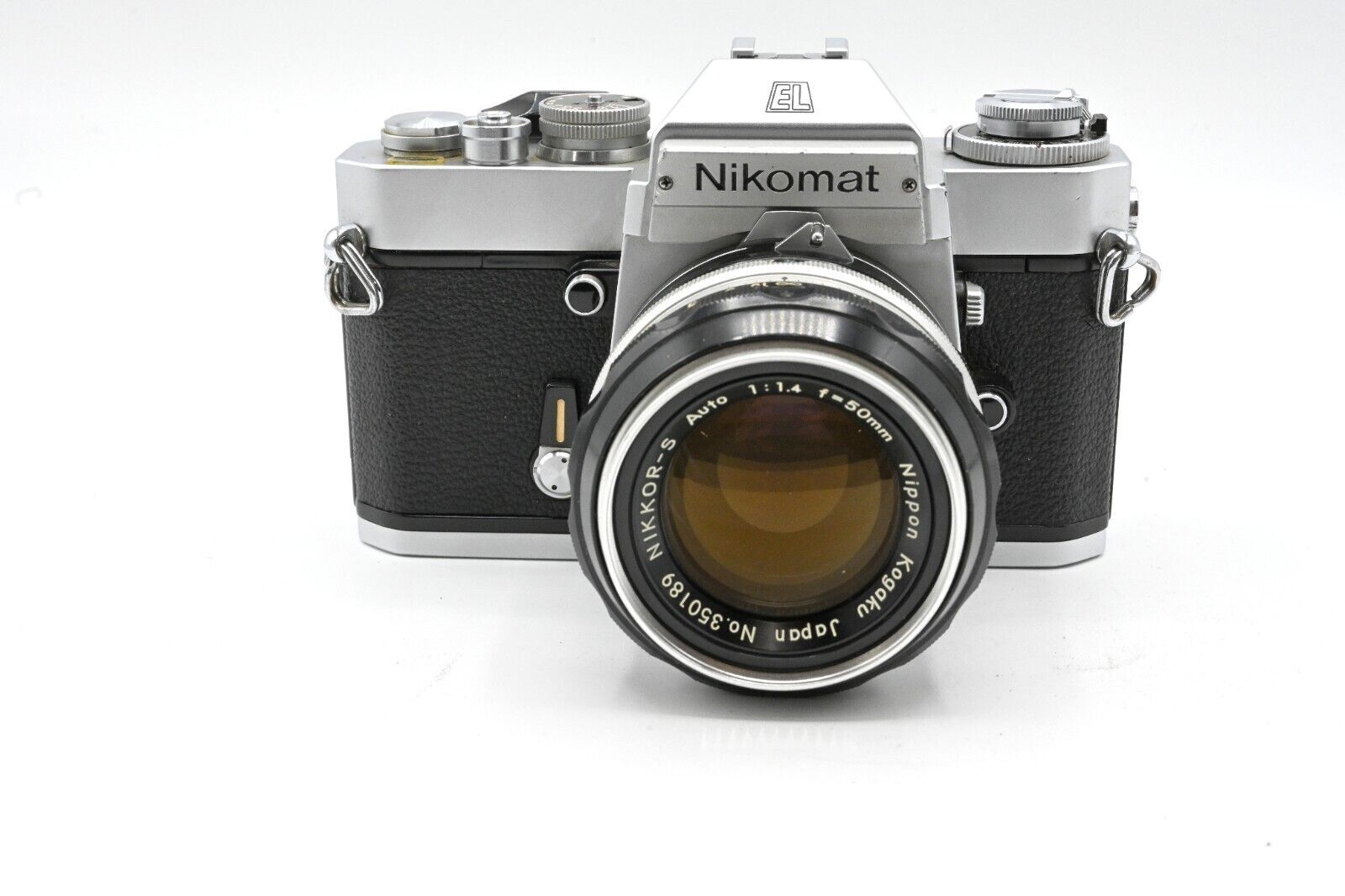


As an eBay Partner, we earn from qualifying purchases. This helps support our independent vintage technology research.
Related Models
- Nikon F-301 (1985-1990)
- Nikon F-401 (1987-1989)
- Nikon F-501 (1986-1986–1989)
- Nikon F (1959-1973)
- Nikon F100 (1999-2006)
- Alpa 6 (1948-1953)
- Agfa Agfaflex
- Agfa Ambiflex
- Agfa Easy
- Agfa Futura Af zoom