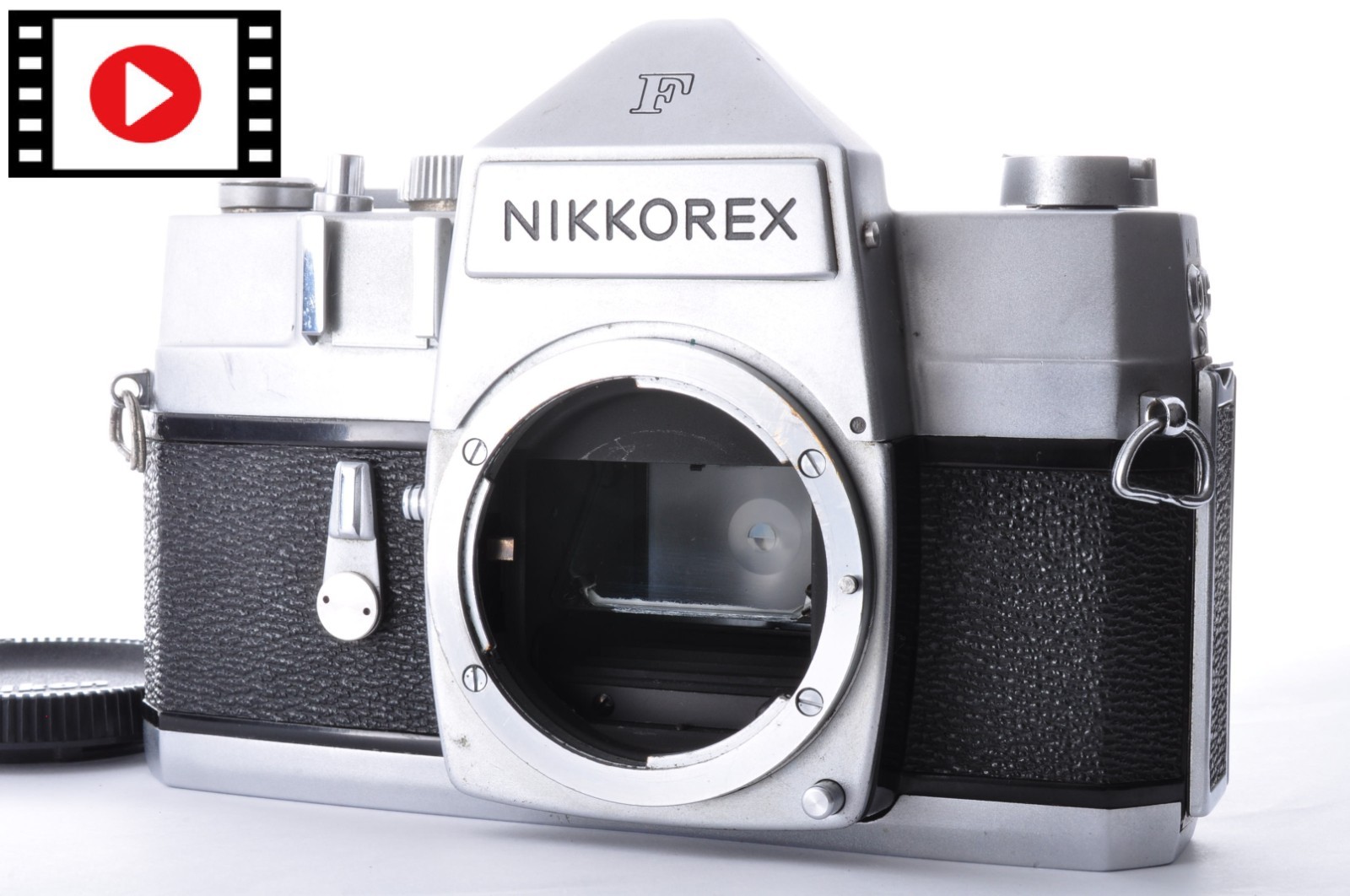
NIKON NIKKOREX F
The Nikon Nikkorex F is a 35mm single-lens reflex (SLR) camera produced by Nikon from 1962 to 1965 as an economical alternative to the high-end Nikon F. Designed to introduce photographers to the F-mount system at a lower price point, the Nikkorex F offered core Nikon functionality with simplified mechanics and a more accessible feature set.
Overview
Introduced in 1962, the Nikkorex F was Nikon’s first attempt at creating a budget-conscious SLR while maintaining compatibility with the rapidly expanding Nikon F lens ecosystem. Marketed primarily in North America and Europe, the Nikkorex F was manufactured not by Nikon directly, but by Mamiya under contract, a fact reflected in its mechanical design and construction. Despite its lower price, the camera retained the full F-mount, enabling use of Nikkor lenses, though with certain limitations in metering and aperture control compared to the flagship Nikon F.
The Nikkorex F targeted amateur photographers and students who desired access to Nikon’s professional-grade optics without the premium cost of the Nikon F body. It featured a vertically traveling focal-plane shutter with speeds from 1 second to 1/1000, a fixed pentaprism viewfinder with a split-image rangefinder, and a non-coupled selenium-cell light meter. Unlike the Nikon F, it lacked interchangeable focusing screens, a mirror lock-up, and a fully mechanical shutter at all speeds—limitations that underscored its positioning as an entry-level model.
Although short-lived, the Nikkorex F played a crucial role in expanding Nikon’s market reach during a period of intense competition with Japanese and European SLR manufacturers. It served as a conceptual precursor to later mid-tier Nikon models such as the Nikkormat series, which would eventually replace it in the lineup by 1965. The Nikkorex F was succeeded by the Nikkorex 3, Nikkorex 5, and ultimately phased out as Nikon transitioned to in-house production of more robust, feature-rich intermediate SLRs.
Specifications
| Specification | Value |
| Type | 35mm Single-Lens Reflex (SLR) |
| Film Format | 35mm (135 cartridge) |
| Years Produced | 1962–1965 |
| Lens Mount | Nikon F-mount (with meter coupling for pre-AI lenses) |
| Shutter | Vertical-travel focal-plane shutter; speeds 1 sec – 1/1000 sec, plus B |
| Metering | Built-in uncoupled selenium-cell meter (center-weighted) |
| Exposure Modes | Manual only; meter used as guide via needle visible in viewfinder |
| Viewfinder | Fixed pentaprism with split-image rangefinder and microprism collar; 0.85x magnification, ~94% coverage |
| Dimensions | 148 × 88 × 55 mm; weight ~640 g (body only, without battery or lens) |
Key Features
- Full Nikon F-mount compatibility: Enabled use of existing Nikkor lenses, a major selling point for photographers invested in the system.
- Vertical metal focal-plane shutter: Offered high-speed performance up to 1/1000 sec, uncommon in budget SLRs of the era.
- Integrated selenium-cell light meter: Required no battery and provided exposure guidance via a needle in the viewfinder, though not coupled to aperture.
- Split-image focusing screen: Improved manual focusing accuracy, a feature often omitted in entry-level models.
- Self-timer and flash sync (X and M contacts): Included standard accessories for creative and studio photography.
Historical Context
The early 1960s marked a pivotal shift in the 35mm SLR market, with Japanese manufacturers aggressively expanding their presence against established European brands like Contax and Leica. Nikon, having launched the professional Nikon F in 1959 to critical acclaim, sought to broaden its appeal beyond photojournalists and professionals. The Nikkorex F was Nikon’s strategic response—an affordable gateway into the F-mount universe.
Despite its Nikon branding, the Nikkorex F was engineered and assembled by Mamiya, leveraging their expertise in mechanical SLRs to reduce production costs. This outsourcing decision allowed Nikon to maintain quality while offering a lower price point. However, the camera faced stiff competition from contemporaries like the Pentax Spotmatic (introduced in 1964), which featured through-the-lens (TTL) metering, and the Topcon RE Super, which offered advanced optics and build quality. The Nikkorex F’s uncoupled meter and lack of aperture-priority or shutter-priority modes limited its appeal as metering technology advanced.
Market reception was mixed. While praised for its solid build and Nikkor lens compatibility, critics noted its non-removable back (requiring film loading through the front), lack of a hot shoe, and the dim viewfinder compared to the Nikon F. By 1965, Nikon discontinued the Nikkorex line and introduced the Nikkormat F, a fully Nikon-designed intermediate SLR with improved ergonomics and metering, effectively superseding the Nikkorex F.
Collectibility & Value
Today, the Nikon Nikkorex F is a niche collectible, valued more for its historical significance than practical use. Fewer than 30,000 units were produced during its three-year run, contributing to its relative rarity. Well-preserved examples with functioning selenium meters and original lenses (such as the 50mm f/2 Nikkor-S or f/1.4 Nikkor-S) can fetch between $400 and $800 in the collector’s market, depending on condition and provenance.
When purchasing a Nikkorex F, collectors should inspect the selenium meter for degradation—a common issue in vintage cameras—though the meter’s uncoupled nature means the camera remains functional even if the meter fails. Other concerns include shutter accuracy at high speeds, mirror movement smoothness, and light seals, which often need replacement after decades. The camera does not require batteries for operation (the meter is selenium-powered), making it fully mechanical and suitable for film use with proper servicing.
Due to its Mamiya origins, parts are not interchangeable with Nikon F or Nikkormat models, complicating repairs. As such, intact, working examples are preferred. The Nikkorex F is particularly sought after by Nikon historians and collectors of transitional Japanese SLRs, representing a brief but important chapter in Nikon’s evolution from professional-only to mass-market appeal.
Similar Cameras
- Pentax Spotmatic (1964) – TTL metering, M42 screw mount, highly influential amateur SLR.
- Canon FX (1964) – Canon’s first 35mm SLR with through-the-lens metering.
- Topcon RE Super (1963) – Advanced Japanese SLR with TTL metering and high-quality lenses.
- Yashica Pentamatic (1959) – Early Japanese SLR with M39 and M42 mounts.
- Praktica FX3 (1965) – East German SLR with M42 mount and robust mechanical design.
Repair & Maintenance
The Nikkorex F requires no batteries for shutter operation; the selenium-cell light meter functions without external power but may lose sensitivity over time due to oxidation. Shutter maintenance is critical—common issues include inconsistent speeds at 1/500 and 1/1000 sec, often due to dried lubricants or blade tension loss. The cloth focal-plane shutter is susceptible to wear, especially if the camera has been stored improperly.
The self-timer mechanism and film advance lever are prone to stiffness and may require disassembly and cleaning. The non-removable film back complicates loading and increases the risk of dust ingress, so careful handling is advised. Replacement light seals and routine CLA (clean, lubricate, adjust) servicing by a technician experienced in vintage SLRs are recommended for regular use. Due to limited parts availability and the camera’s semi-orphan status, preservation of original components is essential.
eBay Listings


As an eBay Partner, we earn from qualifying purchases. This helps support our independent vintage technology research.
Service Manuals & Schematics
- Manual (1962) — archive.org
Related Models
- Nikon F-301 (1985-1990)
- Nikon F-401 (1987-1989)
- Nikon F-501 (1986-1986–1989)
- Nikon F (1959-1973)
- Nikon F100 (1999-2006)
- Alpa 6 (1948-1953)
- Agfa Agfaflex
- Agfa Ambiflex
- Agfa Easy
- Agfa Futura Af zoom