Nikon L35AF (1983–1985)
A compact autofocus 35mm camera with a Sonnar-type lens and infrared autofocus, Nikon’s first fully automatic compact.
Overview
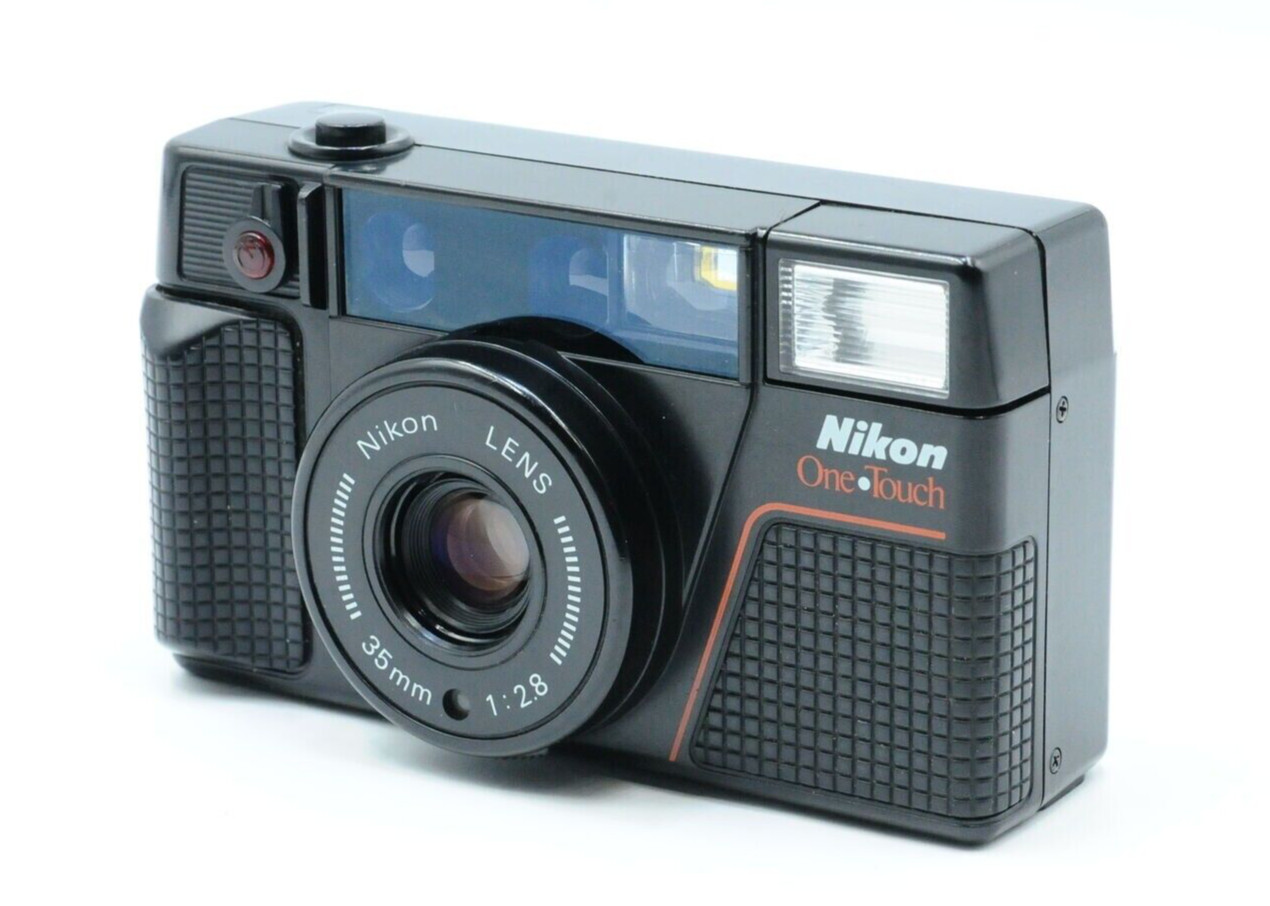
The Nikon L35AF is a compact autofocus 35mm camera produced from 1983 to 1985. It was Nikon’s first fully automatic compact camera, marking the company’s entry into the growing point-and-shoot market. Known internally as the “pikaichi” or “number-one,” it features a 35mm f/2.8 modified Sonnar lens and an infrared rangefinder autofocus system. The body shell was designed by famed industrial designer Giorgetto Giugiaro, giving it a distinctive, angular profile. It was the first model in the Nikon L series, followed by variants like the L35AD and the waterproof L35AWAF.
Specifications
| Lens | 35mm f/2.8 modified Sonnar design |
| Lens construction | 5 elements in 4 groups |
| Minimum focus distance | 80cm |
| Filter thread | 46mm filter thread |
| Film ISO/ASA range | 50 to 1000 |
| Light meter | fully automatic CdS light meter |
| Exposure range | EV 6 to EV 17 |
| Exposure example at ISO 100 | 1/8 sec. with f/2.8 through to 1/430 sec. with an aperture of f/17.5 |
| Backlight compensation | +2.0 exposure compensation |
| Flash guide number | 10 (ISO 100, m) |
| Flash range | 0.7m to 4.0m depending on film speed |
| Viewfinder type | Reverse-Galilean Albada-type bright frame viewfinder |
| Viewfinder coverage | 85% coverage |
| Viewfinder magnification | 0.52x magnification |
| Viewfinder display | scale with icons to display focusing distance |
| Batteries | 2 AA batteries |
| Battery life | 100 rolls without flash, 10 rolls with flash every frame |
| Power switch | situated around the shutter-button |
| Self-timer | a self-timer lever |
| Autofocus system | infrared rangefinder |
| Film handling | Film is advanced and rewound automatically. |
| Film loading | Automatic film loading. |
| Body construction | plastic chassis with metal back |
| Dimensions | 124 x 73 x 46 mm |
| Weight | 345g |
Design
The lens uses a modified Sonnar design, adapted from a longer Sonnar configuration, and is noted for delivering a distinct rendering compared to the Tessar-style lenses common in compact cameras of the era. The CdS light meter is mounted inside the filter thread, allowing accurate exposure readings even when using filters. The body shell was designed by Giorgetto Giugiaro, contributing to its clean, functional aesthetic. Nikon nicknamed the camera “pikaichi,” meaning “number-one,” reflecting its flagship status in the new L series.
Context
The L35AF was Nikon’s first fully automatic compact camera, introduced in 1983 as the company entered a market already populated by Canon, Minolta, and others. It launched the Nikon L series, which included the L35AD (with date-back) and later the waterproof L35AWAF in 1986. Despite arriving later than competitors, the L35AF gained a strong reputation for its lens quality and build. It was succeeded in 1985 by the L35AF2.
Market
The L35AF has gained cult status among collectors, with prices rising significantly over time. The L35AD variant is often less expensive, as collectors favor the original L35AF. A known weakness is the power switch around the shutter button, which can fail with age. Older units may suffer from higher power consumption due to battery compartment corrosion. Common issues also include erratic operation, though some repairs—like cleaning battery contacts with vinegar—are documented and straightforward.
eBay Listings



As an eBay Partner, we earn from qualifying purchases. This helps support our independent vintage technology research.