NIKON FM
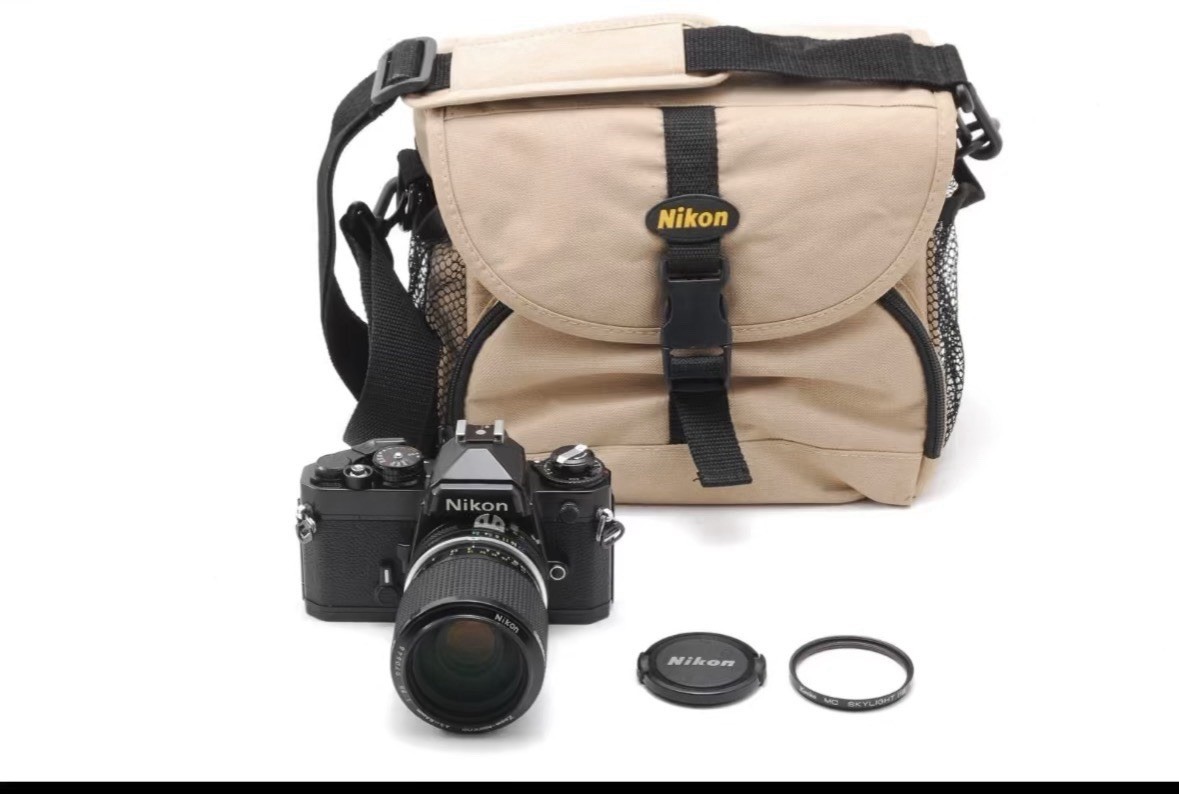
The Nikon FM is a compact, all-mechanical 35mm film SLR camera introduced in 1977 as part of Nikon’s push to offer a lightweight, durable, and precision-built manual-focus camera for advanced amateurs and professionals seeking a secondary or travel body. Renowned for its rugged brass-and-steel construction and reliable mechanical operation, the FM became a benchmark in mechanical SLR design.
Overview
The Nikon FM was launched during a transitional period in photographic technology, when electronic automation was beginning to dominate the SLR market. In contrast, the FM was engineered as a minimalist, user-focused mechanical camera, emphasizing reliability, tactile control, and long-term durability. It was designed to complement Nikon’s professional F2 while offering a more compact and affordable alternative for photographers who preferred manual exposure control without electronic dependency.
Built with a machined brass chassis and stainless steel top and bottom plates, the FM weighs approximately 590 grams (body only), making it significantly lighter than the F2 while retaining exceptional build quality. The camera features a vertically-traveling, focal-plane cloth shutter with speeds from 1 to 1/1000 second, plus Bulb mode. The Nikon FM uses a cadmium sulfide (CdS) photometer for TTL center-weighted metering, not a silicon photodiode (SPD)., offering center-weighted metering through the lens (TTL) with a 60/40 emphasis on the central 12mm diameter of the frame.
The FM was part of Nikon’s "compact F-series" alongside the FE (electronically controlled) and later the FM2. It was aimed at serious photographers who valued mechanical simplicity, reliability in extreme conditions, and compatibility with Nikon’s extensive F-mount lens ecosystem. Its conservative design ensured long service life, and many FM bodies remain functional today, over four decades after production ended in 1982.
Specifications
| Specification | Value |
| Type | 35mm Manual Focus SLR |
| Film Format | 35mm (135) |
| Years Produced | 1977–1984 |
| Lens Mount | Nikon F-mount (with mechanical aperture linkage) |
| Shutter | Vertical-travel cloth focal-plane; 1–1/1000 sec + B |
| Metering | TTL center-weighted CdS metering with 60/40 center weighting |
| Exposure Modes | Manual only (stop-down metering) |
| Viewfinder | Fixed pentaprism, 0.82x magnification, 94% coverage |
| Dimensions | 140 × 85 × 50 mm; ~590 g (body only, no battery) |
Key Features
- All-mechanical operation: No batteries required for shutter function; only needed for light meter (1.35V 1.35V PX625 or equivalent).
- Precision center-weighted TTL metering: Uses a silicon photodiode cell linked to a match-needle system in the viewfinder for accurate exposure.
- Compact and durable build: Machined brass chassis with stainless steel casing, offering professional-grade resilience in a smaller form factor.
- Fully mechanical shutter speeds: Shutter operates at all speeds without batteries; meter requires power.
- Nikon F-mount compatibility: Supports AI and pre-AI lenses with full metering when used in stop-down mode; AI lenses enable open-aperture metering.
Historical Context
The Nikon FM was introduced in 1977 at a time when camera manufacturers were rapidly adopting electronic automation. Competitors like Canon (AE-1), Minolta (XD-11), and Pentax (ME) were pushing electronic aperture-priority or shutter-priority models. In contrast, the FM stood apart as a mechanical purist’s tool, appealing to photographers who distrusted early electronics or needed a dependable backup camera.
Nikon positioned the FM as a high-quality, compact alternative to the flagship F2, targeting enthusiasts, travelers, and professionals needing a lightweight second body. It shared the F2’s core engineering philosophy—robustness, precision, and compatibility—but in a scaled-down, more accessible package. The FM was succeeded by the FM2 in 1982, but the FM remained in production alongside the FM2 until 1984., which featured a faster 1/4000 sec shutter and improved metering, but the original FM remained popular for its simplicity and reliability.
The FM’s release also coincided with the introduction of Nikon’s AI (Aperture Indexing) lens standard, allowing automatic transmission of aperture data to the meter. While the FM works with both AI and pre-AI lenses, AI lenses provide smoother operation and open-aperture metering. This compatibility ensured the FM remained relevant as Nikon transitioned its lens lineup.
Collectibility & Value
The Nikon FM is widely respected among film photography enthusiasts for its durability, mechanical reliability, and compatibility with Nikon F-mount lenses. In good working condition, FM bodies typically sell for $150–$300 USD, with prices varying based on shutter accuracy, meter functionality, and cosmetic condition. Fully functional meters are a key determinant of value, as replacement or repair of the original PX625 mercury battery-dependent circuit can be challenging.
When purchasing an FM, buyers should verify that the shutter fires consistently at all speeds, the mirror movement is smooth, and the light meter responds accurately (adapting to modern silver-oxide or Wein cell replacements). Common issues include stiff shutter curtains from dried lubricant, inaccurate metering due to aging components, and worn shutter speed timing at extremes (especially 1 sec and 1/1000 sec). The camera uses a single 1.35V mercury battery (PX625), though modern equivalents like the WeinCell 1.35V or adapters for 1.5V silver-oxide (MR-9 or PX625S) are used with slight meter calibration adjustments.
Due to its mechanical nature and widespread service support, the FM is relatively easy to maintain. However, originality and low shutter count can significantly enhance collectibility. Cameras with original finish, unblemished viewfinders, and clean film backs are particularly sought after.
Similar Cameras
- Canon FTb: Mechanically robust 35mm SLR with stop-down metering, popular among enthusiasts.
- Pentax K1000: Entry-level mechanical SLR, simpler than the FM but widely used in education.
- Olympus OM-1: Compact, precision-built mechanical SLR with excellent viewfinder and lightweight design.
- Minolta SRT-101: Known for Color Metering System (CdS) and robust build, a strong competitor in the 1970s.
- Yashica FR-I: Mechanical SLR with Nikon F-mount compatibility and reliable Copal shutter.
Repair & Maintenance
The Nikon FM requires a 1.35V PX625 mercury battery for its light meter, though modern alternatives like the WeinCell MRB625 (1.35V) or hearing-aid batteries (with voltage adjustment considerations) are commonly used. The mechanical shutter operates independently of battery power, making the camera functional even with a dead meter.
Common maintenance issues include sluggish shutter speeds due to dried lubricants, inaccurate metering from aging circuitry, and worn shutter cloth. The Copal Square-S shutter mechanism is serviceable but requires expertise to disassemble and recalibrate. Regular CLA (Clean, Lubricate, Adjust) by a technician experienced with Nikon mechanical SLRs is recommended every 5–10 years for frequent users.
The FM’s mechanical simplicity and widespread parts availability make it one of the most repairable vintage SLRs. However, the meter’s dependency on obsolete battery chemistry means some users retrofit modern solutions or accept manual exposure using external meters. Overall, the FM remains a durable, repairable, and highly usable camera for film photographers seeking mechanical reliability and precision engineering.
eBay Listings



As an eBay Partner, we earn from qualifying purchases. This helps support our independent vintage technology research.
Related Models
- Nikon F-301 (1985-1990)
- Nikon F-401 (1987-1989)
- Nikon F-501 (1986-1986–1989)
- Nikon F (1959-1973)
- Nikon F100 (1999-2006)
- Alpa 6 (1948-1953)
- Agfa Agfaflex
- Agfa Ambiflex
- Agfa Easy
- Agfa Futura Af zoom