NIKON FE2
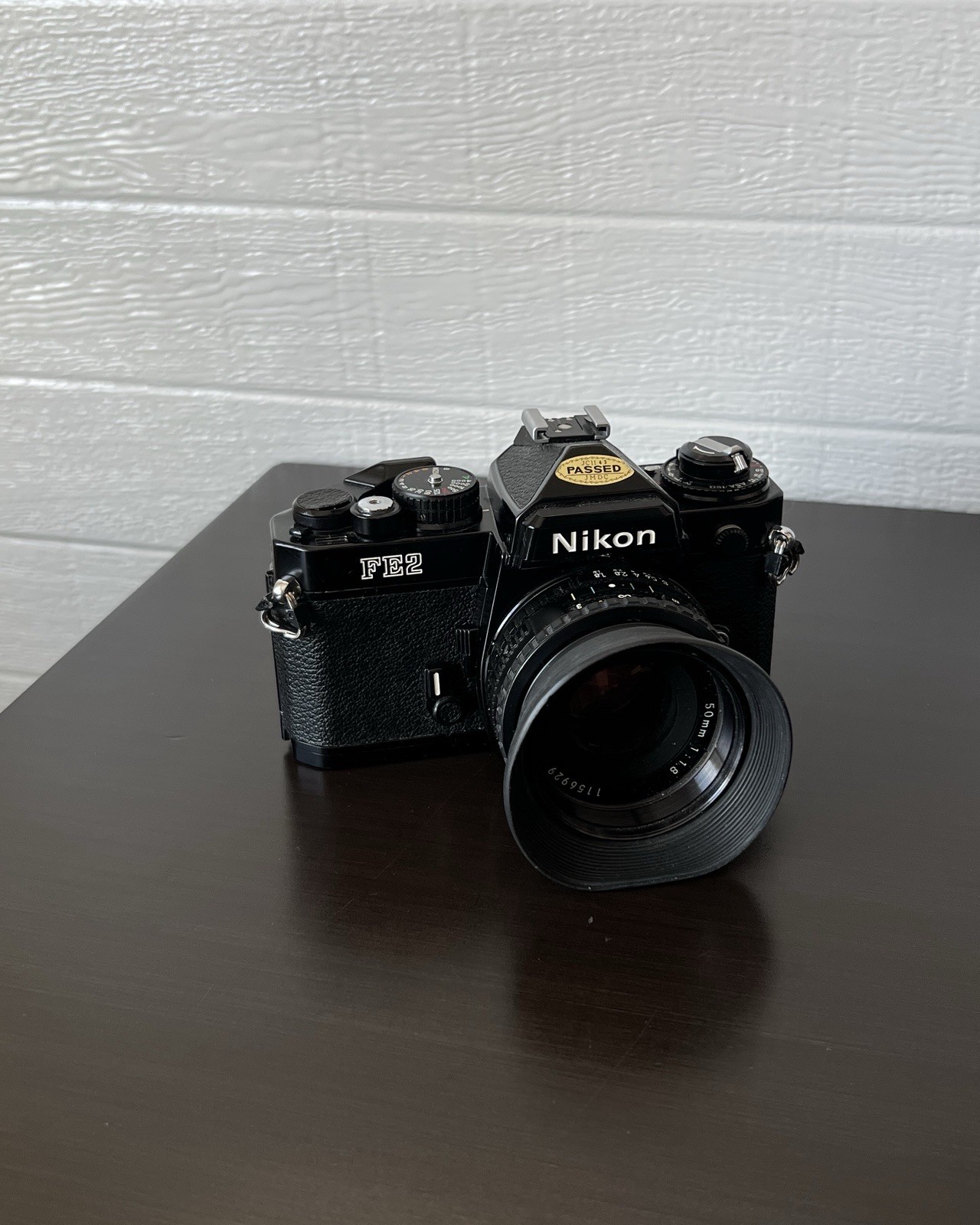
The Nikon FE2 is a mechanically dominant, electronically augmented 35mm film SLR camera introduced in 1983 as a successor to the highly regarded FE. Designed for advanced amateur and professional photographers, it combines robust mechanical construction with precise electronic exposure control, offering high-speed performance and reliable operation in a compact body.
Overview
Released in 1983, the Nikon FE2 was positioned as Nikon’s flagship manual-focus SLR for enthusiasts and working photographers who demanded mechanical reliability with enhanced electronic precision. It replaced the original FE, which had been in production since 1978, and represented a significant technological leap—particularly in shutter performance and flash synchronization. The FE2 was developed during a transitional period in camera design, bridging the gap between fully mechanical cameras like the FM2 and the emerging wave of automation-heavy models such as the F3 and later F-501. It retained the classic Nikon F-mount introduced in 1959, ensuring compatibility with a vast array of Nikon AI and AI-S lenses.
The FE2 was part of Nikon’s "compact F-series" lineup, which included the FM2 and FM2n, sharing their durable brass-and-copper shutter and rugged chassis construction. However, the FE2 distinguished itself with a more sophisticated metering system and broader shutter speed range. It targeted photographers who wanted aperture-priority automation alongside full manual control, making it ideal for both studio and field use. Its 1/4000s maximum shutter speed and 1/250s flash sync were class-leading at the time, particularly among non-professional bodies. The FE2 was manufactured until 1987, after which it was effectively superseded by the FE2’s minor update, the FE2t (a titanium shutter variant), and later by autofocus models in the late 1980s.
Specifications
| Specification | Value |
| Type | 35mm Film SLR |
| Film Format | 35mm (135) |
| Years Produced | 1983–1987 |
| Lens Mount | Nikon F-mount (AI and AI-S compatible) |
| Shutter | Vertical-travel, copper-alloy focal-plane shutter; speeds from 1s to 1/4000s, plus Bulb (B), with automatic exposure up to 1/2000s in aperture-priority mode |
| Metering | TTL (Through-The-Lens) center-weighted metering with silicon photodiode (SPD) sensor |
| Exposure Modes | Aperture-priority auto, manual exposure |
| Viewfinder | Fixed pentaprism with 0.92x magnification, 97% frame coverage, split-image rangefinder spot surrounded by microprism collar |
| Dimensions | 142 mm × 90 mm × 55 mm (5.6 in × 3.5 in × 2.2 in); weight: ~590 g (body only, without battery) |
Key Features
- 1/4000s shutter speed: At the time of release, this was the fastest maximum shutter speed available in a non-professional Nikon SLR, enabling precise control in bright conditions and with fast lenses.
- 1/250s X-sync speed: The highest flash sync speed in its class, allowing for better ambient light blending and use of wide apertures with flash.
- TTL center-weighted metering: Utilized a silicon photodiode for accurate exposure readings with AI and AI-S lenses, with a metering range of EV 2 to EV 17 (at ISO 100, f/1.4).
- Mechanical backup at 1/250s: In the event of battery failure, the camera retains a mechanical 1/250s shutter speed and Bulb mode, ensuring continued operation.
- Compact, durable construction: Built with a die-cast brass top and bottom plates, copper-alloy shutter, and rugged internal chassis, designed for long-term reliability.
Historical Context
The Nikon FE2 was introduced at a pivotal moment in photographic technology. The early 1980s saw rapid advancements in electronics, with manufacturers like Canon and Minolta moving toward autofocus and fully automated exposure systems. Nikon, however, maintained a strong commitment to manual-focus, mechanically robust cameras for photographers who valued precision and longevity. The FE2 was developed as a refined evolution of the FE, addressing limitations in shutter speed and flash performance while retaining the mechanical integrity that defined Nikon’s compact SLRs.
Competitors at the time included the Canon A-1 and AE-1 Program, which offered more automation but less rugged build quality. The Pentax ME-F and Olympus OM-4 also competed in the advanced amateur segment, but few matched the FE2’s combination of speed, durability, and optical quality. The FE2 was well-received by professionals and serious amateurs alike, praised for its balance of automation and mechanical reliability. It was particularly popular among photojournalists and travel photographers who needed a lightweight yet dependable camera. Despite the rise of autofocus, the FE2 remained in production until 1987, a testament to its enduring appeal.
Collectibility & Value
Today, the Nikon FE2 is highly regarded among film photography enthusiasts and collectors. Its combination of mechanical durability, high-speed performance, and classic design makes it a sought-after model in the vintage SLR market. Units in good working condition typically sell for $250–$400 USD, with exceptional examples (especially those with rare finishes or accessories) commanding higher prices. The FE2 is more collectible than the FM2n due to its aperture-priority automation and slightly more advanced metering system, though it is less rare than the titanium-shutter FE2t.
When purchasing an FE2, buyers should verify the functionality of the shutter across all speeds, particularly 1/4000s and 1/250s flash sync. Common issues include degraded light seals, sticky shutter curtains (especially if stored improperly), and weakened meter accuracy due to aging electronics. The camera uses two 1.5V SR44 or PX625 batteries (or modern equivalents like Wein Cell) for the meter and electronic shutter control. A non-functioning meter does not disable the camera—thanks to the mechanical 1/250s and Bulb modes—but accurate metering is essential for consistent results. Collectors should also check for originality, including the leatherette, prism seal, and lens mount condition.
Similar Cameras
- Canon AE-1 Program – A microprocessor-controlled 35mm SLR with shutter-priority and program modes, popular for its automation and affordability.
- Pentax ME Super – A compact aperture-priority SLR with a 1/1000s top shutter speed, known for its sleek design and ease of use.
- Olympus OM-4 – A professional-grade OM-series SLR with TTL metering, 1/2000s shutter, and exceptional build quality.
- Minolta X-700 – A feature-rich manual-focus SLR with program mode and TTL flash, widely used in photography education.
- Nikon FM2n – Mechanically identical in shutter design but lacks aperture-priority automation, favored by purists for its fully mechanical operation.
Repair & Maintenance
The Nikon FE2 uses two 1.5V silver-oxide batteries (SR44) or one 3V lithium battery (with adapter) to power the light meter and electronic shutter control. The original PX625 mercury battery is obsolete, so modern substitutes require voltage regulation to avoid overexposure. Common repair issues include degraded shutter foam, which can cause sticking at high speeds, and worn contacts in the battery compartment. The copper-alloy shutter is highly durable but can suffer from timing inaccuracies if not serviced regularly. Meter calibration is another frequent need, as the SPD sensor and associated circuitry may drift over time. Repairs should be performed by technicians experienced with Nikon’s F-series cameras, as the internal mechanisms are tightly integrated. Routine maintenance includes cleaning the mirror box, replacing light seals, and verifying shutter and aperture timing across all speeds.
eBay Listings



As an eBay Partner, we earn from qualifying purchases. This helps support our independent vintage technology research.
Related Models
- Nikon F-301 (1985-1990)
- Nikon F-401 (1987-1989)
- Nikon F-501 (1986-1986–1989)
- Nikon F (1959-1973)
- Nikon F100 (1999-2006)
- Alpa 6 (1948-1953)
- Agfa Agfaflex
- Agfa Ambiflex
- Agfa Easy
- Agfa Futura Af zoom