NIKON FE
The Nikon FE is a 35mm film single-lens reflex (SLR) camera introduced in 1978 as part of Nikon’s esteemed line of manual focus, electronically controlled SLRs. Designed for advanced amateur and professional photographers, the FE combines mechanical reliability with electronic aperture-priority automatic exposure and precise match-needle metering, offering a balanced blend of automation and manual control.
Overview
The Nikon FE was launched during a transitional period in photographic technology, when manufacturers were integrating electronic automation into traditionally mechanical cameras without sacrificing build quality or optical performance. Positioned between the fully mechanical Nikon FM and the more advanced, shutter-priority Nikon FE2 (released in 1983), the FE served as a technologically progressive yet conservatively engineered option for photographers seeking reliable automation in a compact, durable body. It was part of Nikon’s "compact F-series" lineup, sharing the same 130mm-wide chassis as the FM, but incorporating electronic shutter control and TTL metering circuitry.
The FE was aimed at serious photographers who wanted the convenience of aperture-priority autoexposure while retaining the ability to shoot mechanically at 1/200 sec (X-sync speed) in the event of battery failure. Its rugged brass-and-steel construction, interchangeable focusing screens, and compatibility with Nikon’s extensive F-mount lens ecosystem made it a favorite among photojournalists, travel photographers, and enthusiasts. The camera featured a vertically-traveling, electronically controlled metal-blade focal plane shutter, with speeds from 1 sec to 1/1000 sec, plus Bulb mode.
The FE’s metering system utilized a silicon photodiode (SPD) sensor located in the pentaprism housing, providing center-weighted TTL metering with a match-needle display in the viewfinder. This system, combined with the aperture-priority exposure mode, allowed photographers to set the desired aperture on the lens and let the camera automatically select the correct shutter speed. Manual exposure was also fully supported, with the needle indicating the recommended shutter speed.
Specifications
| Specification | Value |
| Type | 35mm Film SLR |
| Film Format | 35mm (135) |
| Years Produced | 1978–1983 |
| Lens Mount | Nikon F-mount (with AI coupling) |
| Shutter | Electronically controlled vertical-travel metal focal plane shutter; speeds 1 sec to 1/1000 sec, plus B (Bulb); mechanical backup at 1/200 sec |
| Metering | TTL center-weighted silicon photodiode (SPD) with match-needle display |
| Exposure Modes | Aperture-priority autoexposure, manual exposure |
| Viewfinder | Fixed pentaprism with 0.92x magnification, 97% coverage; interchangeable focusing screens |
| Dimensions | 140 × 91 × 50 mm (5.5 × 3.6 × 2.0 in); ~590 g (body only, without battery) |
Key Features
- Aperture-priority AE with match-needle metering: Enables precise exposure control with visual feedback via a single needle in the viewfinder.
- Electronic shutter with mechanical backup: Full electronic control from 1 sec to 1/1000 sec, with the ability to fire at 1/200 sec without batteries.
- AI (Automatic Indexing) lens compatibility: Direct coupling with AI and AI'd lenses for automatic maximum aperture transmission; also supports non-AI lenses with stop-down metering.
- Interchangeable focusing screens: Five optional screens available for different shooting needs (e.g., microprism, split-image, grid).
- Compact, rugged construction: Brass top and bottom plates, die-cast aluminum chassis, and weather-resistant sealing for durability in field conditions.
Historical Context
The Nikon FE was introduced in 1978 at a time when Japanese camera manufacturers were rapidly adopting electronic exposure systems while maintaining mechanical integrity. Competitors such as Canon (AE-1), Minolta (XD-11), and Pentax (ME Super) were pushing fully electronic, lightweight SLRs aimed at consumers, but Nikon targeted a more conservative, quality-focused market. The FE was not a mass-market camera; it was engineered for longevity, precision, and compatibility with professional lenses and accessories.
Compared to the Canon AE-1, which relied on a printed circuit board and lightweight body, the FE’s all-metal construction and conservative electronics emphasized reliability over automation. It shared its basic platform with the Nikon FM (manual shutter, fully mechanical), but added electronic shutter control and aperture-priority automation. The FE was succeeded in 1983 by the FE2, which featured a faster 1/4000 sec shutter and improved metering, but the original FE remained popular due to its simplicity and robustness.
Collectibility & Value
The Nikon FE is highly collectible today, valued for its build quality, classic design, and compatibility with modern Nikon DSLRs and mirrorless cameras via adapters. In good working condition, prices range from $250 to $450 USD, depending on shutter accuracy, light seals, and viewfinder clarity. Fully serviced examples with fresh light seals and calibrated metering command a premium.
Collectors and users should inspect for common issues such as slow shutter speeds (especially at 1 sec), inaccurate metering due to aging SPD sensors, and worn shutter curtains. The FE uses two 1.5V SR44 or PX625 mercury batteries (or modern equivalents with voltage adjustment), and using incorrect batteries can cause metering errors. The camera does not have an exposure compensation dial, so proper battery voltage is critical for accurate exposure. Lenses with AI modification or native AI design are recommended for full functionality.
Similar Cameras
- Canon FTb – Mechanically robust SLR with stop-down metering, popular among professionals.
- Pentax ME Super – Compact aperture-priority SLR with shutter speed display in viewfinder.
- Olympus OM-2 – Advanced aperture-priority OM-series camera with sophisticated center-weighted metering.
- Minolta X-700 – Feature-rich aperture-priority SLR with program mode and TTL flash.
- Nikon FM – Mechanically identical sibling to the FE but without electronic automation.
Repair & Maintenance
The Nikon FE requires two 1.5V SR44 or PX625 batteries (historically mercury PX625, now replaced by alkaline or zinc-air equivalents). Due to voltage differences, using modern substitutes may require a step-down adapter or meter recalibration. The most common failure points are shutter timing inaccuracies at slow speeds and degraded light seals, which should be replaced every 10–15 years to prevent light leaks and sticky mirror mechanisms. Metering circuits can degrade over time; recalibration by a specialist is recommended for critical work. Shutter repair and CLA (Clean, Lubricate, Adjust) services are routinely performed by experienced technicians, though original replacement parts are becoming scarcer. Overall, the FE is considered repairable and durable, with many units still functioning reliably after 40+ years.
eBay Listings
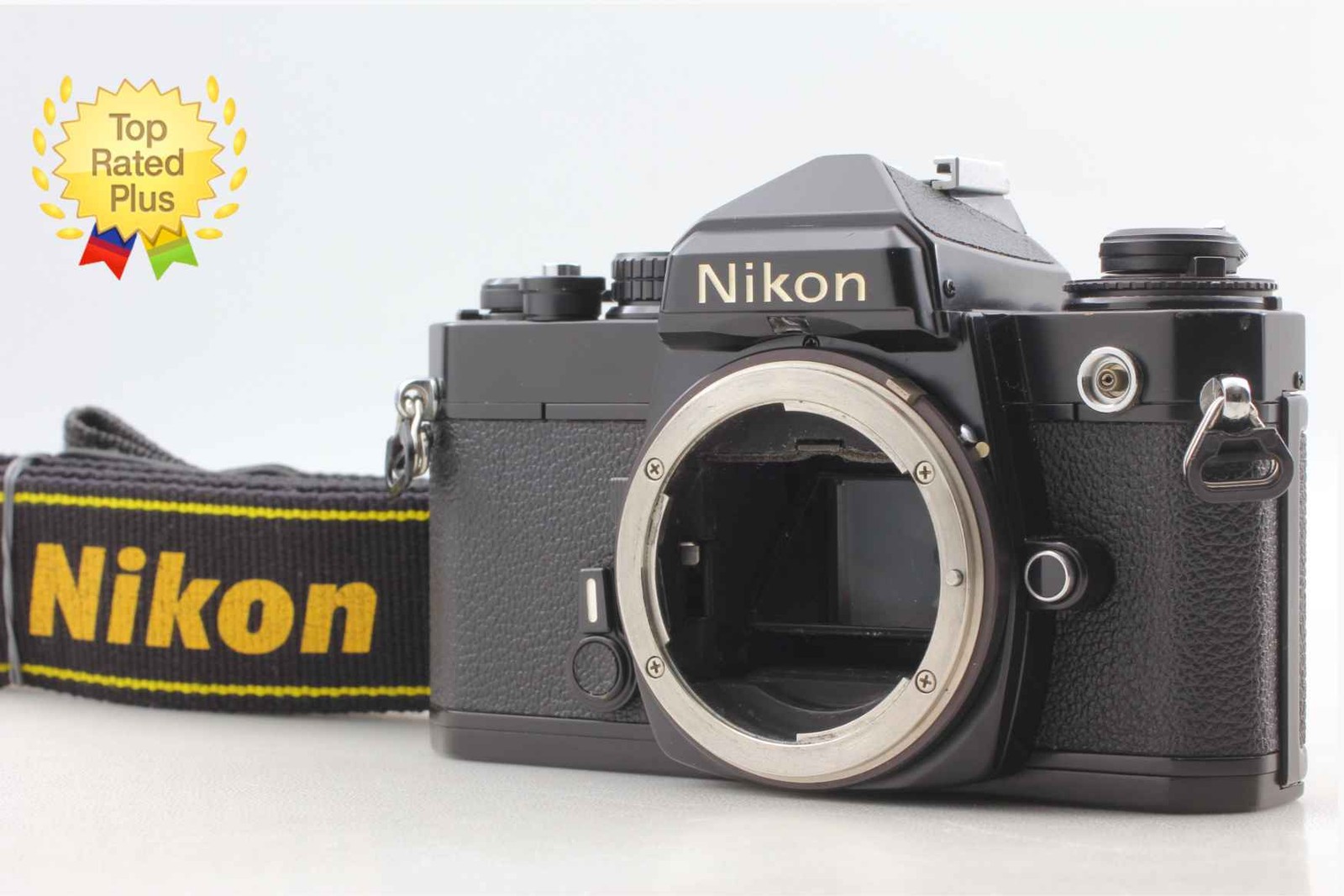


As an eBay Partner, we earn from qualifying purchases. This helps support our independent vintage technology research.
Related Models
- Nikon F-301 (1985-1990)
- Nikon F-401 (1987-1989)
- Nikon F-501 (1986-1986–1989)
- Nikon F (1959-1973)
- Nikon F100 (1999-2006)
- Alpa 6 (1948-1953)
- Agfa Agfaflex
- Agfa Ambiflex
- Agfa Easy
- Agfa Futura Af zoom