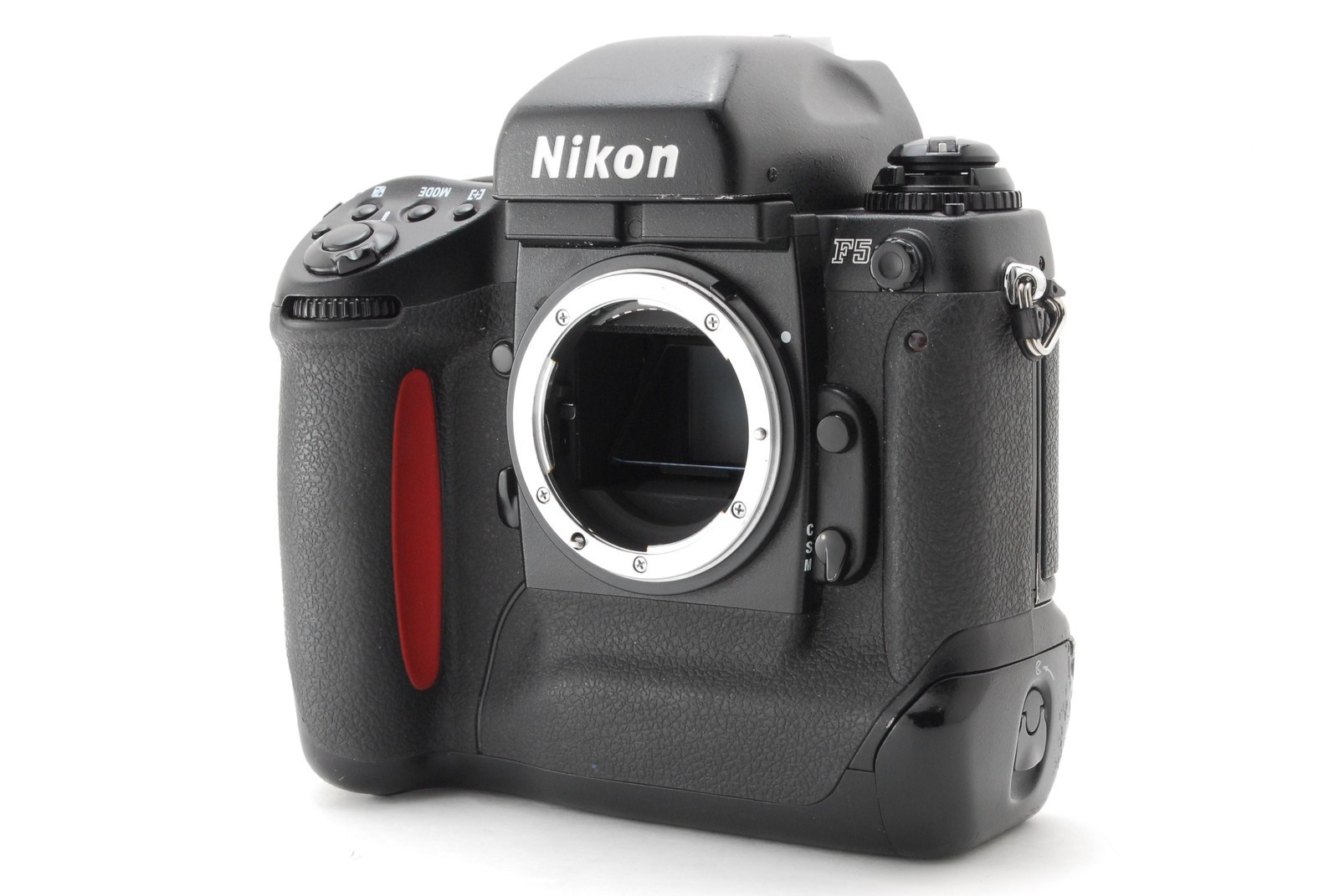
NIKON F5
The Nikon F5 is Nikon’s fifth-generation professional 35mm film SLR, introduced in 1996 as the flagship of the Nikon F-series line. Designed for photojournalists, sports photographers, and demanding professionals, the F5 combines advanced autofocus, rugged construction, and sophisticated metering in a high-speed body with integrated motor drive.
Overview
The Nikon F5 marked a pivotal evolution in Nikon’s professional SLR lineage, succeeding the F4 and representing the culmination of Nikon’s film-era engineering. Released in November 1996, the F5 was developed during a transitional period in photography, as digital imaging began to emerge, yet it remained resolutely focused on delivering the highest possible performance in a film platform. Targeted at working professionals who required reliability, speed, and precision under extreme conditions, the F5 was engineered with a magnesium alloy chassis, weather-sealed body with over 70 rubber gaskets, and a shutter rated for 150,000 cycles.
Central to the F5’s design was its integration of cutting-edge autofocus and metering systems. It featured Nikon’s Multi-CAM1300 autofocus module with 11 focus points (including nine cross-type sensors), offering improved tracking and subject acquisition over its predecessor. The camera’s 1005-pixel RGB 3D Color Matrix Metering II system was revolutionary for its time, using color and distance information (when used with compatible D-type lenses) to calculate exposure with exceptional accuracy across complex lighting scenarios. This metering system laid the groundwork for Nikon’s digital-era exposure engines.
The F5 also introduced a new level of customization and user control, with a 3D Multi Selector joystick for quick focus point selection and a comprehensive Custom Setting menu with 22 user-adjustable parameters. It supported TTL flash metering with Nikon’s Creative Lighting System (CLS) and offered seamless integration with the MB-21 battery grip for vertical shooting and extended battery life. With a maximum mechanical shutter speed of 1/8000 sec and flash sync at 1/250 sec, the F5 provided the technical headroom required for high-speed action and studio work alike.
Specifications
| Specification | Value |
| Type | 35mm Autofocus SLR |
| Film Format | 35mm (135) |
| Years Produced | 1996–2004 |
| Lens Mount | Nikon F-mount (with AI, AI-S, AF, AF-D, AF-G, AF-I, and G-type lens compatibility) |
| Shutter | Vertical-travel, electronically controlled focal-plane shutter; 30 sec to 1/8000 sec, plus Bulb |
| Metering | 1005-pixel RGB 3D Color Matrix Metering II, Center-Weighted, Spot (3.5mm diameter, ~2% coverage) |
| Exposure Modes | Program (P), Shutter-Priority (S), Aperture-Priority (A), Manual (M), Auto (Auto, Auto with Flash) |
| Viewfinder | Fixed pentaprism with interchangeable focusing screens; 100% vertical and 96% horizontal coverage; 0.72× magnification |
| Dimensions | 156 × 159.5 × 89 mm (6.1 × 6.3 × 3.5 in); ~1250 g (44 oz) with battery |
Key Features
- 1005-pixel 3D Color Matrix Metering II: Utilizes color and focus distance data to optimize exposure in challenging lighting, a first for Nikon film SLRs.
- High-Speed Shooting: Up to 8 frames per second (fps) with the MB-21 battery grip and Ni-Cd battery pack, or 6 fps on internal AA batteries.
- Advanced Autofocus System: 11-sensor Multi-CAM1300 module with 9 cross-type sensors for superior tracking and low-light performance.
- Rugged Professional Build: Magnesium alloy chassis with extensive weather and dust sealing, designed for operation in harsh environments.
- Integrated Motor Drive: Full-time motor drive built into the body, enabling continuous shooting and rapid film advance without external accessories.
Historical Context
The Nikon F5 was launched at a critical juncture in photographic history. By the mid-1990s, digital imaging was beginning to gain traction in professional markets, particularly in news and sports photography. Despite this, Nikon committed to refining its film platform, recognizing that many professionals still relied on the dynamic range, archival quality, and logistical familiarity of 35mm film. The F5 was thus positioned not only as a technological showcase but as a statement of Nikon’s continued dedication to film excellence.
It competed directly with Canon’s EOS-1V (released in 2000) and the earlier EOS-1N, both of which were Canon’s final professional film SLRs. Unlike Canon, which adopted an entirely electronic lens mount (EF), Nikon maintained backward compatibility with its decades-old F-mount, allowing F5 users to employ lenses dating back to the 1959 Nikon F. This compatibility was a major selling point and reinforced Nikon’s reputation for system longevity. The F5 received widespread acclaim upon release for its responsiveness, build quality, and metering intelligence, becoming a favorite among photojournalists covering major global events, including the Olympics and conflicts in the late 1990s and early 2000s.
Collectibility & Value
Today, the Nikon F5 is regarded as one of the last and most advanced professional film SLRs ever produced. While Nikon eventually shifted focus to digital with the D1 series (launched in 1999), the F5 remains a sought-after collector’s item, particularly among film enthusiasts and professionals nostalgic for the peak of mechanical-electronic hybrid design. In the used market, fully functional F5 bodies typically sell for $800–$1,300 USD, with higher prices for units that include the MB-21 grip and original accessories.
Condition is critical when purchasing an F5, as aging rubber seals, worn shutter mechanisms, and deteriorating LCDs are common in long-stored units. The camera uses a proprietary Ni-Cd battery pack (MB-21 with NP-20) or eight AA batteries via the MS-21 tray. Battery corrosion in the tray is a frequent issue, and replacement trays can be difficult to source. Additionally, the F5’s complex electronics and reliance on custom ICs make repairs challenging; few technicians are equipped to service it fully. Collectors should seek units with clean viewfinders, functional metering, and no signs of mold or moisture ingress.
Similar Cameras
- Canon EOS-1V (2000–2018) – Canon’s final professional film SLR, offering 10 fps, advanced metering, and EF-mount compatibility.
- Pentax LX (1980–2001) – A modular, precision-crafted manual-focus SLR favored by purists and technical photographers.
- Minolta Maxxum 9 (1998–2001) – A high-end AF SLR with 6 fps, 14-segment metering, and rugged build, often underrated.
- Olympus OM-4Ti (1986–2002) – The last evolution of the OM series, known for its titanium shutter and exceptional metering accuracy.
- Contax RTS III (1990–1997) – A premium manual-focus SLR with advanced metering and Zeiss lens integration.
Repair & Maintenance
The Nikon F5 uses the NP-20 Ni-Cd battery pack (for use with MB-21 grip) or eight AA batteries (via MS-21 tray), supporting alkaline, Ni-Cd, or Ni-MH cells. Battery life varies significantly by type; Ni-Cd offers the fastest frame rate (8 fps), while alkaline batteries limit performance to 6 fps. Corrosion in the MS-21 tray is a common failure point, especially if alkaline batteries leak. The camera’s electronics are dense and rely on proprietary components, making board-level repairs difficult. Shutter replacement or CLA (clean, lubricate, adjust) services are best handled by specialized film camera technicians. Regular use, proper storage, and periodic battery checks are essential to maintaining long-term reliability.
eBay Listings


As an eBay Partner, we earn from qualifying purchases. This helps support our independent vintage technology research.
Related Models
- Nikon F-301 (1985-1990)
- Nikon F-401 (1987-1989)
- Nikon F-501 (1986-1986–1989)
- Nikon F (1959-1973)
- Nikon F100 (1999-2006)
- Alpa 6 (1948-1953)
- Agfa Agfaflex
- Agfa Ambiflex
- Agfa Easy
- Agfa Futura Af zoom