NIKON F4
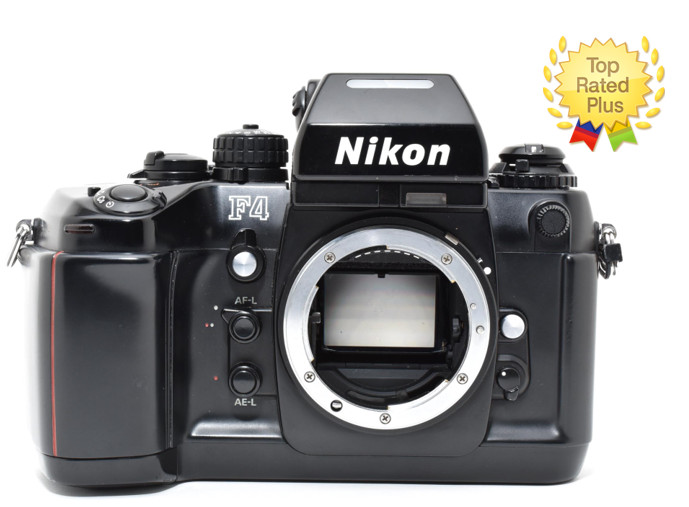
The Nikon F4 is a professional-grade 35mm film SLR camera introduced in 1988 as Nikon’s first autofocus-capable flagship model. Designed for photojournalists, press photographers, and advanced professionals, the F4 combined rugged build quality, modular design, and cutting-edge electronics to meet the demands of high-intensity shooting environments.
Overview
Announced in November 1988, the Nikon F4 marked a pivotal moment in Nikon’s history: the transition of its professional SLR line into the autofocus era. Prior to the F4, Nikon’s pro bodies—the F, F2, and F3—were manual focus cameras renowned for their mechanical reliability and modularity. The F4 retained these core values while integrating advanced autofocus technology, positioning itself as a bridge between traditional mechanical robustness and modern electronic automation. It was developed in collaboration with Italian design firm Giorgetto Giugiaro, whose industrial design influence is evident in the camera’s angular, ergonomic body and textured rubber grip.
Targeted squarely at working professionals, the F4 was engineered for durability, weather resistance, and long-term reliability under extreme conditions. Its modular construction allowed users to interchange viewfinders, focusing screens, and data backs, a hallmark of Nikon’s professional F-series lineage. The camera featured Nikon’s newly developed Multi-CAM400 autofocus sensor module, supporting both single-servo (AF-S) and continuous-servo (AF-C) focusing modes. With a maximum shooting speed of 5.7 frames per second (fps) with the standard MB-21 battery pack, and up to 7 fps in high-speed mode with the optional MB-23 vertical grip and Ni-Cd battery pack, the F4 was among the fastest professional SLRs of its time.
The F4 also introduced several firsts for Nikon: it was the first Nikon F-mount camera with a built-in autofocus motor, the first to feature a dedicated LCD information panel on the top plate, and the first to offer TTL 3D Matrix Metering (utilizing distance information from compatible lenses). These innovations cemented its role as a technological flagship and set the foundation for future professional models like the F5 and F6.
Specifications
| Specification | Value |
| Type | 35mm Single-Lens Reflex (SLR) |
| Film Format | 35mm (135 film) |
| Years Produced | 1988–1996 |
| Lens Mount | Nikon F-mount (with AF coupling screw drive) |
| Shutter | Vertical-travel, focal-plane shutter; speeds from 1/8000 sec to 30 sec, plus Bulb |
| Metering | TTL 3D Matrix Metering (with CPU lens data), Center-Weighted, Spot |
| Exposure Modes | Program (P), Shutter-Priority (S), Aperture-Priority (A), Manual (M), Auto-Index (AI) mode for non-CPU lenses |
| Viewfinder | Interchangeable pentaprism viewfinders (standard: DK-5); 100% frame coverage; 0.74x magnification |
| Dimensions | 152 × 135 × 85 mm (6.0 × 5.3 × 3.3 in); ~1040 g (body only, with battery) |
Key Features
- First Nikon professional SLR with integrated autofocus, using a screw-drive motor compatible with AF-Nikkor lenses.
- Modular design with interchangeable viewfinders, focusing screens, and film backs (including the MF-23 data back with calendar imprinting).
- Advanced TTL 3D Matrix Metering, which used subject distance information from AF lenses to improve exposure accuracy.
- Dual exposure control dials—a front command dial and rear thumb wheel—for intuitive manual adjustments.
- Robust magnesium alloy chassis with weather-sealed body, rated for operation in harsh environments.
Historical Context
The Nikon F4 was released at a time of intense competition in the professional SLR market, primarily driven by Canon’s introduction of the EOS-1 in 1989—a fully electronic, EF-mount autofocus system that broke compatibility with older FD lenses. Nikon, committed to backward compatibility with its vast F-mount lens ecosystem (dating back to 1959), opted for a more evolutionary approach. The F4 preserved mechanical aperture coupling and screw-drive autofocus, allowing it to work with decades of existing Nikkor lenses while still embracing modern automation.
Despite criticism for not adopting an all-electronic mount, the F4 was widely praised upon release for its reliability, handling, and image quality. It became a mainstay in newsrooms and on photojournalism assignments throughout the early 1990s, notably used during the Gulf War and major global events. Its adoption by wire services like the Associated Press and Reuters underscored its status as a trusted tool in high-pressure environments. While eventually succeeded by the F5 in 1996, the F4 remained in production for eight years—a testament to its enduring appeal and performance.
Collectibility & Value
Today, the Nikon F4 is a sought-after collector’s item, particularly among enthusiasts of professional film cameras and Nikon’s F-series heritage. Fully functional units in good condition typically sell for $400–$700, with rare configurations (such as the F4S with dark viewfinder or F4E with enhanced metering) commanding higher prices. The camera’s desirability stems from its historical significance, industrial design, and reputation for durability.
When purchasing an F4, collectors should verify the functionality of the autofocus system, shutter operation across all speeds, and light seals—common points of failure after decades of use. The original MB-21 battery pack often suffers from corroded contacts, and the internal Ni-Cd batteries in MB-23 grips may leak if not properly maintained. Additionally, the LCD display on the top plate can degrade or lose contrast over time. Despite these age-related concerns, the F4 remains relatively serviceable due to its modular design and availability of spare parts from Nikon’s professional support network.
Similar Cameras
- Canon EOS-1 (1989) – Canon’s first professional autofocus SLR, featuring an all-electronic EF mount.
- Minolta Maxxum 9000 (1985) – One of the earliest professional autofocus SLRs, with advanced metering and build quality.
- Pentax LX (1980) – A modular manual focus SLR still in production during the F4’s era, prized for precision engineering.
- Olympus OM-4Ti (1986) – A titanium-shuttered professional SLR with advanced metering, favored by documentary photographers.
- Contax RTS III (1990) – A high-end autofocus SLR with Zeiss optics and precision German engineering.
Repair & Maintenance
The Nikon F4 uses four AA batteries (or an optional Ni-Cd pack in the MB-21 or MB-23 grips) to power its autofocus, metering, and shutter control systems. Battery corrosion in the grips is a common issue, especially with older Ni-Cd packs—regular inspection and cleaning are recommended. The camera’s screw-drive autofocus mechanism relies on a precision motor and gear train, which may require lubrication or adjustment after heavy use. Shutter calibration and light seal replacement are essential maintenance tasks for cameras over 30 years old. Due to its professional pedigree, many Nikon F4s were regularly serviced by authorized technicians, and service records can significantly enhance a unit’s value. While repair parts are no longer manufactured, the robust design and widespread use ensure that skilled technicians can often source or refurbish components.
eBay Listings

As an eBay Partner, we earn from qualifying purchases. This helps support our independent vintage technology research.
Related Models
- Nikon F-301 (1985-1990)
- Nikon F-401 (1987-1989)
- Nikon F-501 (1986-1986–1989)
- Nikon F (1959-1973)
- Nikon F100 (1999-2006)
- Alpa 6 (1948-1953)
- Agfa Agfaflex
- Agfa Ambiflex
- Agfa Easy
- Agfa Futura Af zoom