NIKON F3T
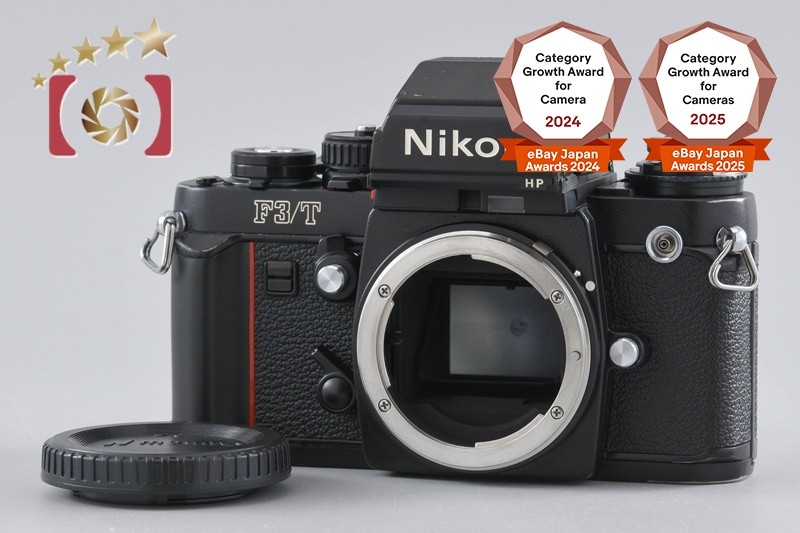
The Nikon F3T is a limited-production, premium variant of the iconic Nikon F3 professional 35mm film SLR, distinguished by its titanium top and bottom plates and enhanced finish. Introduced in 1982, it was designed as a high-end alternative for discerning professionals and collectors seeking both superior build quality and a distinctive aesthetic.
Overview
The Nikon F3T was launched in 1982 as a special edition of the Nikon F3, which had debuted in 1980 as Nikon’s flagship professional SLR. While the standard F3 featured chrome or black-painted brass top and bottom plates, the F3T replaced these with solid titanium components, reducing weight slightly while enhancing durability and giving the camera a unique dark gray, satin-finished appearance. The "T" in F3T stands for titanium, underscoring its primary material distinction. This model was not a functional upgrade but rather a premium build variant, aimed at professional photographers and high-end enthusiasts who valued craftsmanship and exclusivity.
Positioned at the top of Nikon’s F-series SLR lineup, the F3T retained all the core mechanical and electronic features of the standard F3, including the electronically controlled vertical-travel focal-plane shutter, advanced through-the-lens (TTL) metering, and compatibility with Nikon’s extensive F-mount lens ecosystem. It was offered with the standard DE-10 prism or the DP-12 data-prism, which could imprint time, date, or exposure information into the film frame. Despite its limited production—estimated at fewer than 10,000 units—the F3T became a symbol of Nikon’s commitment to precision engineering and premium build quality during the late film era. Its release coincided with a period of intense competition among Japanese manufacturers to dominate the professional SLR market, with Canon, Minolta, and Pentax introducing increasingly sophisticated electronic systems.
Specifications
| Specification | Value |
| Type | 35mm Film SLR |
| Film Format | 35mm (135) |
| Years Produced | 1982–1989 |
| Lens Mount | Nikon F-mount (AI/AI-S compatible) |
| Shutter | Electronically controlled vertical-travel focal-plane; speeds from 1/2000 sec to 8 sec, plus Bulb (B) |
| Metering | TTL center-weighted metering via silicon photodiode |
| Exposure Modes | Manual exposure only (shutter speed set manually, aperture via lens) |
| Viewfinder | Interchangeable pentaprism; standard with DX-1 finder (approx. 0.85× magnification) |
| Dimensions | 147 × 95 × 56 mm (5.8 × 3.7 × 2.2 in); ~640 g (body only, without battery) |
Key Features
- Titanium Top and Bottom Plates: Significantly increase durability while reducing weight compared to brass-bodied variants; provide a distinctive dark gray finish.
- Professional Build Quality: Rugged, weather-resistant construction with extensive sealing against dust and moisture, suitable for demanding field use.
- Advanced TTL Metering: Center-weighted metering system with LED display in the viewfinder for precise exposure guidance.
- Interchangeable Viewfinders and Focusing Screens: Allows customization for different shooting disciplines (e.g., sports, macro, low-light).
- DP-12 Data Back Option: Available with a motorized back that imprints time, date, or exposure data onto the film, useful for scientific, journalistic, or archival work.
Historical Context
The Nikon F3T was introduced during a transitional period in professional photography, as electronic integration in SLRs became standard. The original F3 was Nikon’s first professional SLR to rely entirely on electronic shutter control (lacking a mechanical backup), marking a shift from the fully mechanical F and F2 models. The F3T, while functionally identical, emphasized craftsmanship and exclusivity. It was produced in limited numbers primarily for the Japanese domestic market and select international distributors, often sold in special presentation boxes with premium accessories.
Competitors at the time included the Canon New F-1 (1981), which offered modular design and mechanical backup, and the Minolta XK (XE) series, known for advanced metering. However, the F3T was not positioned as a technological rival but as a luxury object within the professional toolkit. Its titanium construction was a rarity in 35mm SLRs—only a few models, such as the Leica R6 and later the Pentax LX (with optional titanium door), used similar materials. The F3T was well-received by professionals for its tactile quality and reliability, though its premium price limited widespread adoption.
Collectibility & Value
Today, the Nikon F3T is highly sought after by collectors due to its limited production run, distinctive materials, and association with Nikon’s golden era of professional SLRs. In excellent condition, with original box and accessories, the F3T commands prices between $1,200 and $2,500 on the secondary market, depending on configuration (e.g., presence of DP-12 data back, original strap, documentation). Models with the DP-12 back are particularly rare and valuable.
When purchasing an F3T, collectors should verify the authenticity of the titanium plates—some counterfeit or modified units exist with replaced or plated covers. Functional checks should include shutter operation across all speeds, meter accuracy (requires PX28 or PX625 battery), and smooth film advance. Common issues include degraded light seals, sticky shutter curtains (especially if stored improperly), and oxidation on electrical contacts. As with all F3 variants, the camera requires a functioning battery (mercury equivalent, though modern substitutes are used) for metering and shutter operation, as it lacks mechanical speeds.
Similar Cameras
- Canon New F-1 (1981) – Professional SLR with modular design, mechanical and electronic shutter options, F-mount equivalent in durability.
- Pentax LX (1980) – Precision-engineered SLR with interchangeable viewfinders and focusing screens; optional titanium door version.
- Minolta XK/XE (1977–1981) – High-end SLR with advanced metering and robust build, popular among photojournalists.
- Leica R3–R6 series – German-engineered SLRs with premium construction; R6 (1984) also featured titanium top plate option.
- Nikon F3HP – Standard F3 variant with High-Eyepoint finder, more common and less collectible than the F3T.
Repair & Maintenance
The Nikon F3T uses a single 6V PX28 or PX625 battery (or modern equivalents like Wein Cell MRB625 or adapters for 6V lithium batteries) to power its electronic shutter and metering system. Without power, the camera is inoperable—there is no mechanical backup, a notable departure from earlier F-series models. Common maintenance issues include deteriorated light seals (which should be replaced to prevent film fogging), sluggish shutter speeds due to dried lubricants, and intermittent meter function caused by corroded battery contacts.
Repair requires experienced technicians familiar with Nikon’s F-mount SLR electronics and mechanical systems. While many parts are interchangeable with the standard F3, the titanium plates are unique to the F3T and difficult to source if damaged. Regular use and proper storage in a dry environment are recommended to preserve functionality. Due to its collectible status, non-original modifications (e.g., rewiring, non-factory battery adapters) can reduce value, so conservation-focused servicing is advised.
eBay Listings



As an eBay Partner, we earn from qualifying purchases. This helps support our independent vintage technology research.
Related Models
- Nikon F-301 (1985-1990)
- Nikon F-401 (1987-1989)
- Nikon F-501 (1986-1986–1989)
- Nikon F (1959-1973)
- Nikon F100 (1999-2006)
- Alpa 6 (1948-1953)
- Agfa Agfaflex
- Agfa Ambiflex
- Agfa Easy
- Agfa Futura Af zoom