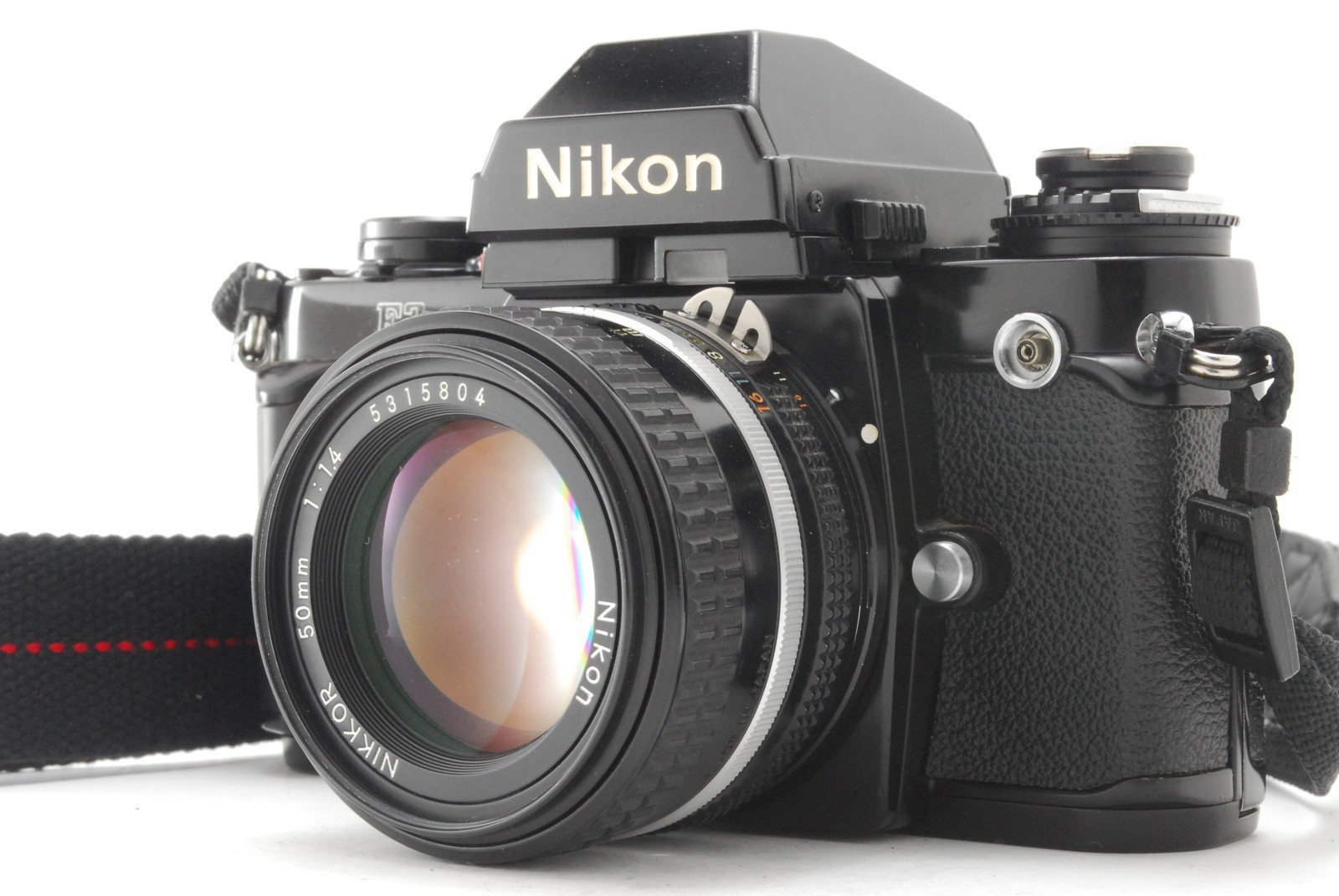
NIKON F3
The Nikon F3 is a professional 35mm film single-lens reflex (SLR) camera introduced in 1980 as Nikon’s first electronically controlled flagship model. It marked a pivotal transition from fully mechanical systems to electronic automation while maintaining the durability and modularity expected of a professional Nikon SLR.
Overview
The Nikon F3 was launched in March 1980 as the successor to the legendary Nikon F2, representing Nikon’s first fully electronic professional SLR. Designed for photojournalists, press photographers, and serious enthusiasts, the F3 combined advanced electronic metering and exposure control with the rugged build quality and system expandability that defined Nikon’s F-mount lineage. Its development coincided with the rise of aperture-priority automation in professional photography, allowing faster operation in dynamic environments without sacrificing precision.
The F3 was engineered with input from renowned industrial designer Giorgetto Giugiaro, whose influence is evident in its angular, ergonomic body and distinctive red stripe over the handgrip. Despite its electronic core, the F3 retained manual shutter cocking via a traditional lever and offered fully mechanical shutter operation at 1/200 sec in the event of battery failure—a critical fail-safe for professionals. Over its 21-year production run, the F3 became one of the longest-produced Nikon professional SLRs, with multiple variants including the F3HP (High Point), F3P (Press), F3/T (Titanium), and F3AF (an early autofocus prototype).
The F3 cemented Nikon’s dominance in the professional SLR market during the 1980s and early 1990s. It was widely adopted by news agencies, sports photographers, and military photographers due to its reliability in extreme conditions. The camera supported a vast ecosystem of interchangeable finders, focusing screens, motor drives (notably the MD-4), and data backs, making it a modular system camera tailored to diverse shooting needs.
Specifications
| Specification | Value |
| Type | 35mm Film SLR |
| Film Format | 35mm (135) |
| Years Produced | 1980–2001 |
| Lens Mount | Nikon F-mount (with AI and AI-S compatibility) |
| Shutter | Vertical-travel, metal-blade focal-plane shutter; speeds from 1 sec to 1/2000 sec, plus Bulb; X-sync at 1/80 sec |
| Metering | Center-weighted TTL metering via silicon photodiode (SPD) |
| Exposure Modes | Aperture-priority auto exposure and manual mode |
| Viewfinder | Interchangeable pentaprism with fixed focusing screen (standard DK-21); optional waist-level and action finders |
| Dimensions | 147 × 96 × 69 mm (5.8 × 3.8 × 2.7 in); ~690 g (body only, without battery) |
Key Features
- Aperture-Priority Automation: First professional Nikon to offer aperture-priority auto exposure, enabling faster workflow in fast-paced environments.
- Interchangeable Viewfinders and Screens: Compatible with multiple finders (e.g., DE-3 for action, DW-21 for waist-level) and 11 focusing screen types for specialized applications.
- Electronic Shutter with Mechanical Backup: Full electronic control with a mechanical 1/200 sec shutter speed available when batteries are dead.
- Modular System Design: Supports motor drives (MD-4), data imprinters (MF-16), and film backs for extended shooting and metadata logging.
- Durable Titanium Top Plate (F3/T): The F3/T variant featured a lightweight titanium top and bottom plate, offering corrosion resistance and reduced weight.
Historical Context
The Nikon F3 was introduced at a time when Canon and Minolta were advancing electronic automation in SLRs, particularly with shutter-priority and program modes. Nikon, historically conservative in adopting electronics for its pro line, responded with the F3 to maintain its foothold in the professional market. Unlike competitors who pursued full automation, Nikon emphasized reliability and user control, making the F3 a hybrid of electronic sophistication and mechanical robustness.
The F3’s release followed the success of the Nikon FE and FM series, which had already incorporated electronic metering and aperture-priority modes for the enthusiast market. However, the F3 was the first to bring these features to the professional tier without compromising on durability. It competed directly with the Canon New F-1 (1981) and the Minolta XK (XE in the US), both of which also targeted photojournalists. The F3 quickly gained favor due to its superior ergonomics, extensive accessory system, and consistent performance in adverse conditions. It became the camera of choice for photographers covering major global events, including the Vietnam War’s aftermath, the 1984 Los Angeles Olympics, and conflicts in Central America.
Collectibility & Value
The Nikon F3 remains a highly collectible camera, particularly the F3P (Press) and F3/T (Titanium) variants. The F3P, designed for extreme durability, features reinforced seals, a flat front for glove operation, and compatibility with bulk film backs—making it sought after by collectors and working photojournalists alike. The F3/T, produced in limited numbers, is prized for its lightweight titanium construction and aesthetic appeal.
In the current market (2024), a fully functional Nikon F3 in good condition typically sells for $250–$400, while an F3P or F3/T can command $500–$800 depending on condition and accessories. Original boxes, manuals, and rare finders (such as the DE-2 action finder) significantly increase value. When purchasing an F3, buyers should verify the shutter operation, light meter accuracy, and mirror movement. Common issues include degraded foam light seals (causing light leaks), sticky shutter curtains, and meter inaccuracy due to aging electronics or corroded battery contacts.
Battery conversion is often necessary, as the original PX625 mercury battery (1.35V) is no longer available. Modern replacements require either a Wein Cell (zinc-air) or adapter for 1.5V silver oxide batteries with meter recalibration. The camera uses two 1.5V batteries in series (SR44/LR44) in later models with the MB-1 battery pack, which powers motor drives and advanced metering.
Similar Cameras
- Canon New F-1 (1981): Canon’s professional SLR with interchangeable finders and modular design; offered manual and shutter-priority modes.
- Minolta XK/XE (1981): High-end SLR with aperture-priority and manual modes; known for precision engineering and compact size.
- Pentax LX (1980): Rival system camera with interchangeable viewfinders and exceptional build quality; favored by some professionals over Nikon and Canon.
- Olympus OM-4 (1983): Professional OM-series SLR with advanced metering and titanium shutter; compact alternative to full-frame pro bodies.
Repair & Maintenance
The Nikon F3 uses two 1.5V SR44/LR44 batteries (or equivalent) in the standard body, or a 6V 4SR44 battery pack with the MB-1 motor drive. Due to the discontinuation of 1.35V mercury PX625 cells, users must adjust exposure compensation (+1/2 to +1 stop) when using modern 1.5V batteries unless the meter is recalibrated.
Common maintenance issues include deteriorated light seals (requiring replacement every 10–15 years), sluggish shutter speeds due to dried lubricants, and oxidized battery contacts. The cloth focal-plane shutter is durable but can develop pinholes or stick if not exercised regularly. Professional servicing is recommended for shutter cleaning, CLA (clean, lubricate, adjust), and meter calibration. Repair parts remain available through Nikon’s legacy service centers and third-party specialists, though some components (e.g., titanium plates for the F3/T) are scarce. Overall, the F3 is considered repairable and reliable with proper care, making it a viable working camera even decades after production ended.
eBay Listings



As an eBay Partner, we earn from qualifying purchases. This helps support our independent vintage technology research.
Related Models
- Nikon F-301 (1985-1990)
- Nikon F-401 (1987-1989)
- Nikon F-501 (1986-1986–1989)
- Nikon F (1959-1973)
- Nikon F100 (1999-2006)
- Alpa 6 (1948-1953)
- Agfa Agfaflex
- Agfa Ambiflex
- Agfa Easy
- Agfa Futura Af zoom