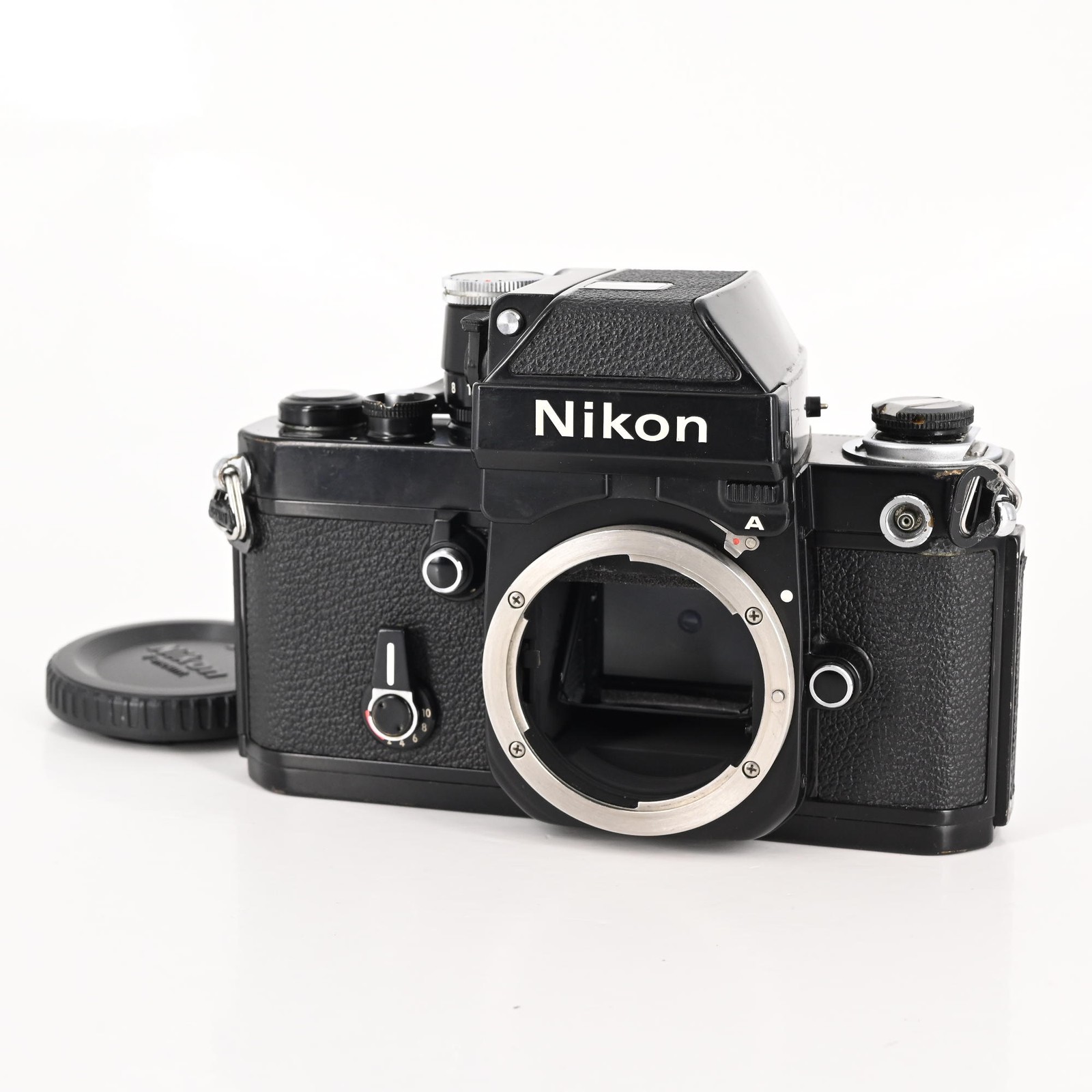
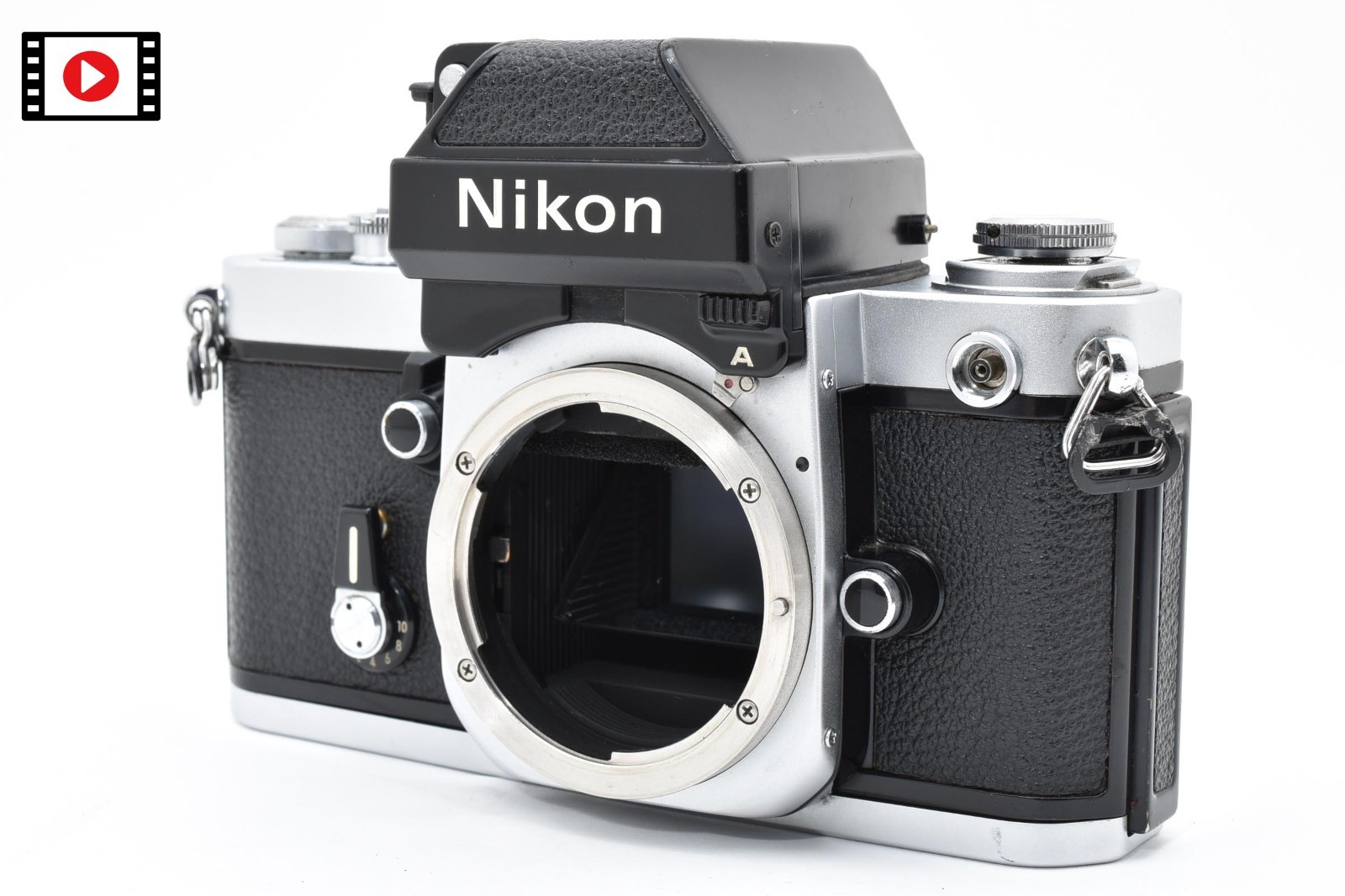
Nikon F2A Photomic (1977–1980)
At 880g, it lands in your hands like a block of forged steel—dense, deliberate, and utterly mechanical.
Overview
The Nikon F2A Photomic isn’t a camera that asks for attention; it commands respect through sheer presence. Introduced in 1977 as an evolution of the original F2 platform, this professional 35mm SLR was built for photojournalists, scientists, and anyone who needed a camera that wouldn’t fail—under sand, snow, or combat conditions. It’s all-metal, all-mechanical, and powered only by muscle and two tiny A76 batteries that serve the meter alone. No electronics govern the shutter, no microprocessors mediate exposure. What you get is pure, tactile control: a titanium-foil shutter snapping horizontally across the frame, a meter needle swaying in the viewfinder like a pendulum of precision.
Owners report it was the first F2 model equipped with the DP-11 Photomic finder, which brought automatic maximum aperture indexing (AI) compatibility—a game-changer for faster lens changes and seamless meter coupling. That meant photographers could use newer AI Nikkors without manual adjustments, a subtle but critical upgrade over earlier Photomic variants. The meter itself uses two CdS cells in a 60/40 center-weighted pattern, concentrating sensitivity in a 12mm central circle—enough to guide exposures accurately without being overly influenced by edge distractions. It’s not spot metering, but in the hands of a skilled user, it’s devastatingly effective.
Despite its mechanical simplicity, the F2A was no relic at launch. It benefited from optical and engineering advances developed under contract for NASA, giving it a level of build quality and optical alignment that filtered down into civilian production. The body offers 100% frame coverage via its pentaprism finder, a rarity even today, so what’s framed is exactly what’s captured. Multiple exposures are handled via the rewind release button, mirror lock-up via a dedicated lever—features not tacked on, but integrated with surgical precision. It’s the kind of camera that, once set, stays set, even after years in a closet.
Specifications
| Manufacturer | Nikon |
| Model | F2A Photomic |
| Type | Professional 35mm SLR |
| Production years | 1977–1980 |
| Picture format | 24mm x 36mm |
| Lens mount | Nikon bayonet mount |
| Shutter | Horizontal-travel Titanium-foil focal-plane shutter |
| Shutter speeds | 1 to 1/2000 second and "B" in fourteen steps; intermediate dial settings possible between 1/80 and 1/2000 second (stepless); speeds of from 2 to 10 seconds also available at "B" using self-timer; Time exposure setting also provided |
| Flash sync speed | 1/90 X-sync |
| Flash connection | PC (Prontor-Compur) socket on the front / threaded sync terminal also provided |
| Metering type | Through-the-lens (TTL), center-weighted full-aperture measurement employing two Cds cells |
| Metering pattern | Centre-Weighted TTL metering system that concentrates 60% of the reading within the 12 mm-diameter central portion of the view-field |
| Metering range | EV-1 to EV-17 (i.e., f/1.4 at 1 sec., f/8 at 1/2000 sec.) with 50mm f/1.4 lens at ASA 100 |
| Film speed range | ASA 6 to 6400 |
| Aperture coupling range | f/1.2 to f/32 |
| Battery | Two 1.5V silver-oxide batteries |
| Battery type | Two common A76 button cells |
| Viewfinder | Interchangeable eye level pentaprism type with built-in TTL exposure meter (F2A Photomic Finder DP-11); virtually 100% frame coverage |
| Focusing screen | Type K focusing screen supplied as standard |
| Self-timer | Can be set for 2 to 10 sec. delay |
| Multiple exposure capability | Yes / Via rewind release button |
| Mirror lock-up | Yes, via dedicated lever |
| Depth-of-field preview | Button provided; coaxial with mirror lock |
| Dimensions (body only) | 152.5mm (W) x 102mm (H) x 65.5mm (D) |
| Weight (body only) | 880g |
Key Features
DP-11 Photomic Finder with AI Coupling
The heart of the F2A’s upgrade lies in the DP-11 finder head. Unlike earlier Photomic models that required stop-down metering or manual indexing, the DP-11 introduced compatibility with Nikon’s AI (Automatic Indexing) system. A built-in meter coupling lever engages with AI Nikkors the moment they’re mounted, automatically transferring the lens’s maximum aperture to the meter. This eliminated fiddly dials and guesswork, making lens swaps faster and exposure readings immediate. The finder also houses the CdS meter cells and provides the iconic center-weighted pattern that prioritizes the central 12mm of the frame—ideal for portraits, street shots, and any scenario where the subject dominates the middle.
100% Frame Coverage Pentaprism
Few SLRs, even today, offer true 100% viewfinder coverage, but the F2A delivers it as standard. What’s seen through the pentaprism is exactly what will be captured on film—no cropping surprises, no errant heads at the edge of the frame. This precision was critical for press photographers and architectural shooters who couldn’t afford to waste film or miss composition. The viewfinder image is bright, sharp, and framed by a matte focusing screen that aids manual focus, especially with fast primes. For users upgrading from consumer SLRs of the era, the leap in clarity and accuracy was nothing short of revelatory.
Titanium-Foil Focal-Plane Shutter
The shutter is a marvel of mechanical engineering: a horizontally traveling curtain made of titanium foil, chosen for its strength-to-weight ratio. It cycles reliably from 1 second to 1/2000 second, with a Time setting for long exposures and Bulb for flash or extended manual control. The shutter is entirely mechanical—no batteries needed—so even with dead cells, the camera functions. The 1/90 sec flash sync speed is modest by modern standards, but it was standard for the era and sufficient for most studio and on-camera flash work. Flash sync is handled via both a PC terminal and a hotshoe with safety switch, accommodating both studio strobes and Nikon Speedlights via the AS-1 coupler.
All-Mechanical Operation with Depth-of-Field Preview
Every function on the F2A is mechanical, from film advance to aperture control. The depth-of-field preview button, coaxial with the mirror lock lever, stops the lens down to the selected aperture, allowing the user to check focus fall-off directly in the viewfinder. This wasn’t just a convenience—it was a necessity for macro and landscape work. The mirror lock-up feature, required for certain fisheye lenses like the 6mm f/5.6, also reduces vibration during long exposures. Combined with the self-timer (adjustable from 2 to 10 seconds), it gave photographers multiple tools to minimize camera shake.
Film Speed Range from ASA 6 to 6400
The meter supports an extraordinary film speed range—ASA 6 to 6400—via a simple index ring on the DP-11 head. That span covers everything from ultra-slow technical films to high-speed press stocks used in dimly lit venues. The wide range reflects the camera’s intended use in unpredictable environments where lighting could shift from bright daylight to dim interiors in minutes. While the meter’s accuracy at the extremes depends on cell condition, the design ensures flexibility first and foremost.
Interchangeable Finders and Focusing Screens
One of the F2 platform’s defining traits was modularity. The F2A inherits this fully: the DP-11 finder can be swapped for other Photomic heads, waist-level finders, or even motorized viewfinders. The focusing screen is also replaceable, allowing users to switch to grid screens, microprisms, or split-image rangefinders depending on the task. This adaptability made the F2A a system camera in the truest sense—configured not by accessories bolted on, but by core components swapped out.
Filter Compatibility Without Exposure Compensation
According to documentation, “Except for the R60, no Nikon filter requires exposure compensation when used with the Nikon F2A Photomic.” This is a direct result of the TTL metering system measuring through the lens, after the filter is in place. Most filters—UV, skylight, polarizers, mild NDs—don’t throw off the meter, eliminating guesswork. The R60 red filter is the exception, likely due to its extreme spectral absorption affecting CdS cell response. For all others, what the meter sees is what the film gets.
Historical Context
The F2A emerged in 1977 as Nikon’s answer to the growing demand for AI-compatible professional SLRs. While the original F2 launched in 1971, the F2A refined it with the DP-11 finder, aligning it with Nikon’s new AI lens standard. It shared DNA with cameras developed for NASA, benefiting from extreme environmental testing and precision assembly techniques. Production ended in 1980 with the arrival of the Nikon F3, which introduced electronic shutter control and a more automated experience. Yet, despite being superseded, the F2A retained a cult following. Some photographers reportedly paid more for used F2As in the early 1980s than for new F3s, valuing the all-mechanical reliability over modern conveniences.
Collectibility & Value
The F2A is a staple of serious film collections, valued for its durability and precision. Current estimates place an “Excellent” condition body at $180–200, while “Mint” examples can fetch $600–700. These figures reflect market demand, not original pricing—no official list price for the F2A specifically has been documented. Most units on the market today require a CLA (Clean, Lubricate, Adjust) to ensure smooth operation, especially if stored for decades. The most frequently reported issue is a malfunctioning meter prism: CdS cells degrade over time, and the needle may stick, drift, or fail entirely. When functional, the meter is accurate, but buyers are advised to test it across apertures and lighting conditions. Beyond the meter, the camera’s mechanical core is nearly indestructible—many units from the 1970s still operate flawlessly without service.
eBay Listings


As an eBay Partner, we earn from qualifying purchases. This helps support our independent vintage technology research.