NIKON F2
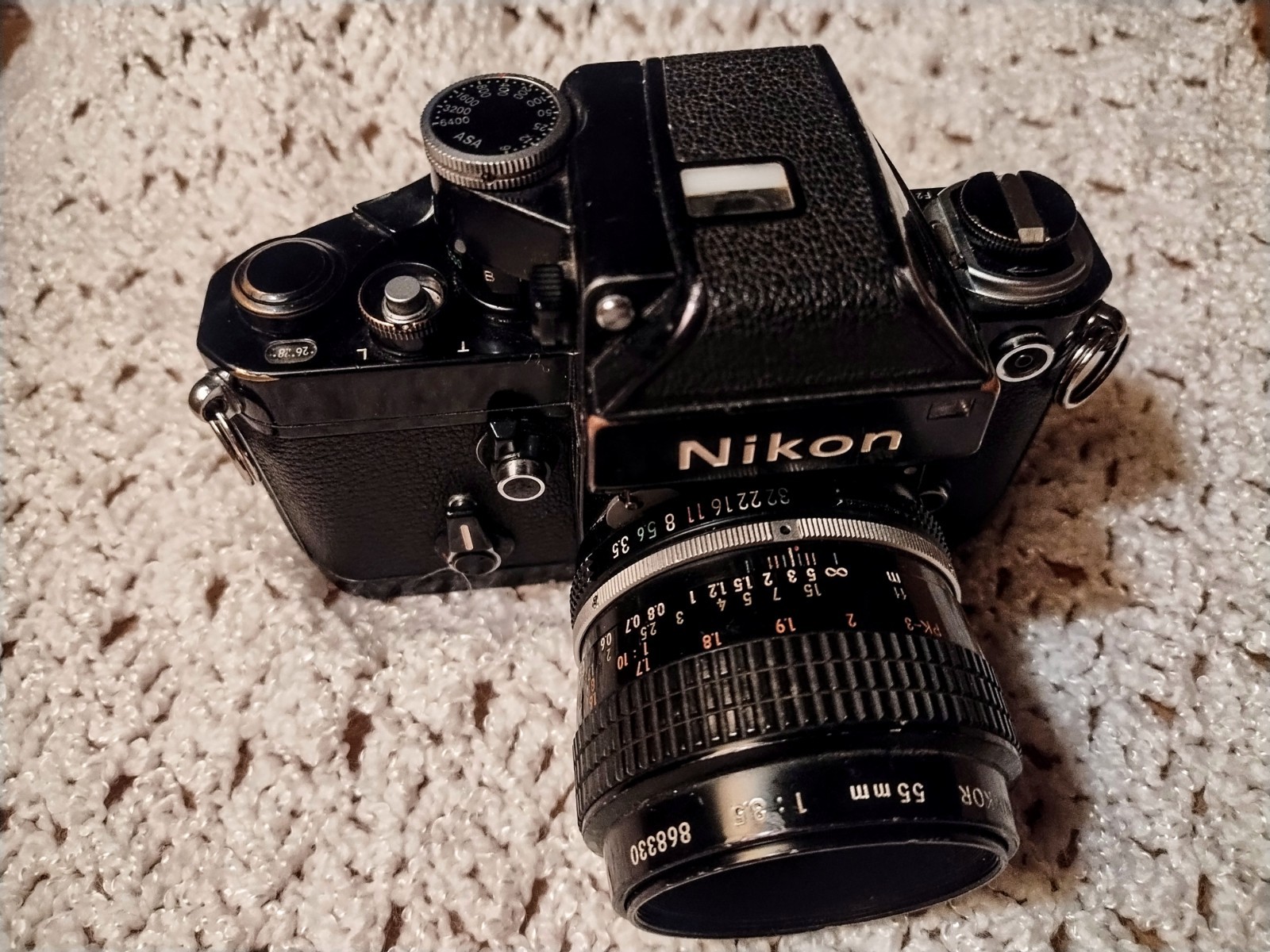
The Nikon F2 is a 35mm film single-lens reflex (SLR) camera introduced in 1971 as Nikon’s flagship professional camera. It represents the culmination of Nikon’s all-mechanical SLR design philosophy, offering robust construction, exceptional reliability, and modular versatility for demanding photojournalists and professional photographers.
Overview
Launched in October 1971, the Nikon F2 succeeded the legendary Nikon F and solidified Nikon’s dominance in the professional photography market during the 1970s. Designed as a fully mechanical, manual-exposure SLR, the F2 was engineered to withstand extreme conditions and intensive use, making it a favorite among press photographers, war correspondents, and studio professionals. Unlike its predecessor, the F2 featured a redesigned pentaprism housing, improved ergonomics, and a more refined shutter mechanism, while maintaining full compatibility with the Nikon F-mount lenses introduced in 1959.
The F2 was not a single camera but a modular system, with the body sold separately from viewfinders, focusing screens, and motor drives. This allowed photographers to customize their setup based on application—whether for sports, studio work, or photojournalism. The camera’s most iconic configuration included the DP-11 prism finder with match-needle metering, which provided through-the-lens (TTL) exposure guidance via a needle visible in the viewfinder. Despite the advent of electronic shutters and aperture-priority automation in competing models, the F2 remained entirely mechanical, relying on no batteries for core operation—only for metering.
The F2 remained in production until 1980, when it was succeeded by the Nikon F3. Throughout its nine-year run, it underwent minor revisions, including the replacement of the DP-1 with the DP-11 metered prism in 1977, which offered improved light meter accuracy and compatibility with newer AI (Automatic Indexing) lenses. The F2 Photomic variants (F2AS, F2A) became standard issue for many news agencies and were widely used during major global events of the 1970s, including the Vietnam War and the Apollo space program’s final missions.
Specifications
| Specification | Value |
| Type | 35mm film single-lens reflex (SLR) |
| Film Format | 35mm (135 film), 24 × 36 mm image format |
| Years Produced | 1971–1980 |
| Lens Mount | Nikon F-mount (with mechanical aperture linkage) |
| Shutter | Vertically-traveling, focal-plane shutter; speeds from 1 sec to 1/2000 sec, plus B (bulb); flash sync at 1/80 sec |
| Metering | TTL center-weighted metering (in Photomic variants: DP-1, DP-2, DP-3, DP-11); meter powered by two 1.35V PX625 mercury batteries (adapters available for modern alternatives) |
| Exposure Modes | Manual exposure only; aperture set on lens, shutter speed selected manually |
| Viewfinder | Interchangeable viewfinder system; standard eye-level pentaprism (non-metered), or Photomic prisms with match-needle meter display |
| Dimensions | 149 × 96 × 59 mm (body only); weight: ~690 g (body only, without battery or lens) |
Key Features
- All-mechanical operation: No batteries required for shutter or film advance; only used for metering in Photomic versions.
- Titanium-bladed shutter: Lightweight, durable vertical-travel shutter enabling 1/2000 sec top speed with excellent reliability.
- Modular system design: Interchangeable viewfinders, focusing screens, and motor drives (e.g., MD-2, MD-3) for customization.
- Match-needle metering (DP-11): In-viewfinder exposure guidance via a needle aligned with markings for correct exposure.
- Full compatibility with Nikon F-mount lenses: Supports pre-AI, AI, and AI-S lenses (with stop-down metering for non-AI types).
Historical Context
The Nikon F2 was developed during a period of intense competition in the professional SLR market, with Canon, Pentax, and Minolta introducing increasingly automated models. While rivals moved toward aperture-priority and eventually shutter-priority systems, Nikon doubled down on mechanical reliability and modularity, targeting professionals who valued durability and repairability over automation. The F2’s release coincided with the height of photojournalism’s golden age, and its ruggedness made it ideal for field use in war zones, remote locations, and harsh environments where electronic systems might fail.
Despite lacking built-in automation, the F2 was technologically advanced for its time. Its titanium shutter was a significant engineering achievement, reducing inertia and wear while enabling a high flash sync speed of 1/80 sec—critical for studio and on-location flash work. The modular Photomic finder system allowed Nikon to offer metering as an optional upgrade, keeping the base F2 body affordable and appealing to photographers who preferred external meters or used flash extensively. The F2AS variant, introduced in 1977, became the definitive version, featuring the DP-11 finder and compatibility with AI lenses, which simplified meter coupling by eliminating the need for stop-down metering.
Collectibility & Value
Today, the Nikon F2 is highly sought after by collectors, vintage camera enthusiasts, and film photographers seeking a durable, repairable mechanical SLR. Complete systems with the DP-11 finder, AI-compatible metering, and motor drive can command $800–$1,500 depending on condition and provenance. Base non-metered F2 bodies are more affordable, typically selling for $300–$500. Cameras with original boxes, manuals, and accessories, especially those used by news agencies or bearing service stamps, carry significant premium value.
When purchasing an F2, buyers should verify shutter functionality across all speeds, check for mirror slap noise (indicative of worn dampers), and inspect the light seals and foam light trap around the film door—common points of degradation. The original PX625 mercury batteries used in the meter are no longer available, so users must employ modern silver oxide equivalents (e.g., Wein Cell) or adapters for zinc-air batteries to ensure accurate meter readings. Additionally, focus screen clarity and prism brightness should be assessed, as internal fogging or fungus can affect usability.
Similar Cameras
- Canon F-1 (1971): Canon’s professional mechanical SLR, directly competing with the F2; later updated to the New F-1.
- Pentax LX (1980): A modular, mechanical SLR with interchangeable viewfinders and focus screens, often considered the F2’s spiritual peer.
- Minolta SRT-101: While not modular, it offered robust build and advanced TTL metering in a more affordable package.
- Olympus OM-1 (1972): A compact, fully mechanical SLR favored for its portability and optical quality.
- Leica R3 (1976): Leica’s first electronically controlled SLR, marking a shift from mechanical systems but still targeting professionals.
Repair & Maintenance
The Nikon F2 requires no batteries for mechanical operation, but the Photomic variants depend on two 1.35V mercury PX625 batteries for metering. Since these are obsolete, modern substitutes such as the Wein Cell (zinc-air) or hearing aid batteries with voltage adapters are commonly used, though calibration may be necessary. The camera’s mechanical shutter and film transport are highly reliable but benefit from periodic CLA (clean, lubricate, adjust) servicing by a technician experienced with vintage Nikon gear.
Common issues include degraded light seals (causing light leaks), stiff shutter curtains (from dried lubricants), and worn mirror dampers (resulting in loud mirror slap). The film advance lever can also develop play over time due to wear in the drive linkage. Replacement parts remain available through Nikon’s heritage support program and third-party suppliers, contributing to the F2’s reputation for longevity. With proper care, many F2 bodies remain fully functional over 50 years after production.
eBay Listings



As an eBay Partner, we earn from qualifying purchases. This helps support our independent vintage technology research.
Related Models
- Nikon F-301 (1985-1990)
- Nikon F-401 (1987-1989)
- Nikon F-501 (1986-1986–1989)
- Nikon F (1959-1973)
- Nikon F100 (1999-2006)
- Alpa 6 (1948-1953)
- Agfa Agfaflex
- Agfa Ambiflex
- Agfa Easy
- Agfa Futura Af zoom