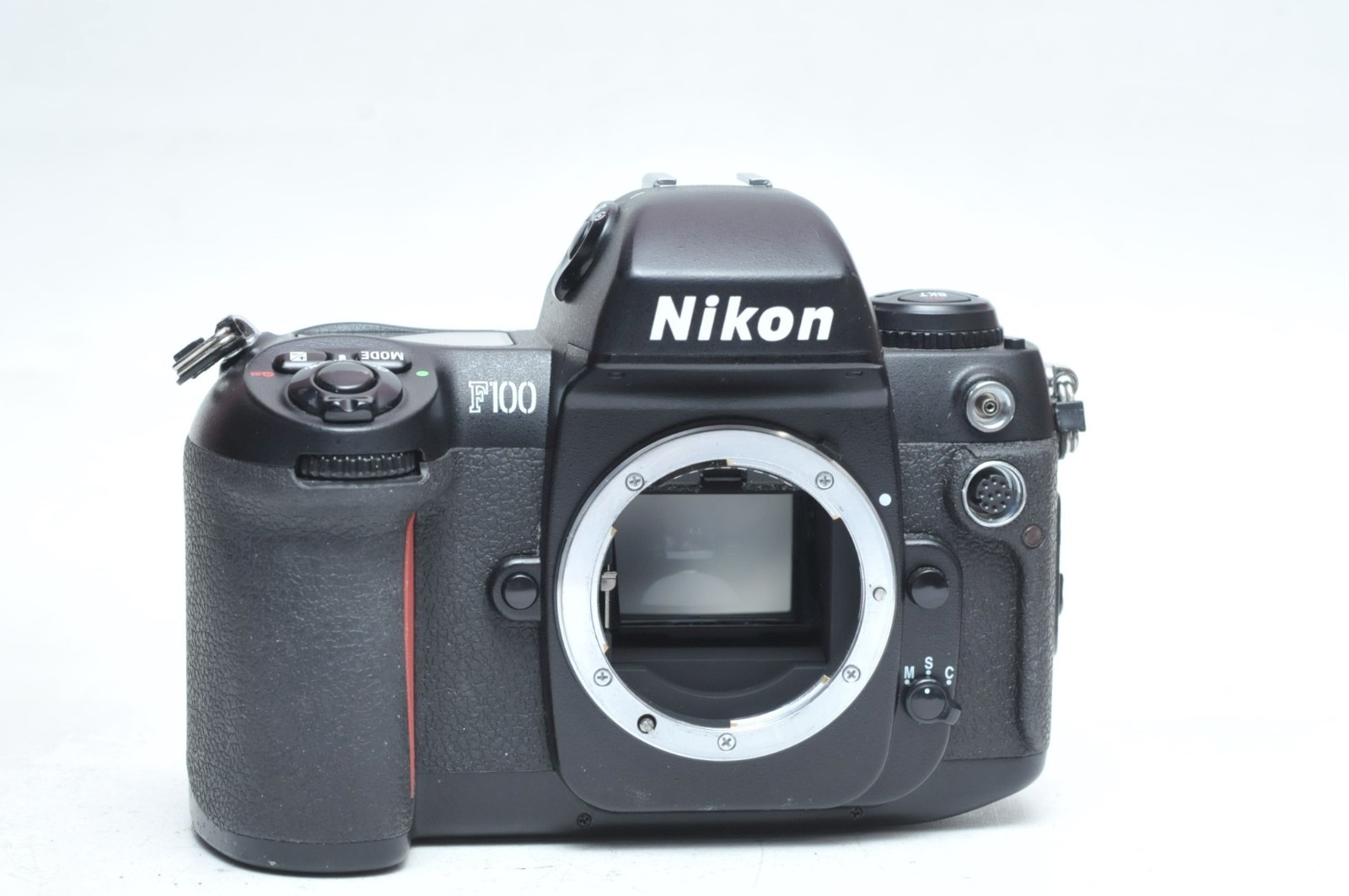
NIKON F100
The Nikon F100 is a 35mm film single-lens reflex (SLR) camera introduced in 1999 as a high-performance model positioned between Nikon’s professional F5 and the enthusiast-level N80. Designed for advanced amateurs and semi-professional photographers, the F100 combines robust build quality, advanced autofocus, and comprehensive exposure controls in a compact, weather-resistant magnesium alloy body.
Overview
Released in November 1999, the Nikon F100 was developed during a transitional period for Nikon as the company balanced the growing digital photography market with continued demand for high-end film SLRs. Positioned as a scaled-down version of the flagship Nikon F5, the F100 offered many of the same core technologies—such as the Multi-CAM 1300 autofocus sensor and 10-segment matrix metering—but in a lighter, more compact body aimed at serious photographers who needed professional-grade performance without the bulk and cost of the F5.
The F100 targeted photojournalists, wedding photographers, and advanced hobbyists who required fast, reliable operation, excellent low-light AF performance, and compatibility with Nikon’s extensive F-mount lens ecosystem. It featured a 4.5 frames-per-second continuous shooting rate, a wide ISO range (automatically detectable from ISO 6 to 6400), and a durable shutter rated for 150,000 cycles. Despite its "amateur-pro" classification, the F100 included many features previously reserved for Nikon’s professional line, including customizable user settings, TTL flash metering with CLS compatibility (when used with compatible Speedlights), and a large, bright viewfinder with 100% frame coverage.
The F100 remained in production until 2006, outlasting many of its contemporaries and earning a strong reputation for reliability and image quality. It was one of the last high-end film SLRs released by Nikon before the company shifted focus toward digital SLRs with the D1 series and later the D200, which effectively succeeded the F100 in Nikon’s lineup.
Specifications
| Specification | Value |
| Type | 35mm Film SLR |
| Film Format | 35mm (135) |
| Years Produced | 1999–2006 |
| Lens Mount | Nikon F-mount (with AI, AI-S, AF, AF-D, AF-I, AF-S, and VR lens compatibility) |
| Shutter | Vertical-travel focal-plane shutter; 30 sec to 1/8000 sec, plus Bulb and X-sync at 1/250 sec |
| Metering | 10-segment matrix metering, center-weighted, spot (3.5mm circle, ~2% of frame) |
| Exposure Modes | Program (P), Shutter Priority (S), Aperture Priority (A), Manual (M), and Flexible Program |
| Viewfinder | Fixed pentaprism with 100% vertical and horizontal coverage, 0.74x magnification (50mm f/1.4 at infinity) |
| Dimensions | 150 × 118 × 75 mm (5.9 × 4.6 × 3.0 in); ~725 g (body only, without battery) |
Key Features
- Multi-CAM 1300 Autofocus Module: Seven AF points (center cross-type), offering fast and accurate autofocus, especially in low light (down to -1 EV).
- Advanced 10-Segment Matrix Metering: Utilizes a dedicated sensor for highly accurate exposure calculations, referencing a database of real-world scenes.
- 4.5 fps Continuous Shooting: With optional MB-15 battery grip, continuous shooting increases to 5 fps and enables vertical shutter release.
- Custom Function System: 21 customizable settings (C1–C9, P1–P4, U1–U8) allow users to save personalized configurations for rapid recall.
- DX Film Speed Sensing & Manual ISO Override: Automatically reads DX codes from film cartridges; ISO manually adjustable from 6 to 6400 in 1/3-stop increments.
Historical Context
The Nikon F100 was launched at a pivotal moment in photographic history. While digital cameras were beginning to gain traction in professional markets—Nikon had already released the D1 in 1999—film remained dominant for many photographers due to cost, dynamic range, and workflow familiarity. The F100 filled a critical gap in Nikon’s lineup by offering near-professional performance in a more accessible package. It competed directly with Canon’s EOS-3 and the later EOS-1V, both of which targeted the same semi-pro segment.
The F100’s development reflected Nikon’s strategy of leveraging professional technology in enthusiast models. Its Multi-CAM 1300 AF system was derived from the F5, and its metering system shared algorithms with Nikon’s top-tier cameras. Unlike the N80 (its consumer-oriented sibling), the F100 featured a full magnesium alloy chassis, weather sealing on key joints, and a shutter rated for 150,000 cycles—features typically reserved for professional bodies.
Market reception was highly favorable. Reviewers praised its handling, autofocus speed, and metering accuracy. The F100 was particularly lauded for its low-light focusing capability and ruggedness, making it a favorite among photojournalists and event photographers. It remained in production longer than expected, a testament to its enduring appeal even as digital SLRs gained momentum.
Collectibility & Value
Today, the Nikon F100 is regarded as one of the last great film SLRs and is increasingly sought after by collectors and film photographers. While not as rare as the F4 or F5, its production numbers were limited compared to consumer models, and well-maintained examples with clean viewfinders and responsive shutters command premium prices. As of 2024, a fully functional F100 typically sells for $400–$700, depending on condition and inclusion of accessories like the MB-15 battery grip or original box.
When purchasing an F100, buyers should verify the shutter operation across all speeds, check for mirror slap noise, and inspect the viewfinder for fungus or haze—common issues in older Nikon SLRs. The camera uses an EN-EL1 lithium-ion battery (or four AA batteries via MB-15), and original EN-EL1 cells are now aging; replacements are available but may vary in quality. Other potential issues include sticky aperture levers (especially when used with older AI lenses) and wear on the film advance mechanism if the camera was heavily used.
Despite these age-related concerns, the F100 is considered reliable and repairable, with many service technicians still familiar with its mechanics. Its compatibility with modern AF-S and G-type lenses (with full metering and autofocus) enhances its utility for contemporary film shooters.
Similar Cameras
- Canon EOS-3 (1998–2007) – Professional-oriented 35mm SLR with advanced AF and weather sealing.
- **Pentax *ist D** (2003) – Early digital SLR with similar ergonomics and target market.
- Minolta Maxxum 7 (2001) – Feature-rich film SLR with built-in panorama mode and advanced metering.
- Canon EOS-1V (2000–2018) – Flagship film SLR, direct competitor to the Nikon F5, but with broader pro appeal.
- Nikon F5 (1996–2004) – Professional flagship, sharing many technologies with the F100 but larger and more expensive.
Repair & Maintenance
The Nikon F100 uses a proprietary EN-EL1 rechargeable lithium-ion battery, which provides approximately 1,000 exposures per charge. The optional MB-15 battery grip accepts either the EN-EL1 or six AA batteries, offering extended shooting and improved vertical handling. Due to the age of the model, original EN-EL1 batteries may suffer from reduced capacity or failure; third-party replacements are available but should be sourced from reputable suppliers to avoid voltage issues.
Common maintenance concerns include degraded light seals (which should be replaced during servicing), aging foam light traps in the film chamber, and potential shutter curtain wear at extreme speeds. The camera’s AF system is generally robust but may require realignment if the camera has suffered impact. Regular cleaning of the mirror and focus screen is recommended, especially if used in dusty environments.
Professional servicing is advisable for internal cleaning, CLA (clean, lubricate, adjust), and shutter calibration. While not as complex as the F5, the F100’s electronics and mechanical systems require specialized tools and knowledge. Nikon officially discontinued service support for the F100 in most regions by 2015, but independent repair shops with expertise in Nikon film cameras remain a viable option.
eBay Listings
![Read No Sticky [Near MINT in Box] Nikon F100 SLR 35mm FilmCa](https://i.ebayimg.com/images/g/WewAAeSwBkhpwT~s/s-l1600.jpg)
![[MINT] Nikon F100 35mm Film Camera AF 50mm f/1.4 D Lens From](https://i.ebayimg.com/images/g/UgwAAeSwsl9pw-sJ/s-l1600.jpg)
![No Sticky [Exc+5 w/Strap] Nikon F100 SLR 35mm Film Camera Bo](https://i.ebayimg.com/images/g/5DYAAeSwLM5pxLS4/s-l1600.jpg)
As an eBay Partner, we earn from qualifying purchases. This helps support our independent vintage technology research.
Service Manuals & Schematics
Related Models
- Nikon F-301 (1985-1990)
- Nikon F-401 (1987-1989)
- Nikon F-501 (1986-1986–1989)
- Nikon F (1959-1973)
- Nikon F2 (1971–1980)
- Alpa 6 (1948-1953)
- Agfa Agfaflex
- Agfa Ambiflex
- Agfa Easy
- Agfa Futura Af zoom