NIKON F-401
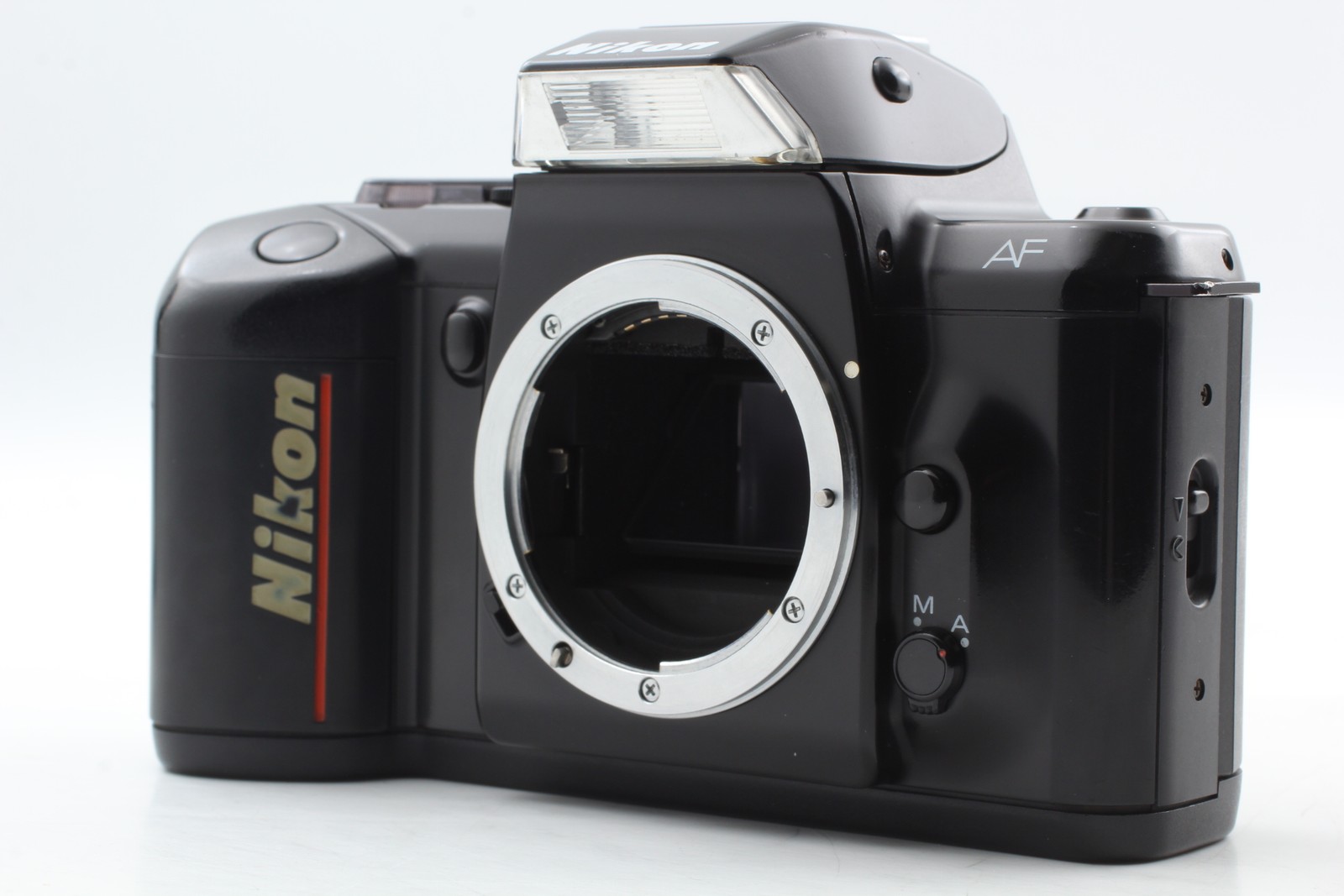
The Nikon F-401 burst onto the scene in 1987 as Nikon’s first true foray into affordable, in-body autofocus SLRs. No longer just for pros and enthusiasts, Nikon’s legendary F-mount now had a gateway for beginners. With its built-in AF motor, pop-up flash, and intuitive design, the F-401 brought serious SLR capability to the point-and-shoot crowd—marking the moment Nikon finally embraced the autofocus revolution with both hands.
Overview
When the F-401 hit the market in late 1987—sold as the N4004 in North America—it signaled a strategic pivot for Nikon. While rivals like Minolta had already seized the consumer AF spotlight with the Maxxum 7000, Nikon had lagged, relying on clunky external motors for its earlier F-301. The F-401 changed that. For the first time, autofocus lived inside the camera body, making it compact, self-contained, and far more approachable.
Designed for photographers stepping up from compact cameras, the F-401 stripped away complexity without sacrificing core SLR functionality. Its polycarbonate shell kept weight down, while automatic exposure modes and a built-in TTL flash made shooting fast and foolproof. Yet beneath the simplicity was real system flexibility: the full Nikon F-mount welcomed AI, AI-S, and AF lenses, preserving decades of lens investment. Autofocus itself was basic—single-servo only, with a passive phase-detection sensor and focus confirmation in the viewfinder—but it worked, and it worked without add-ons.
Sitting beneath the pro-grade F3 and the more advanced F-501 (N2000), the F-401 carved out a new niche: the beginner’s SLR. It didn’t offer manual fine-tuning or blazing speed, but it delivered reliability, automation, and that all-important taste of creative control. When the F-401s (N4004s) arrived in 1989 with program mode and better handling, it built on a foundation the original had firmly laid.
Specifications
| Specification | Value |
| Type | Autofocus 35mm SLR |
| Film Format | 35mm (135) |
| Years Produced | 1987–1989 |
| Lens Mount | Nikon F-mount (AI, AI-S, AF compatible) |
| Shutter | Vertical-travel focal-plane shutter; 1–1/2000 sec, plus Bulb; flash sync at 1/90 sec |
| Metering | TTL center-weighted metering with 6% center emphasis |
| Exposure Modes | Aperture-priority auto, manual, and program auto (in flash mode only) |
| Viewfinder | Fixed pentamirror, 0.85x magnification, 90% coverage; split-image rangefinder spot with microprism collar |
| Dimensions | 139 × 84 × 52 mm (5.5 × 3.3 × 2.0 in); ~490 g (17.3 oz) with battery |
Key Features
- Integrated autofocus system: First Nikon SLR with built-in AF motor, eliminating need for motorized film advance units.
- Built-in pop-up flash: Automatically deploys in low light or manual activation; GN 12 (ISO 100, meters), with TTL auto exposure.
- User-friendly interface: Simplified controls with exposure mode dial, making it ideal for beginners.
- F-mount compatibility: Supports AI, AI-S, and AF lenses, preserving lens investment and system flexibility.
- Compact polycarbonate body: Lightweight and durable construction, a departure from Nikon’s traditional metal-bodied professional models.
Historical Context
The mid-1980s were a battleground for autofocus dominance. Minolta lit the fuse with the 1985 Maxxum 7000, a sleek, fully integrated SLR that left Nikon’s pro-focused lineup looking outdated. The F-301 (N2020) had tried to answer with AF, but its external motor drive was bulky and costly—hardly a mass-market solution. The F-401 was Nikon’s real response: a compact, self-contained AF body built for the everyday shooter.
It entered a crowded field—up against the Canon EOS 650, Minolta Maxxum 3000i, and Pentax SFX. Unlike Canon and Minolta, Nikon stuck with the F-mount, sacrificing some optical innovation for backward compatibility. The trade-off paid off for loyal users. While the F-401’s screw-drive AF was slower than competitors’, its ability to use decades of existing Nikon glass was a powerful draw. Reviews praised its build and ease of use, though enthusiasts dismissed it as underpowered. Still, it did its job: bringing Nikon into the AF era without alienating its core user base.
Collectibility & Value
The F-401 isn’t a grail camera, but it’s earned quiet respect among vintage collectors. It’s not rare—Nikon built plenty between 1987 and 1989—but finding one in full working order is becoming harder. Many suffer from seized shutters, degraded light seals, or flash mechanisms that refuse to pop. When they work, though, they deliver a satisfying taste of early AF history.
Today, a functional F-401 trades for $50–$100. Original boxes, manuals, or accessories can nudge the price up slightly. The 2CR5 battery it needs is still available but pricey—some shooters swap in CR123A adapters to save costs. While it won’t appreciate like a Nikon F2, the F-401 holds its own as a milestone: the first time Nikon made autofocus feel accessible, not intimidating.
Similar Cameras
- Minolta Maxxum 3000i (1986) – Compact AF SLR with integrated motor drive and TTL flash.
- Canon EOS 650 (1987) – First EOS camera, featuring in-body AF and Canon’s new EF mount.
- Pentax SFX (1987) – Weather-sealed AF SLR with built-in flash and autofocus motor.
- Olympus OM-200AF (1988) – Late-entry AF SLR with compact design and TTL metering.
- Yashica Samurai Z (1987) – Budget AF SLR with advanced features for its price point.
Repair & Maintenance
Power comes from a single 2CR5 lithium battery—modestly efficient, lasting around 15–20 rolls under regular use. But time takes its toll. Shutter lag, erratic metering (thanks to aging CdS cells), and flash mechanisms that won’t deploy are common. The pop-up flash often fails due to broken gears or weak springs. Autofocus, driven by a mechanical screw in the lens mount, can slow down if the drive shaft is dirty or misaligned.
Repairs sit in the moderate zone. The body isn’t sealed, so moisture and dust can creep in, leading to internal corrosion. Shutter or AF fixes demand precision—best left to a technician. DIYers can handle light seal swaps, contact cleaning, and basic inspection. Parts are scarce, but donor bodies pop up occasionally. The best preservation? Keep it dry, use it regularly, and treat it like the pioneer it was.
eBay Listings


As an eBay Partner, we earn from qualifying purchases. This helps support our independent vintage technology research.
Service Manuals & Schematics
- Manual (1988) — archive.org
Related Models
- Nikon F-301 (1985-1990)
- Nikon F-501 (1986-1986–1989)
- Nikon F (1959-1973)
- Nikon F100 (1999-2006)
- Nikon F2 (1971–1980)
- Alpa 6 (1948-1953)
- Agfa Agfaflex
- Agfa Ambiflex
- Agfa Easy
- Agfa Futura Af zoom