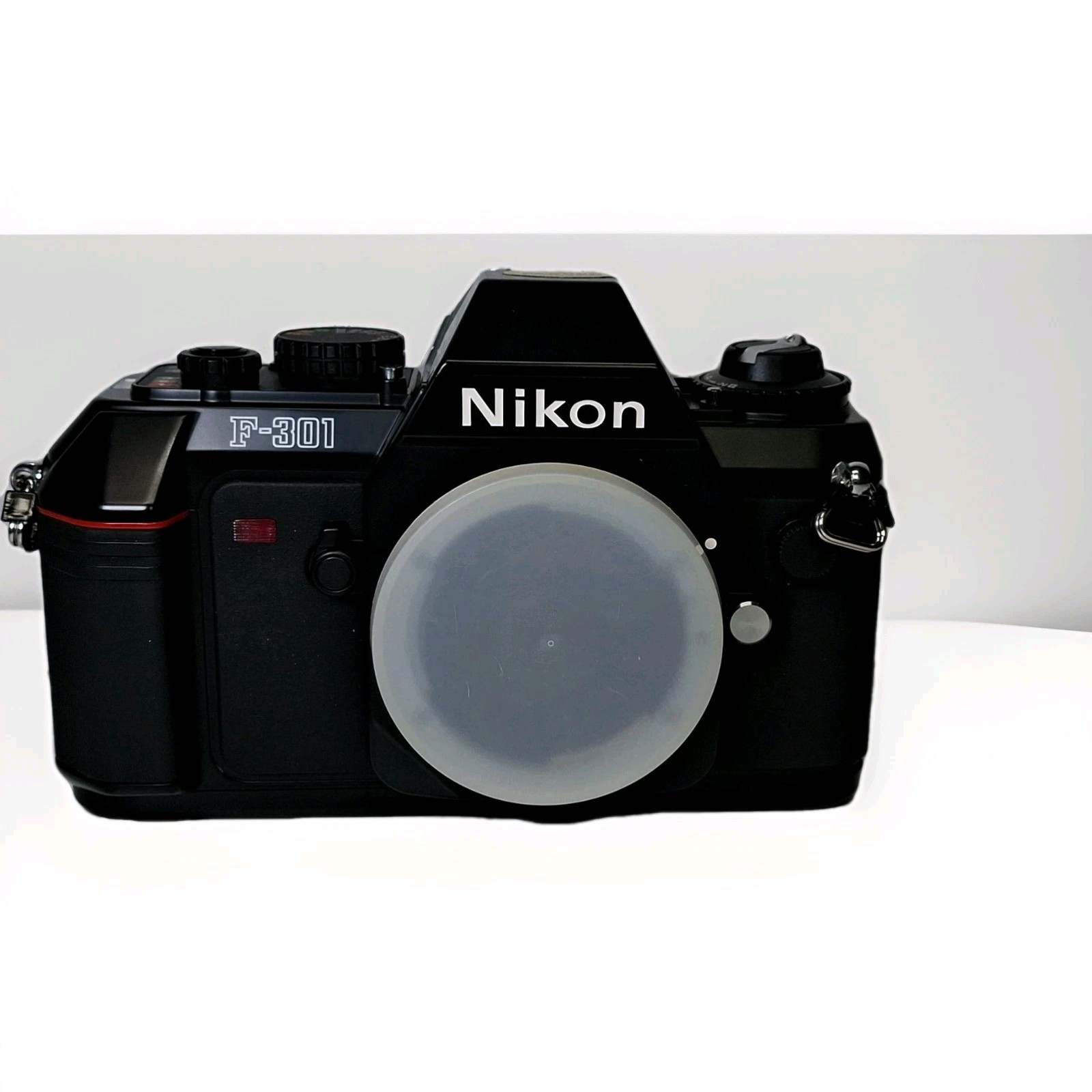
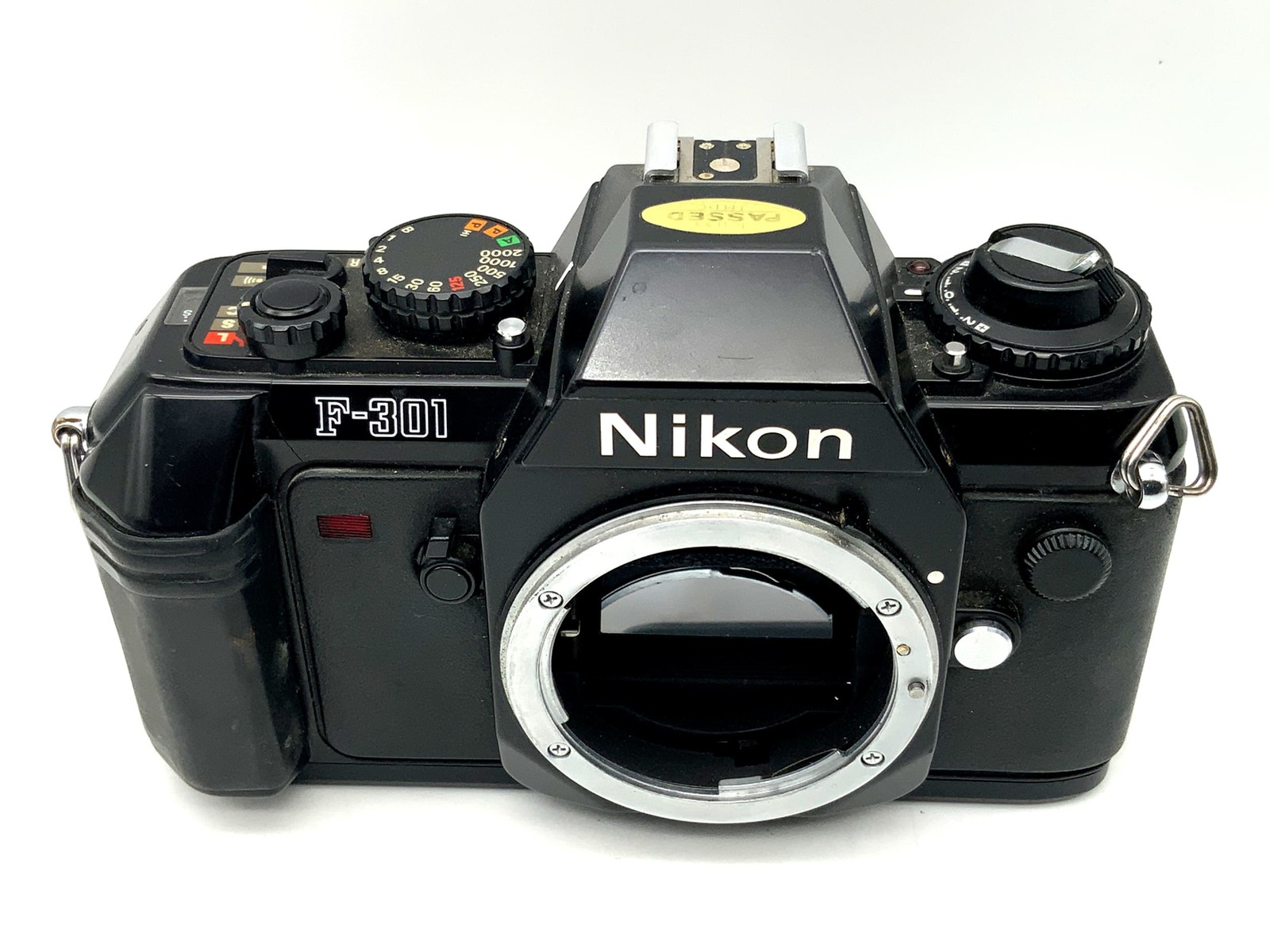
NIKON F-301
The Nikon F-301 is a 35mm film single-lens reflex (SLR) camera introduced in 1985 as an entry-level autofocus-capable model in Nikon’s F-mount lineup. Marketed under the name N2000 in North America, the F-301 was designed to bring autofocus technology to beginner and amateur photographers at an accessible price point during a pivotal transition period in camera development.
Overview
Released in 1985, the Nikon F-301 represented Nikon’s strategic push into the burgeoning consumer autofocus SLR market, a segment increasingly dominated by Canon, Minolta, and Pentax. Positioned as the most affordable Nikon SLR with autofocus capability, the F-301 targeted novice photographers and students seeking a bridge between point-and-shoot automation and interchangeable-lens flexibility. Despite its budget orientation, the F-301 retained core Nikon engineering principles, including compatibility with the extensive Nikon F-mount lens ecosystem, albeit with limitations in metering and autofocus performance compared to higher-end models.
The F-301 features a vertically-traveling, focal-plane shutter, built-in motorized film advance and rewind, and DX film speed coding for automatic ISO detection. Its autofocus system, while rudimentary by modern standards, utilized a phase-detection sensor in the camera body to drive compatible AF lenses—specifically the newly introduced Nikon AF Nikkor 35–70mm f/3.3–4.5 and 75–300mm f/4.5–5.6. Manual focus lenses could still be mounted and used in manual exposure mode, though without through-the-lens autofocus assist. The camera’s design emphasized simplicity, with a top-mounted LCD display indicating shutter speed, exposure mode, and flash status, and a central mode dial offering Program, Aperture Priority, and Manual exposure modes.
Historically, the F-301 served as a transitional model in Nikon’s evolution toward full autofocus integration. It preceded the more advanced Nikon F-501 (N2020) and shared design elements with it, such as the motor drive and autofocus mechanism. However, unlike the F-501, the F-301 lacked aperture control in Program mode for non-CPU lenses and had a more limited metering system. It was discontinued around 1990, succeeded by more sophisticated entry-level models with improved autofocus and metering capabilities.
Specifications
| Specification | Value |
| Type | 35mm Single-Lens Reflex (SLR) |
| Film Format | 35mm (135) |
| Years Produced | 1985–1990 |
| Lens Mount | Nikon F-mount (with AI, AI-S, and AF lens compatibility) |
| Shutter | Electronically controlled, vertical-travel focal-plane shutter; speeds from 1 to 1/2000 sec, plus Bulb; X-sync at 1/90 sec |
| Metering | Center-weighted TTL metering via silicon photodiode (SPD) sensor |
| Exposure Modes | Program (P), Aperture Priority (A), Manual (M) |
| Viewfinder | Fixed pentamirror, 0.82x magnification, 94% coverage; split-image rangefinder spot with microprism collar |
| Dimensions | 142 mm (W) × 95 mm (H) × 53 mm (D); approx. 550 g (body only, with battery) |
Key Features
- Autofocus capability with Nikon’s first generation AF lenses, enabling automatic focusing with compatible 35–70mm and 75–300mm zooms.
- Integrated motor drive for automatic film advance at 1.4 frames per second and automatic rewind at film end.
- DX film speed recognition automatically sets ISO between 25 and 3200 based on film canister coding.
- Programmed autoexposure mode with shutter speed automation, optimized for ease of use by beginners.
- TTL center-weighted metering ensures accurate exposure under most lighting conditions when using AI and AI-S lenses.
Historical Context
The Nikon F-301 was launched at a time of rapid technological change in the SLR market. The early 1980s saw the rise of autofocus technology, pioneered by Minolta with the Maxxum 7000 in 1985, which forced traditional manufacturers like Nikon and Canon to respond. Unlike Minolta, which adopted a new lens mount, Nikon chose to maintain backward compatibility with its F-mount, resulting in hybrid designs like the F-301 that could autofocus only with lenses containing built-in focus motors.
The F-301 was Nikon’s answer to the growing demand for affordable, easy-to-use SLRs. It competed directly with models such as the Pentax SFX, Canon T50, and Minolta Maxxum 7000i. While it lacked the full feature set of its rivals—particularly in autofocus speed and lens compatibility—it offered the advantage of access to Nikon’s vast legacy lens library. This made it appealing to photographers who already owned manual focus Nikkors or planned to upgrade to higher-end Nikon bodies later.
Market reception was mixed. Critics praised its build quality and Nikon reliability but noted sluggish autofocus performance and limited lens support. Nonetheless, the F-301 found a niche among budget-conscious buyers and served as an important stepping stone in Nikon’s transition to autofocus, demonstrating the brand’s commitment to maintaining its F-mount while gradually introducing modern features.
Collectibility & Value
Today, the Nikon F-301 is considered a niche collectible, primarily of interest to Nikon historians and enthusiasts of 1980s SLR technology. It is not rare, as it was produced in significant numbers during its five-year production run, but complete examples with original packaging and accessories are increasingly uncommon. The camera typically sells for $50–$120 on the secondhand market, depending on condition and inclusion of original lenses.
When purchasing an F-301, collectors should verify the functionality of the autofocus system, which relies on aging electronics and rubber drive couplings that may have degraded over time. The motor drive is generally reliable but can suffer from worn gears or dried lubricants in long-term storage. Battery compartment corrosion from expired 6V PX28 or 4SR44 batteries is a common issue, potentially affecting the camera’s circuitry. Additionally, the light seals should be replaced to prevent light leaks, and the mirror damping mechanism should be checked for smooth operation.
Due to its reliance on proprietary battery types and limited lens compatibility for autofocus, the F-301 is not ideal as a daily shooter. However, it remains a functional and historically significant camera, illustrating Nikon’s cautious yet determined entry into the autofocus era.
Similar Cameras
- Canon T50 (1983) – Canon’s first AF SLR, featuring aperture-priority and program modes.
- Pentax SFX/SF1 (1987) – First Pentax AF SLR with TTL metering and motor drive.
- Minolta Maxxum 7000 (1985) – Groundbreaking full-featured AF SLR with integrated motor and advanced electronics.
- Olympus OM-2000 (1989) – Entry-level AF model in the OM series, though with limited lens support.
- Yashica Samurai Z (1987) – Budget AF SLR with compact design and TTL metering.
Repair & Maintenance
The Nikon F-301 uses a 6-volt 4SR44 or PX28 battery to power its electronic shutter, autofocus system, and metering. These batteries are now largely obsolete, though modern equivalents (such as 4LR44 with a voltage booster) or adapters to use two 3V CR1/3N cells are available. Battery leakage is a frequent problem in older units, requiring careful inspection and cleaning of the battery contacts and surrounding circuitry.
Common mechanical issues include sluggish or failed autofocus, often due to worn rubber drive wheels in the lens coupling mechanism or degraded internal lubricants. The film transport motor is robust but may require servicing if the advance or rewind functions fail. Shutter accuracy should be tested, as aging capacitors can cause timing drift at slower speeds.
Repair difficulty is moderate: while the camera is not hermetically sealed, disassembly requires precision tools and familiarity with Nikon’s internal layout. Replacement parts are scarce, making donor cameras a practical necessity for serious repairs. For regular maintenance, cleaning the mirror, replacing light seals, and checking the viewfinder clarity are recommended to preserve functionality and image quality.
eBay Listings


As an eBay Partner, we earn from qualifying purchases. This helps support our independent vintage technology research.
Related Models
- Nikon F-401 (1987-1989)
- Nikon F-501 (1986-1986–1989)
- Nikon F (1959-1973)
- Nikon F100 (1999-2006)
- Nikon F2 (1971–1980)
- Alpa 6 (1948-1953)
- Agfa Agfaflex
- Agfa Ambiflex
- Agfa Easy
- Agfa Futura Af zoom