NIKON F
The Nikon F, introduced in 1959, was Nikon’s first 35mm single-lens reflex (SLR) camera and marked the company’s decisive entry into the professional photography market. Renowned for its rugged build, modular design, and the introduction of the enduring Nikon F-mount, it quickly became the standard for photojournalists, scientists, and NASA engineers alike.
Overview
The Nikon F was developed during a pivotal era in photography when SLR systems began to supplant rangefinder cameras as the preferred tools for professional photographers. Released in March 1959, the Nikon F was engineered to meet the demanding needs of press, scientific, and industrial photographers who required precision, reliability, and interchangeability. It was designed as a fully mechanical, modular system camera, allowing users to swap viewfinders, focusing screens, film backs, and motor drives—features that were revolutionary at the time.
Targeted explicitly at professionals, the Nikon F offered an unprecedented level of customization and durability. Its all-metal construction, precision-machined from brass and aluminum, ensured longevity under harsh conditions. The camera’s most enduring legacy was the introduction of the Nikon F-mount—a 44mm throat diameter bayonet mount with a 46.5mm flange focal distance—which remains in use in modified form in Nikon’s digital SLRs over six decades later. This backward compatibility is a testament to the foresight in the F’s design.
The Nikon F’s success established Nikon as a dominant force in professional photography, displacing German rangefinder systems like the Leica M3 and Contax in many fields. It was rapidly adopted by major news agencies, including The Associated Press and Magnum Photos, and became the camera of choice for documenting historic events such as the Vietnam War, the Civil Rights Movement, and the Apollo space missions. Its modular system allowed for specialized configurations, including use in NASA’s Mercury, Gemini, and Apollo programs, where modified Nikon Fs were used in space with Zeiss and Nikon lenses.
Specifications
| Specification | Value |
| Type | 35mm Single-Lens Reflex (SLR) |
| Film Format | 35mm (135 film), 24 x 36mm frame |
| Years Produced | 1959–1973 |
| Lens Mount | Nikon F-mount (mechanical, non-AI) |
| Shutter | Vertically-traveling, focal-plane cloth shutter; 1–1/2000 sec, plus B (bulb) |
| Metering | None (body-integrated metering not available; optional external meters such as Photomic FT) |
| Exposure Modes | Manual only (shutter speed and aperture set on lens) |
| Viewfinder | Interchangeable pentaprism or waist-level finder; eye-level prism with 0.72× magnification (standard) |
| Dimensions | 149 × 96 × 57 mm (body only); Weight: ~770 g (body with prism, no lens) |
Key Features
- Modular System Design: Interchangeable viewfinders, focusing screens, film backs, and motor drives (e.g., F Motor Drive, capable of 3.5 fps).
- Nikon F-Mount Introduction: The original 44mm bayonet mount with mechanical aperture coupling, compatible with modern Nikon DSLRs (with limitations).
- Precision Mechanical Shutter: Reliable 1–1/2000 sec + B shutter with flash synchronization at 1/60 sec (X-sync).
- NASA-Certified Reliability: Used in space missions with modifications for zero-gravity operation and extreme thermal environments.
- Professional Ecosystem: Supported by a wide array of accessories, including data backs, photomicrography attachments, and specialized lenses.
Historical Context
The Nikon F was launched at a time when German optical firms dominated professional photography, particularly with rangefinder cameras. However, the limitations of rangefinders—especially parallax error and inability to use long telephoto lenses accurately—created demand for a robust SLR system. Nikon, already respected for its high-quality optics (developed initially for military use), leveraged its engineering expertise to create a camera that addressed these shortcomings.
The Nikon F’s debut at the 1959 Photokina exhibition stunned the industry. Its build quality, precision, and system expandability far exceeded contemporary SLRs like the Asahi Pentax or the Exakta Varex. It outperformed them in durability, lens selection, and ergonomic design. By 1962, Nikon had established a strong foothold in the U.S. market, aided by aggressive marketing and support from distributors like Ehrenreich Photo-Optical Industries.
Its adoption by NASA in the 1960s cemented its reputation. Modified Nikon Fs were used aboard Mercury, Gemini, and Apollo missions, often fitted with 35mm f/1.4 or 55mm f/1.2 lenses to capture high-resolution images in low light. These space-flown units, often without mirrors to prevent imbalance in zero-G, demonstrated the camera’s adaptability and reliability under extreme conditions.
Collectibility & Value
The Nikon F remains one of the most collectible 35mm SLRs ever made, particularly early models with the chrome "Nikkor" script and the original bayonet prism. Complete systems with motor drives, multiple finders, and rare lenses command premium prices at auction. As of 2024, a fully functional Nikon F body in excellent condition typically sells for $800–$1,500, with rare configurations (e.g., NASA-issued or press kits) reaching $3,000 or more.
Collectors should prioritize originality, shutter functionality, and the presence of matching serial numbers on interchangeable components. Common issues include degraded light seals, stiff shutter speeds (especially at 1/1000 and 1/2000 sec), and prism fungus. The camera requires no batteries for operation, but optional metered prisms (e.g., Photomic T, FT, or FTn) use mercury or modern PX625-equivalent batteries. Due to its mechanical complexity, servicing should be performed by specialists familiar with vintage Nikon systems.
Similar Cameras
- Canon F-1 (1971) – Canon’s first professional SLR, directly inspired by the Nikon F.
- Pentax Spotmatic (1964) – Popular 35mm SLR with TTL metering, aimed at advanced amateurs.
- Topcon RE Super (1963) – Japanese SLR with high-quality optics and interchangeable viewfinders.
- Praktina FX (1952) – Early modular SLR from East Germany, technically advanced but less reliable.
- Alpa-Reflex (1943–1960s) – Swiss precision SLR favored by studio photographers for its build and lens quality.
Repair & Maintenance
The Nikon F is a fully mechanical camera and operates without batteries. However, metered viewfinder accessories (e.g., Photomic FT) require 1.35V mercury batteries (original PX625), now replaced by zinc-air or adapter solutions. The camera’s shutter and film transport mechanisms are robust but require periodic cleaning and lubrication after decades of use.
Common issues include sticky shutter curtains (especially at high speeds), mirror bounce, and worn film advance levers. The film advance mechanism is prone to wear if the camera has seen heavy use, and the internal light seals often degrade, causing light leaks. Replacement seals and careful recalibration are essential during servicing.
Due to its modular nature, parts compatibility must be verified—early and late production models have slight differences in prism alignment and film back latches. Repair is considered moderately difficult and should be undertaken by technicians experienced with vintage Nikon equipment. Replacement parts are available through specialty suppliers and salvage units, though original Nikon service manuals remain the best resource for restoration.
eBay Listings

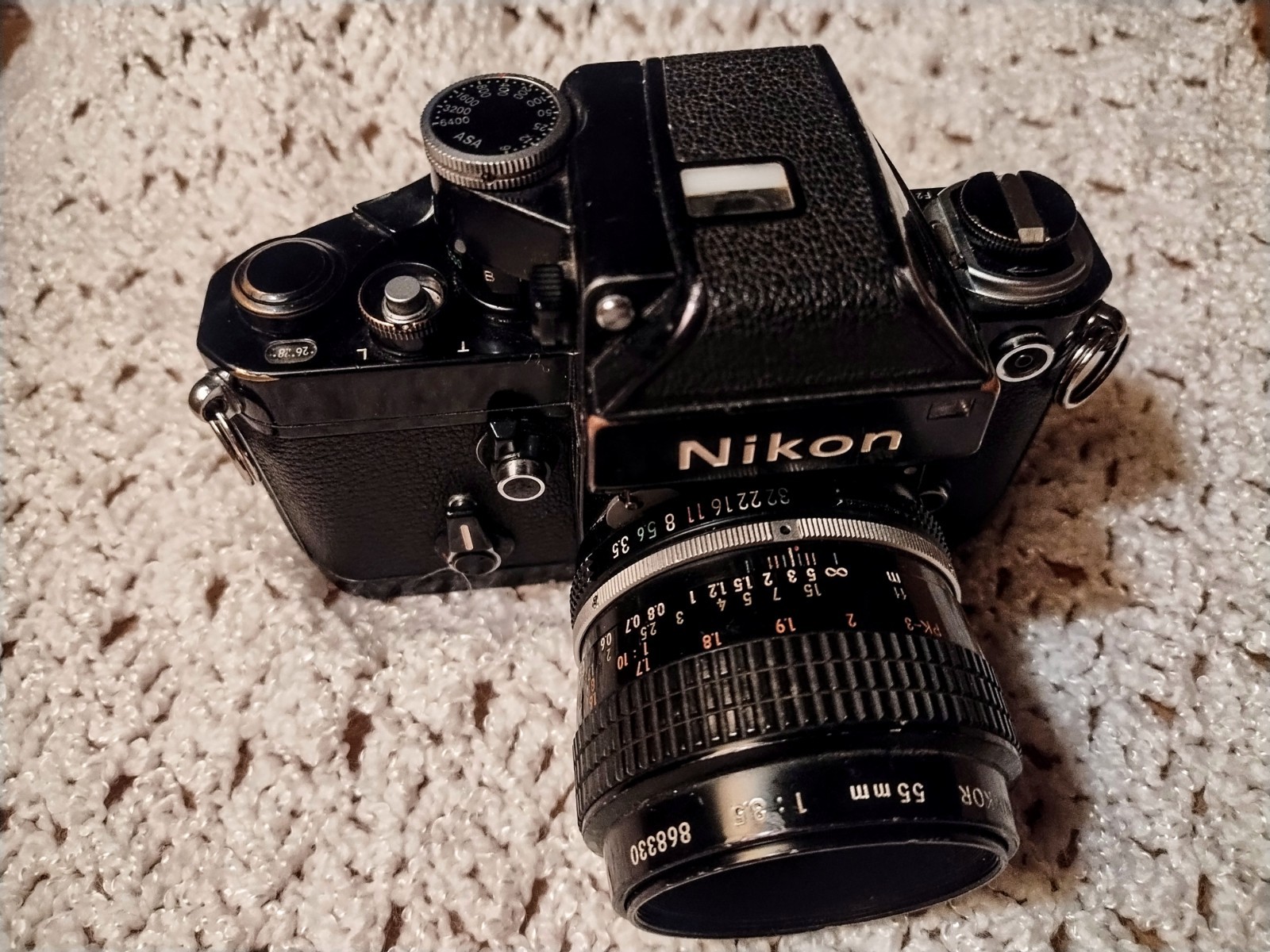
![[US Duty Paid] Nikon F Eye Level 35mm Film Camera Nikkor-SC](https://i.ebayimg.com/images/g/2PkAAeSwAXppBESM/s-l1600.jpg)

As an eBay Partner, we earn from qualifying purchases. This helps support our independent vintage technology research.
Related Models
- Nikon F-301 (1985-1990)
- Nikon F-401 (1987-1989)
- Nikon F-501 (1986-1986–1989)
- Nikon F100 (1999-2006)
- Nikon F2 (1971–1980)
- Alpa 6 (1948-1953)
- Agfa Agfaflex
- Agfa Ambiflex
- Agfa Easy
- Agfa Futura Af zoom