NIKON 35TI
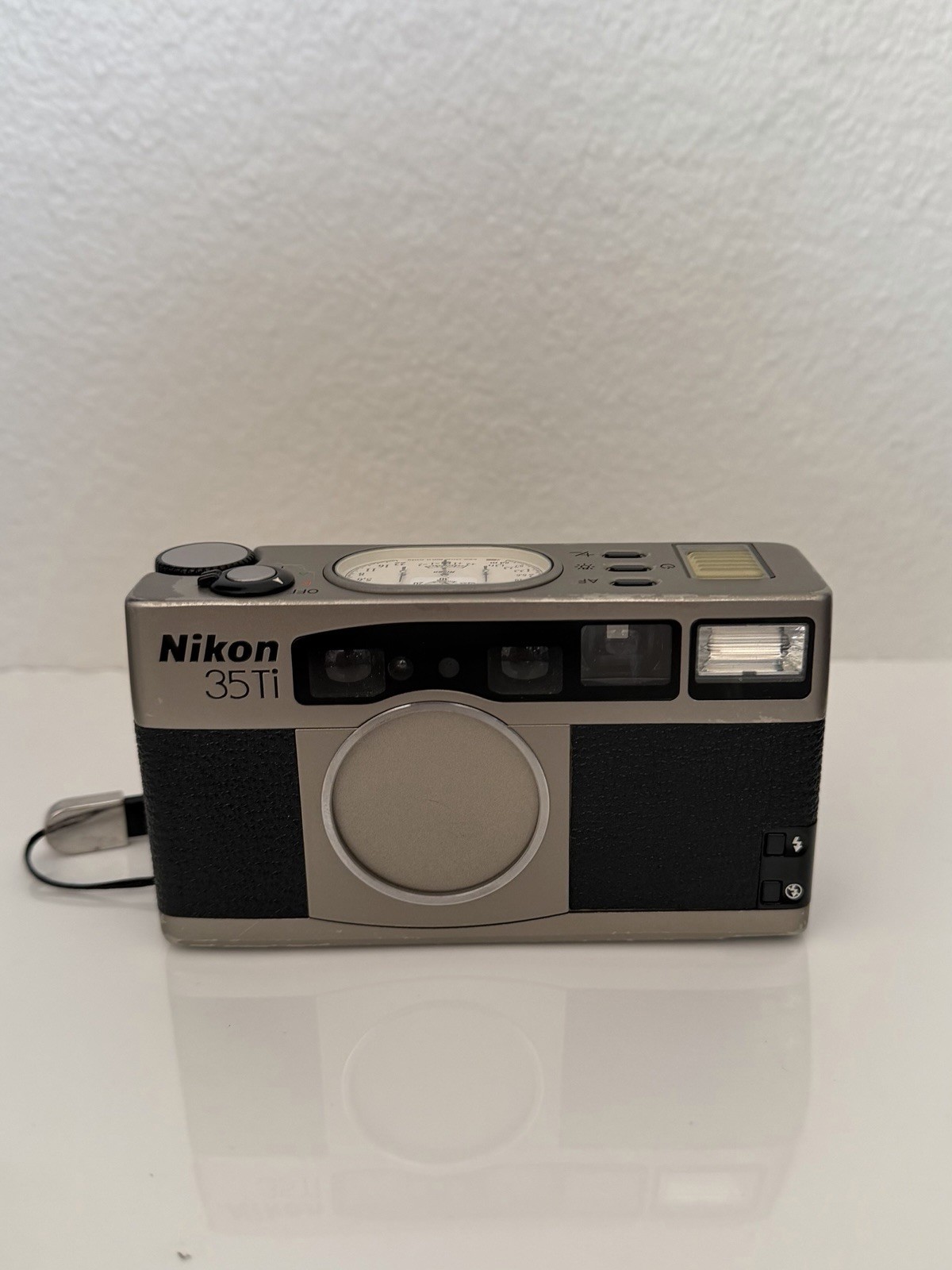
The Nikon 35Ti is a premium 35mm compact film camera introduced in 1993, combining advanced metering technology, a high-quality fixed Nikkor lens, and a distinctive analog-dial interface. Designed for enthusiasts and professionals seeking a portable yet sophisticated film camera, the 35Ti stands out for its precision engineering, compact titanium-clad body, and integration of Nikon’s 3D Matrix Metering system in a point-and-shoot format.
Overview
Released in 1993, the Nikon 35Ti was part of a short-lived but highly regarded series of premium compact cameras from Nikon, which also included the 28Ti (with a wider 28mm lens) and the later 35TiQD. Positioned above consumer-grade point-and-shoot models, the 35Ti targeted serious photographers who valued portability without sacrificing optical quality or manual control. Its design philosophy emphasized mechanical refinement and intuitive operation, evident in its analog dials for shutter speed, aperture, and exposure compensation—unusual for compact cameras of the era, which typically relied on digital LCDs and button-based interfaces.
The 35Ti featured a fixed 35mm f/2.8 Nikkor lens, a focal length widely regarded as ideal for street, documentary, and travel photography. Despite its compact form, the camera incorporated Nikon’s advanced 3D Matrix Metering system—borrowed from its professional F-series SLRs—utilizing subject distance information from the lens and RGB scene analysis for highly accurate exposure calculations. This made the 35Ti one of the most technically advanced compact cameras of the early 1990s. The camera’s body was constructed with a titanium top and base plate, lending durability and a premium tactile feel, while maintaining a relatively lightweight profile at approximately 280 grams (with battery).
Within Nikon’s lineup, the 35Ti occupied a niche between the mass-market Nikon One Touch series and the professional F4/F5 SLRs. It represented Nikon’s commitment to optical excellence in compact formats and showcased their ability to miniaturize SLR-level technologies. Though not a commercial blockbuster, the 35Ti gained a cult following among photographers who appreciated its blend of understated elegance, manual control, and superior lens performance. Production ended around 2000, with the model being succeeded briefly by the 35TiQD (Quick Disable), which added a lens cover lock feature.
Specifications
| Specification | Value |
| Type | Fixed-lens compact camera |
| Film Format | 35mm (135) |
| Years Produced | 1993–2000 |
| Lens Mount | Fixed 35mm f/2.8 Nikkor lens (no interchangeable mount) |
| Shutter | Electronically controlled vertical-travel focal-plane shutter; 16 sec to 1/200 sec (auto), 4 sec to 1/200 sec (manual), plus Bulb mode |
| Metering | 3D Matrix Metering (RGB-segmented sensor with distance integration), center-weighted, and spot metering |
| Exposure Modes | Program AE, Shutter Priority, Aperture Priority, Manual, and Auto (with flash) |
| Viewfinder | Optical direct-vision viewfinder with parallax correction marks, diopter adjustment (-2 to +1), and LED exposure indicators |
| Dimensions | 116 × 64 × 40 mm; weight: 280 g (with battery) |
Key Features
- 35mm f/2.8 Nikkor lens with 6 elements in 5 groups, delivering sharp, contrast-rich images with minimal distortion and excellent close-focus capability (0.8m minimum).
- Analog dial interface for shutter speed (top plate) and aperture (front ring), providing tactile, SLR-like control rare in compact cameras.
- 3D Matrix Metering system that uses subject distance data from the lens and scene color/contrast analysis for precise exposure—technology derived from the Nikon F90 and F4.
- Program Shift function allowing manual override of auto-exposure settings while maintaining correct exposure.
- Titanium-clad body offering durability and a high-end finish, with sealed construction for dust and moisture resistance.
Historical Context
The Nikon 35Ti was launched during a period of intense competition in the premium compact camera market, dominated by offerings from Contax (T2, T3), Canon (Sure Shot QL17, EOS M), and Minolta (TC-1). Nikon aimed to differentiate the 35Ti by leveraging its SLR heritage, particularly its metering and lens technologies. The inclusion of 3D Matrix Metering—a feature previously exclusive to Nikon’s flagship SLRs—was a bold move, positioning the 35Ti as a “miniature F4” in functionality.
Despite its technical merits, the 35Ti faced challenges in market penetration. Its premium price point (over $600 at launch) limited its appeal compared to more automated or stylistically sleeker rivals. Additionally, the rise of autofocus zoom compacts in the mid-1990s shifted consumer preferences toward versatility over optical purity. Nevertheless, the 35Ti earned critical acclaim for its image quality and build, often praised in contemporary reviews for its “SLR-like” handling and reliability. It remains a benchmark for fixed-lens compact design, influencing later models like the Nikon 25mm f/2.8 Compact (discontinued in 2002) and even modern digital compacts such as the Nikon Coolpix A.
Collectibility & Value
Today, the Nikon 35Ti is a sought-after collector’s item, particularly among film photography enthusiasts and Nikon aficionados. Units in excellent working condition typically sell for $400–$700 on the secondary market, with higher prices for models accompanied by original boxes, manuals, or rare accessories. The camera’s relative rarity—especially outside Japan—and its titanium construction contribute to its desirability. Well-maintained examples with clean viewfinders, responsive dials, and accurate metering are highly prized.
When purchasing a 35Ti, buyers should verify the functionality of the shutter, meter, and autofocus system. Common issues include degraded light seals (leading to light leaks), stiff or unresponsive dials due to dried lubricants, and failure of the electronic contacts. The camera uses a single 2CR5 lithium battery (3V), which powers both the electronics and autofocus motor. While still available, expired batteries can leak and damage internal components, so a thorough inspection is recommended. Additionally, the lens extension mechanism should operate smoothly; any grinding or hesitation may indicate misalignment or motor wear.
Similar Cameras
- Contax T2 (1990) – 38mm f/2.8 Sonnar lens, titanium body, aperture/shutter priority, renowned for its Zeiss optics and compact design.
- Minolta TC-1 (1996) – 28mm f/3.5 G-Rokkor lens, ultra-compact titanium body, advanced metering, considered one of the greatest 35mm compacts ever made.
- Canon Canonet QL17 G-III (1972–1982) – Rangefinder-style 35mm compact with 40mm f/1.7 lens, popular for its speed and optical quality.
- Yashica T4 (TZ-1) – 35mm f/3.5 lens with Carl Zeiss Tessar design, known for sharpness and rugged build.
- Nikon 28Ti – Sister model to the 35Ti with a 28mm f/2.8 lens, even rarer and more collectible.
Repair & Maintenance
The Nikon 35Ti uses a 2CR5 3V lithium battery, commonly found in older cameras and security devices. Battery life is approximately one year with moderate use. Due to the camera’s sealed construction, battery replacement requires a small screwdriver to open the base compartment. Always remove the battery when storing the camera long-term to prevent leakage.
Common maintenance issues include worn light seals (which should be replaced every 10–15 years), sluggish autofocus motors, and oxidation on electrical contacts. The analog dials may stiffen over time due to dried lubricants; professional servicing may be required to clean and re-lubricate internal mechanisms. The lens retracts automatically when powered off, but mechanical obstruction can damage the drive system. Repair parts are limited, and few technicians specialize in this model, making experienced Nikon film camera repair services essential. Regular use and storage in a dry, temperature-stable environment are recommended to preserve functionality.
eBay Listings


As an eBay Partner, we earn from qualifying purchases. This helps support our independent vintage technology research.
Service Manuals & Schematics
- Service Manual — archive.org