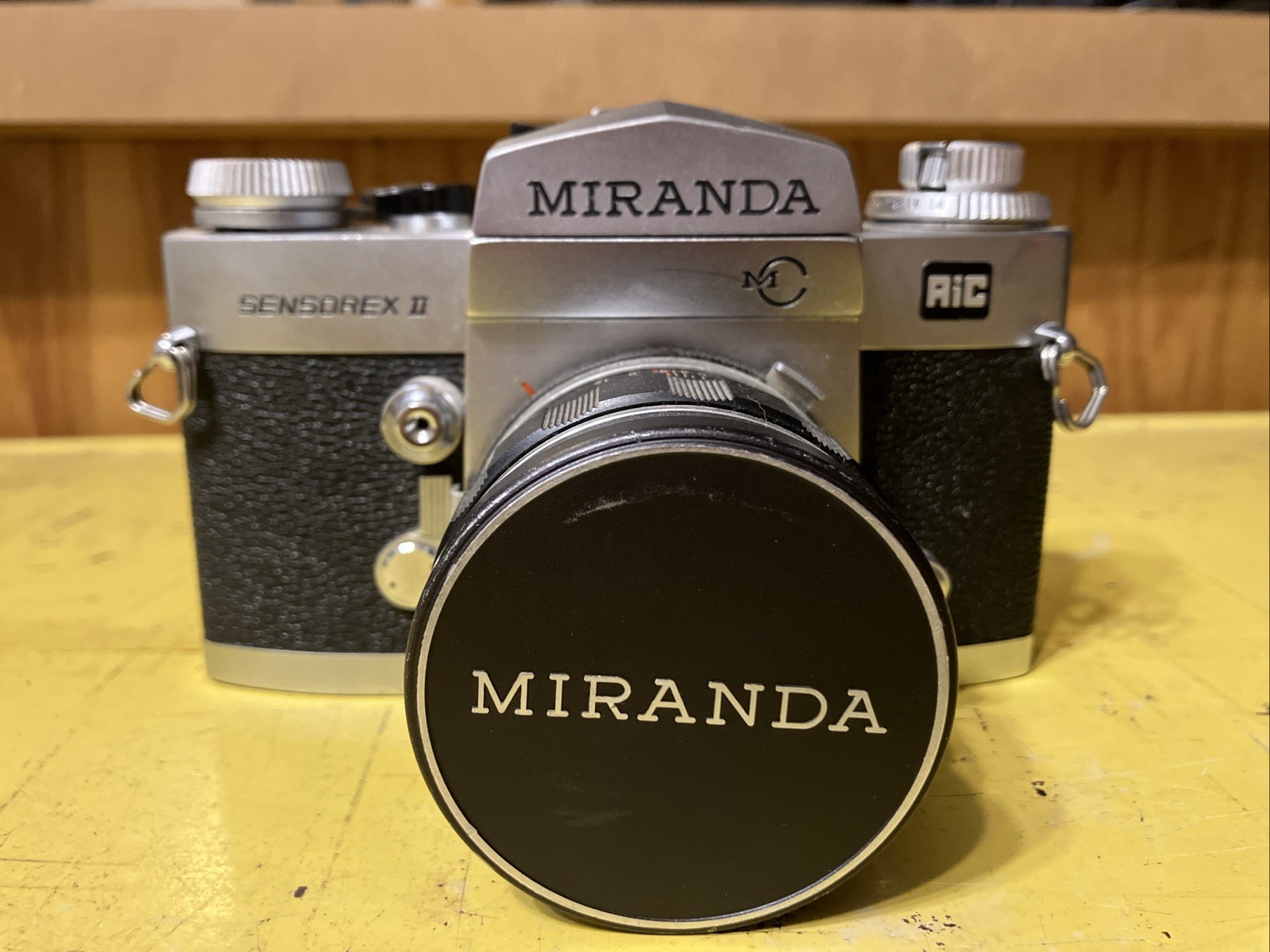
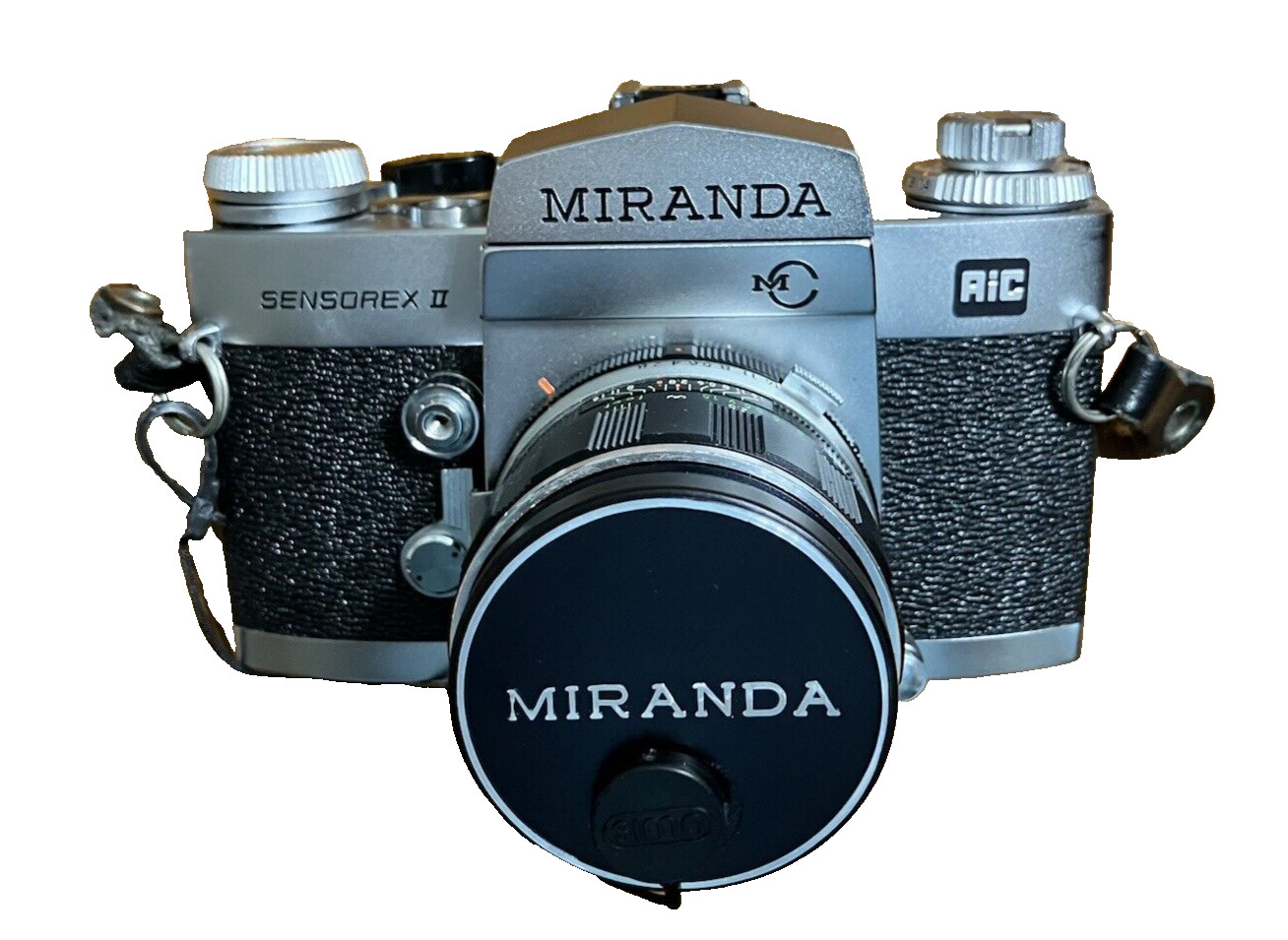
MIRANDA SENSOREX II
As an evolution of the original Sensorex, the Sensorex II refined its predecessor’s advanced metering system and mechanical reliability, positioning itself as a high-end manual focus SLR aimed at serious amateur and professional photographers during a transformative period in Japanese camera engineering.
Overview
Introduced in 1971, the Miranda Sensorex II represented the culmination of Miranda’s long-standing commitment to precision mechanical design and innovative exposure metering integration. It succeeded the original Sensorex (1966), which had been one of the first SLRs to feature through-the-lens (TTL) open-aperture metering using a selenium cell. The Sensorex II updated this system with a more sensitive and durable CdS (cadmium sulfide) photoresistor, enabling center-weighted metering with improved low-light performance and consistent battery-powered operation. This shift from selenium to CdS marked a significant technological advancement, aligning Miranda with contemporaries like Nikon and Pentax who were also adopting CdS cells during this era.
The Sensorex II was marketed toward advanced photographers who demanded accurate exposure control, robust build quality, and compatibility with a wide array of lenses. It featured a full suite of professional-grade controls, including a vertically traveling cloth focal-plane shutter, a fixed pentaprism viewfinder with split-image rangefinder focus aid, and a self-timer lever. Built with a die-cast aluminum chassis and metal top and bottom plates, the camera exuded durability and mechanical integrity. Despite its relatively late release in the early 1970s—when fully automatic exposure systems were gaining traction—the Sensorex II remained a fully manual camera, emphasizing mechanical precision over automation.
Within Miranda’s product lineup, the Sensorex II occupied the top tier, above models like the D, DX, and Auto Sensorex. It was part of a lineage that began with the original Miranda T of 1955, among Japan’s early 35mm SLRs. By the time of the Sensorex II’s release, Miranda had established a reputation for engineering excellence, though it struggled to maintain market share against larger competitors with broader marketing reach and faster innovation cycles. The Sensorex II, while technically accomplished, was produced in relatively limited numbers and discontinued by 1975, marking the end of Miranda’s high-end mechanical SLR era.
Specifications
| Specification | Value |
| Type | 35mm Single-Lens Reflex (SLR) |
| Film Format | 35mm (135 cartridge) |
| Years Produced | 1971–1975 |
| Lens Mount | Miranda bayonet mount (incompatible with M42 or Nikon F) |
| Shutter | Vertically traveling cloth focal-plane; speeds 1 sec to 1/1000 sec, plus B |
| Metering | TTL CdS meter with match-needle display; center-weighting is not documented in official specifications |
| Exposure Modes | Manual exposure only |
| Viewfinder | Fixed pentaprism with split-image rangefinder and microprism collar; ~94% coverage |
| Dimensions | Approx. 148 × 95 × 55 mm; Weight: ~740 g (body only, with battery) |
Key Features
- TTL Center-Weighted CdS Metering: Utilized a cadmium sulfide cell for accurate through-the-lens exposure readings, displayed via a match-needle system in the viewfinder and on the top-plate meter window.
- Miranda Bayonet Mount: A proprietary lens mount supporting automatic diaphragm and open-aperture metering, offering excellent lens-to-body communication but limiting third-party lens compatibility.
- Mechanical Shutter with Flash sync at 1/60 sec (X-sync); no provision for flash sync at all speeds: The vertical cloth shutter allowed flash synchronization at all speeds (X-sync at 1/60 sec), a feature valued by studio and press photographers.
- Split-Image Focusing Screen: Integrated split-image rangefinder with microprism collar for precise manual focusing, typical of professional SLRs of the era.
- Self-Timer and Depth-of-Field Preview: Included mechanical self-timer lever and dedicated depth-of-field preview button for critical focusing and aperture control.
Historical Context
The Miranda Sensorex II was released at a pivotal moment in the evolution of 35mm SLR photography. By the early 1970s, Japanese manufacturers such as Nikon, Canon, Pentax, and Minolta were rapidly advancing electronic integration, introducing aperture-priority automation and eventually full program modes. The Nikon F (1959) and its successors had already set the standard for professional SLRs, while Pentax’s Spotmatic series (introduced 1964) popularized TTL metering in a mass-market format. Against this backdrop, the Sensorex II stood out for its refined mechanical execution and high-quality metering system, but it lacked the automation features increasingly expected by photographers.
Miranda, while respected for its build quality and optical innovations, operated on a smaller scale than its competitors and failed to invest heavily in electronic automation or global marketing. The Sensorex II’s reliance on a proprietary lens mount further limited its appeal, as photographers increasingly favored systems with broad lens ecosystems. Despite favorable reviews for its metering accuracy and tactile controls, the camera did not achieve widespread commercial success. Production ceased around 1975, and Miranda effectively withdrew from the SLR market shortly thereafter, marking the Sensorex II as one of the brand’s final significant contributions to 35mm photography.
Collectibility & Value
Today, the Miranda Sensorex II is a sought-after model among collectors of vintage mechanical SLRs, particularly those interested in niche Japanese engineering or the evolution of TTL metering systems. Its limited production numbers and high build quality contribute to its relative rarity, especially in fully functional condition.
When purchasing a Sensorex II, collectors should verify the functionality of the shutter across all speeds, the accuracy of the CdS meter (which requires an obsolete PX625 1.35V mercury battery or modern voltage adapter), and the condition of the light seals, which often degrade and cause light leaks. The proprietary battery dependency is a common issue—substitutes like Wein Cell MRB625 or adapters with 1.5V zinc-air batteries can be used but may require meter recalibration. Additionally, the Miranda bayonet mount lenses are rare and expensive, so buyers should consider availability and cost of compatible optics. The camera’s mechanical complexity demands skilled servicing, and while parts are scarce, specialized vintage camera technicians can often restore functionality.
Similar Cameras
- Pentax Spotmatic F (1973–1976): Shared TTL CdS metering and manual focus, but used the universal M42 screw mount.
- Nikon F Photomic T (1965–1971): Professional-grade SLR with interchangeable finders and TTL metering, though earlier than the Sensorex II.
- Canon FTb (1971–1978): Featured TTL metering, robust build, and the FD lens mount, offering strong competition in the pro-am market.
- Yashica TL Electro-X (1973): Combined manual controls with electronic shutter and CdS metering, representing a more automated direction.
- Topcon RE Super (1963–1971): High-end Japanese SLR with excellent optics and TTL metering, though slightly earlier and with a different market focus.
Repair & Maintenance
The Miranda Sensorex II requires a 1.35V mercury PX625 battery for proper meter operation, though modern equivalents like the Wein Cell MRB625 (1.35V) or zinc-air replacements (1.5V) can be used with potential meter calibration offsets. Shutter maintenance is critical due to age-related cloth deterioration and lubricant hardening; a full CLA (clean, lubricate, adjust) by a technician experienced with vintage Japanese SLRs is recommended for non-functional units. Common issues include sticky shutter curtains, inaccurate meter readings due to aging CdS cells, and light leaks from degraded foam seals. The camera’s mechanical shutter operates without batteries, but meter functionality is essential for intended use. Given the scarcity of parts and specialized knowledge, repair should be entrusted to experts familiar with Miranda’s unique mechanics. Regular use, proper storage, and periodic servicing can preserve the Sensorex II’s functionality for continued photographic use.
eBay Listings


As an eBay Partner, we earn from qualifying purchases. This helps support our independent vintage technology research.
Related Models
- Miranda AutoSensorex EE (1972-1976)
- Miranda D (1960-1965)
- Miranda F (1963-1970)
- Miranda G (1967-1971)
- Miranda Sensorex (1966-1972)
- Alpa 6 (1948-1953)
- Agfa Agfaflex
- Agfa Ambiflex
- Agfa Easy
- Agfa Futura Af zoom