MIRANDA G
It represents the culmination of the company’s mechanical engineering expertise, featuring a modular design, interchangeable viewfinders, and one of the last SLR systems to offer a fully removable pentaprism.
Overview
The Miranda G was released at a pivotal moment in the history of 35mm photography, as the industry began transitioning from fully mechanical systems to electronically controlled cameras. Positioned as Miranda’s top-tier professional model, the G was designed for photographers demanding maximum versatility, rugged construction, and precision optics. The G was marketed as a system camera, compatible with a wide array of accessories, including motor drives, multiple focusing screens, interchangeable backs, and a range of viewfinders—most notably the removable pentaprism, a feature increasingly rare by the late 1960s.
One of the defining characteristics of the Miranda G is its adherence to modularity at a time when competitors like Nikon (F) and Canon (F-1) were also embracing system-based designs. However, Miranda distinguished itself by retaining full mechanical operation and a user-replaceable pentaprism, allowing photographers to switch between eye-level, waist-level, and prism finders without tools. This made the G particularly appealing to press, scientific, and technical photographers who required adaptability in the field. Despite its advanced capabilities, the G arrived as Japanese manufacturers were rapidly gaining dominance in the SLR market, and Miranda’s limited marketing reach and production scale hindered its broader commercial success.
Specifications
| Type | 35mm Single-Lens Reflex (SLR) |
| Film Format | 35mm (135 cartridge) |
| Years Produced | 1965–1966 |
| Lens Mount | Miranda Quick Change Mount (QCM), bayonet-type, 44mm flange focal distance |
| Shutter | Focal-plane, 1 sec to 1/1000 sec, B |
| Metering | None built-in (optional CdS attachment) |
| Exposure Modes | Manual only |
| Viewfinder | Interchangeable pentaprism, waist-level, or sports finders; screen with microprism collar and split-image rangefinder |
| Dimensions | 148 × 95 × 55 mm (body only); weight: approx. 877 g (body with prism) |
Key Features
Let's talk about what makes the G such a fascinating beast. First, that Interchangeable Viewfinder System is the star of the show. You can pop off the pentaprism with your bare hands and slap on a waist-level finder for discreet street shooting or macro work. It’s a tactile, satisfying bit of engineering that most cameras had already abandoned.
Now, a crucial point of confusion: the standard Miranda G does not have built-in TTL metering. That was a feature of the later GT model. The G is a pure, mechanical instrument. Its heart is a Robust Mechanical Shutter that’ll fire from 1 second all the way up to a crisp 1/1000th, completely independent of any battery. You get flash sync at a respectable 1/60 sec, which was pretty standard for the era.
Where the G really shines is its System Compatibility. Beyond the finders, you could hook it up to a motor drive (the Auto-Winder G), use interchangeable film backs, and mount a huge variety of lenses via its clever Quick Change Mount. The best part? With simple adapters, you could use lenses from Nikon, Canon, and even Leica screw mounts. Miranda was playing the ecosystem game before it was cool. For focusing, you got a terrific Precision Focusing Screen with a central split-image rangefinder ringed by a microprism collar—bright enough to use even in dim light.
Historical Context
Launched in 1965 (not 1967), the Miranda G entered a market increasingly dominated by Japanese SLRs such as the Nikon F (1959) and the soon-to-arrive Canon F-1 (1971). While Miranda had established a reputation in the 1950s and 1960s for innovative, modular designs—particularly with models like the T and Automat—no further flagship models were released before the company's decline. It arrived during a transitional period when electronic shutters, aperture-priority automation, and lightweight materials were beginning to define the next generation of SLRs. Despite its advanced mechanical design and system capabilities, the G failed to achieve widespread adoption outside niche markets due to limited distribution, lack of automation, and rising competition.
The G was also released just before the decline of the Miranda brand. Financial difficulties and inability to keep pace with electronic innovation led to the company’s exit from the camera market by the mid-1970s. As such, the G stands as both the pinnacle and the endpoint of Miranda’s engineering legacy. It was praised by users for its build quality and flexibility but criticized for its weight, complexity, and absence of modern features like through-the-lens (TTL) flash metering or aperture-priority exposure.
Collectibility & Value
Today, the Miranda G is a sought-after collector’s item, particularly among enthusiasts of modular and mechanical SLR systems. Its rarity—due to limited production and short production run—combined with its status as the last professional Miranda, contributes to its desirability. Models with the Auto-Winder G or rare focusing screens are especially prized.
When purchasing a Miranda G, collectors should verify the functionality of the shutter across all speeds, the accuracy of the CdS meter (which relies on a PX625 1.35V mercury battery or modern equivalent with voltage adjustment), and the condition of the film advance and rewind mechanisms. Common issues include stiff shutter blades, degraded light seals, and failing meter cells due to age. Additionally, the removable prism lock can become loose over time, affecting finder alignment. Due to the camera’s mechanical complexity, servicing requires specialized knowledge, and replacement parts are scarce.
Similar Cameras
If you like the G, you should definitely check out the Nikon F (1959–1973): the benchmark professional SLR of the era, also modular and rugged, with interchangeable finders and focus screens. Canon’s answer came later with the Canon F-1 (1971–1981), another fully mechanical system workhorse. For a later, more refined take, look at the Pentax LX (1980–2001). An often-overlooked contemporary is the Topcon RE Super (1963–1970), a Japanese pro SLR famous for its superb lenses. And for a real deep-cut, the Praktina FX (1952–1959) was an earlier European modular SLR that pioneered the whole system concept.
Repair & Maintenance
The Miranda G operates mechanically and does not require a battery for shutter function, but the built-in TTL CdS meter requires a 1.35V mercury PX625 battery (now obsolete). Modern substitutes such as Wein Cell or adapters with zinc-air batteries can be used, though voltage regulation may be necessary for accurate metering. The camera’s shutter and film transport are robust but susceptible to lubricant hardening after decades of inactivity. Regular use and periodic CLA (Clean, Lubricate, Adjust) by a technician familiar with vintage SLRs are recommended.
Common repair challenges include recalibrating the meter needle alignment, replacing deteriorated foam light seals around the film chamber, and ensuring the mirror return spring maintains proper tension. The interchangeable finder mechanism may require cleaning to prevent light leaks or misalignment. Due to the scarcity of replacement parts and specialized tooling, repairs should be entrusted to experienced vintage camera technicians. Despite these challenges, the G’s fully mechanical design ensures longevity when properly maintained.
eBay Listings


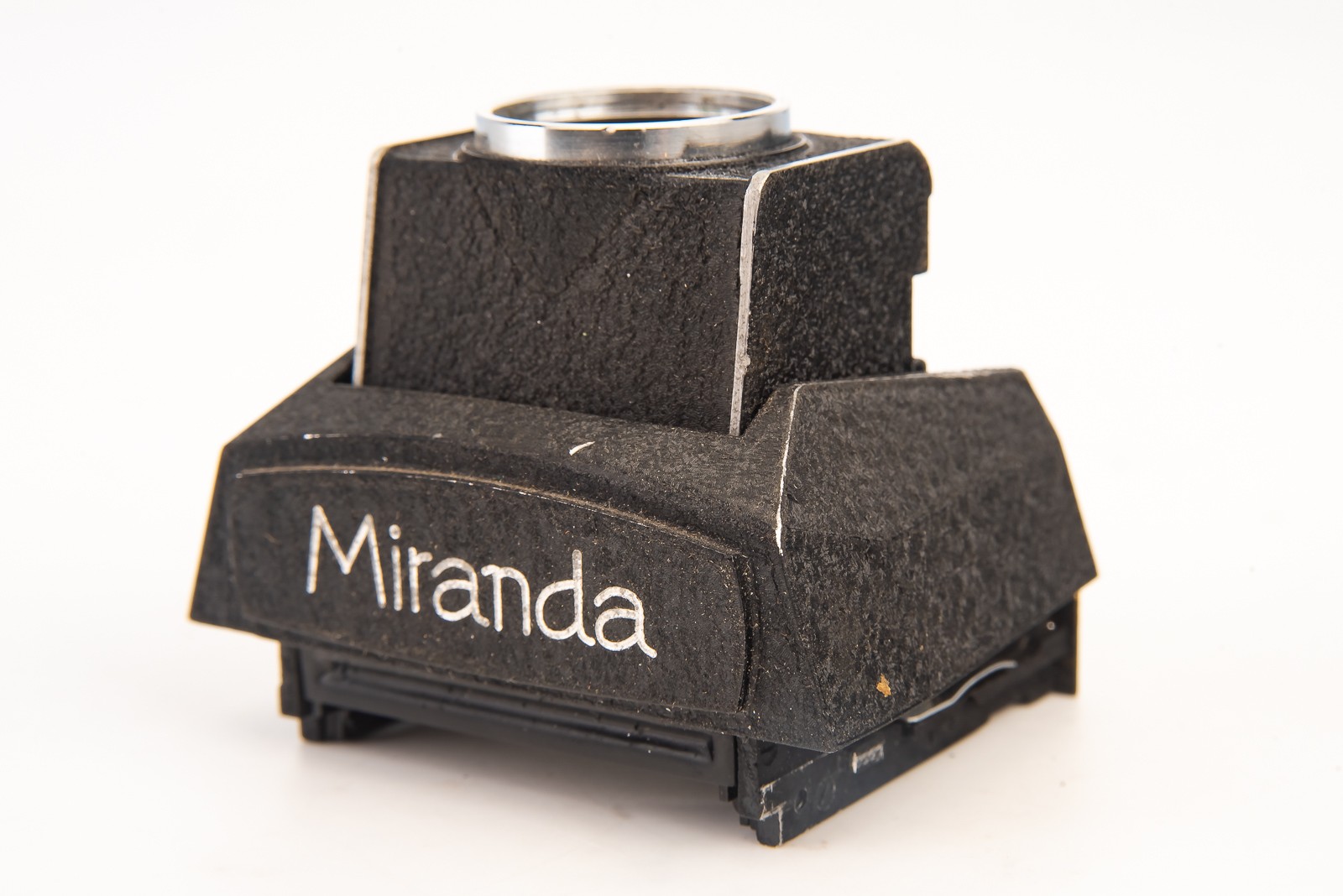
As an eBay Partner, we earn from qualifying purchases. This helps support our independent vintage technology research.
Related Models
- Miranda AutoSensorex EE (1972-1976)
- Miranda D (1960-1965)
- Miranda F (1963-1970)
- Miranda Sensorex II (1971-1975)
- Miranda Sensorex (1966-1972)
- Alpa 6 (1948-1953)
- Agfa Agfaflex
- Agfa Ambiflex
- Agfa Easy
- Agfa Futura Af zoom