MIRANDA AUTOSENSOREX EE
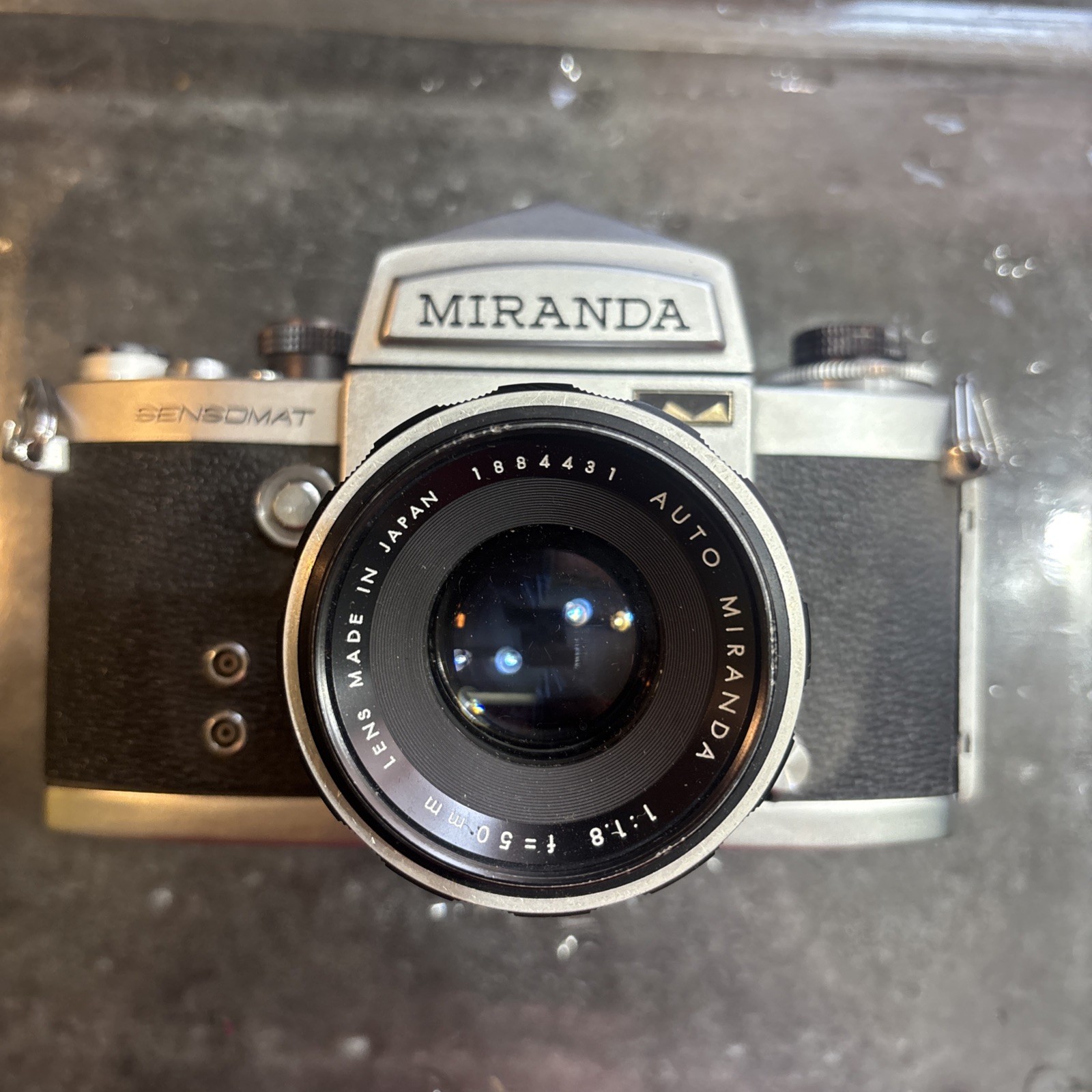
The Miranda AutoSensorex EE is a 35mm single-lens reflex (SLR) camera introduced in 1972 as the first automatic exposure model in the Miranda lineup. Featuring shutter-priority autoexposure and a built-in TTL (through-the-lens) CdS light meter, the AutoSensorex EE marked a pivotal transition for the Japanese manufacturer from manual mechanical cameras to electronically augmented systems in response to the growing demand for automation in consumer photography.
Overview
Released during a period of rapid technological evolution in the SLR market, the AutoSensorex EE represented Miranda’s strategic effort to modernize its product range and remain competitive amid the rising dominance of Japanese brands like Canon, Nikon, Minolta, and Pentax. Positioned as a mid-tier professional and advanced amateur camera, the AutoSensorex EE combined Miranda’s traditional robust build quality with emerging electronic exposure control systems. It was the first Miranda model to feature automatic exposure, specifically shutter-priority AE, allowing photographers to set the desired aperture manually while the camera selected the appropriate shutter speed based on ambient light readings.
The camera retained the Miranda SR bayonet lens mount, ensuring compatibility with the extensive range of existing Miranda SR-mount lenses, a key selling point for loyal users. Its pentaprism viewfinder offered a bright, clear image with a split-image rangefinder and microprism collar for precise manual focusing. The AutoSensorex EE was powered by two PX625 (1.35V) mercury batteries, which supplied energy to both the light meter and the electronic shutter control system. Despite its automation, the camera maintained mechanical shutter functionality at 1/90 sec in case of battery failure, a practical design consideration common in transitional-era electronic SLRs.
Historically, the AutoSensorex EE signified the beginning of Miranda’s shift toward electronic integration, though it arrived relatively late compared to competitors. By 1972, several other manufacturers had already introduced aperture- and shutter-priority models with TTL metering. Nevertheless, for Miranda users, the AutoSensorex EE was a significant upgrade path, offering automation without sacrificing lens compatibility or build integrity.
Specifications
| Specification | Value |
| Type | 35mm Single-Lens Reflex (SLR) |
| Film Format | 35mm (135 film) |
| Years Produced | 1972–1976 |
| Lens Mount | Miranda SR bayonet mount |
| Shutter | Vertical-travel metal focal-plane shutter; speeds 1 sec to 1/1000 sec, plus B; electronic control with mechanical 1/90 sec backup |
| Metering | TTL CdS (Cadmium Sulfide) center-weighted metering |
| Exposure Modes | Shutter-priority automatic exposure; manual metering indication |
| Viewfinder | Fixed pentaprism with split-image rangefinder and microprism collar; 0.92x magnification; 95% coverage |
| Dimensions | Approx. 145 × 95 × 55 mm; Weight: approx. 710 g (body only, no battery or lens) |
Key Features
- Shutter-Priority AE System: One of the first Japanese SLRs to offer shutter-priority automation, allowing photographers to select aperture manually while the camera calculated and set the correct shutter speed.
- TTL CdS Metering: Through-the-lens center-weighted light metering for accurate exposure readings, displayed via a needle visible in the viewfinder.
- Electronic Shutter with Mechanical Backup: Full electronic shutter control powered by batteries, with a mechanical 1/90 sec setting available if power is lost.
- Miranda SR Mount Compatibility: Full support for the extensive lineup of Miranda SR-mount lenses, including AI-compatible variants and third-party optics.
- Hot Shoe & PC Sync Terminal: Flash synchronization via both hot shoe and PC terminal, supporting X-sync at all shutter speeds.
Historical Context
The early 1970s saw a paradigm shift in SLR design, with manufacturers rapidly adopting electronic automation to appeal to amateur photographers seeking ease of use without sacrificing image quality. The Miranda AutoSensorex EE was launched in 1972, entering a market already populated by advanced models such as the Minolta XE (1974), Pentax ES (1971), and Canon AE-1 (1976). While not the first shutter-priority SLR, it was Miranda’s first foray into automatic exposure, arriving at a time when the brand was struggling to maintain relevance against larger, more innovative competitors.
Miranda had built a reputation in the 1950s and 1960s for rugged, modular SLRs favored by professionals and technical photographers. However, by the 1970s, the company lagged in electronic integration. The AutoSensorex EE was a direct response to this gap, attempting to modernize the lineup while preserving backward compatibility. Despite its solid engineering, it lacked features like aperture-priority or full program modes that were beginning to emerge. Market reception was moderate, primarily among existing Miranda users upgrading from manual models, but it failed to attract a broad new customer base. Production ceased by 1976, as Miranda’s market share continued to decline in the face of aggressive competition and internal financial challenges.
Collectibility & Value
Today, the Miranda AutoSensorex EE is considered a niche collectible, valued more for its historical significance within the Miranda lineage than for widespread usability. It is relatively rare compared to mainstream Japanese SLRs of the era, with complete, functional units fetching between $150 and $300 on the secondary market, depending on condition and included accessories. Cameras with original boxes, manuals, and lenses command premiums, particularly when paired with sought-after Miranda optics like the Sensorex or Reomar series.
Collectors should be cautious about battery availability and meter functionality. The original PX625 mercury batteries are obsolete and no longer manufactured, though modern 1.5V alkaline or hearing-aid zinc-air replacements can be used with exposure compensation (typically -1/3 to -1/2 stop). The CdS meter cell degrades over time and may require recalibration or replacement. Other common issues include shutter timing inaccuracies due to aging capacitors and stiff aperture linkages from dried lubricants. Given the limited number of technicians familiar with Miranda electronics, repair can be challenging, and parts are scarce.
Similar Cameras
- Pentax ES (1971) – Shutter-priority AE, M42 screw mount, TTL metering
- Minolta XE (1974) – Advanced shutter/aperture priority hybrid, SR-mount, precision build
- Canon FX (1964) / Canon Pellix – Early Canon SLRs with TTL metering (though not autoexposure)
- Nikkormat EL (1972) – Nikon’s first AE SLR, aperture-priority, F-mount
- Yashica TL Electro-X (1973) – Electronic shutter-priority SLR with M42 mount
Repair & Maintenance
The AutoSensorex EE requires two PX625 1.35V mercury batteries (or modern equivalents) for operation of the light meter and electronic shutter. Due to the unavailability of true mercury cells, users often substitute WeinCell or zinc-air hearing aid batteries, but these operate at 1.5V, potentially leading to overexposure; a -1/3 stop compensation is recommended. The CdS meter should be checked for accuracy, as aging cells often become sluggish or fail entirely.
Common mechanical issues include inconsistent shutter speeds at slower settings, typically due to dried lubricants in the timing mechanism. The electronic control circuitry, while robust for its time, may suffer from capacitor leakage or contact oxidation. Cleaning the battery contacts and switch contacts is essential during servicing. Aperture coupling with older Miranda lenses must be verified, as misalignment can result in incorrect exposure. Given the complexity of the hybrid electro-mechanical shutter and limited service infrastructure, professional repair by a technician experienced with vintage Japanese electronics is advised. Regular use and storage in a dry environment help preserve functionality.
eBay Listings



As an eBay Partner, we earn from qualifying purchases. This helps support our independent vintage technology research.
Related Models
- Miranda D (1960-1965)
- Miranda F (1963-1970)
- Miranda G (1967-1971)
- Miranda Sensorex II (1971-1975)
- Miranda Sensorex (1966-1972)
- Alpa 6 (1948-1953)
- Agfa Agfaflex
- Agfa Ambiflex
- Agfa Easy
- Agfa Futura Af zoom