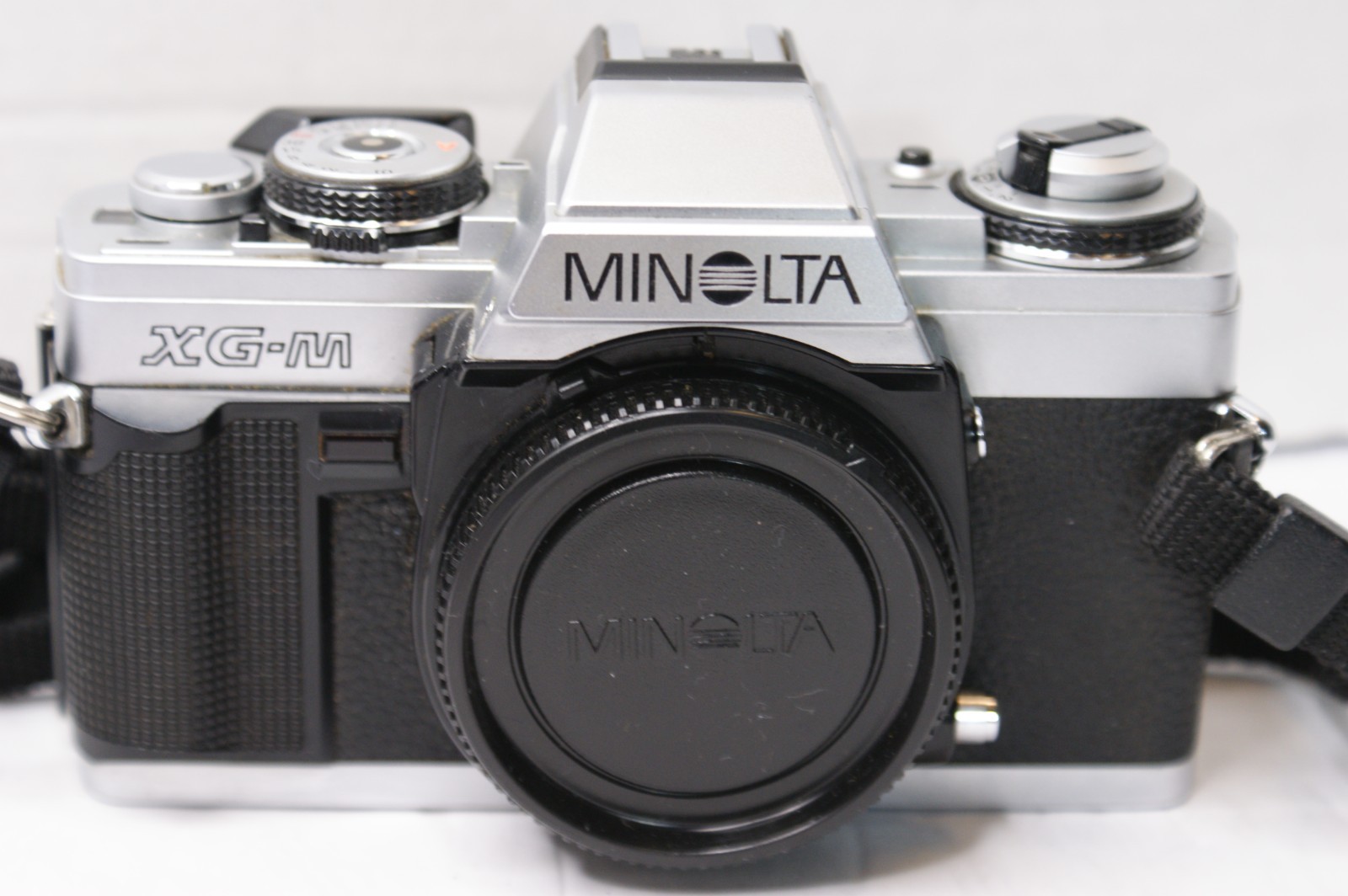
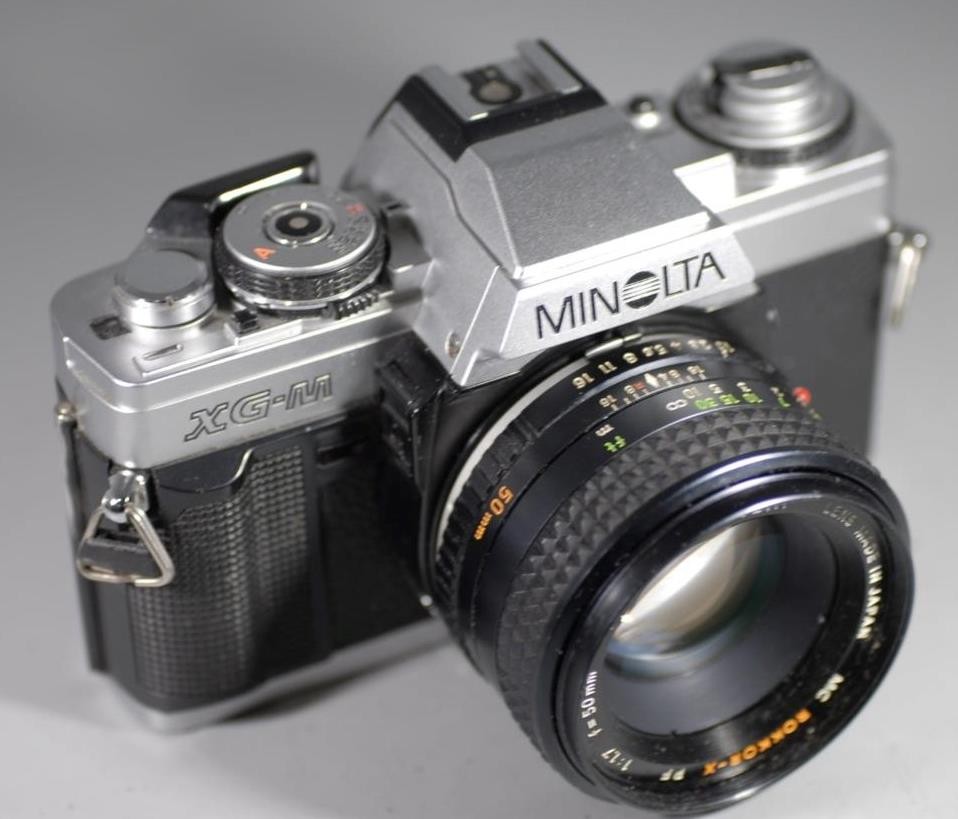
MINOLTA XG-M
Born in 1981, the Minolta XG-M stands as the refined apex of Minolta’s XG series—a camera that quietly bridged the gap between accessible automation and near-professional build quality. It wasn’t the flashiest SLR of its era, nor the most advanced, but it delivered something rarer: balance. With aperture-priority AE, a bright pentaprism viewfinder, and a metal chassis wrapped in practicality, the XG-M was built for photographers who wanted smart electronics without sacrificing mechanical reliability. In a market racing toward full digitization, it held firm with a hybrid soul—electronic brains, mechanical heart.
Overview
Launched at the dawn of the 1980s, the XG-M arrived as Minolta’s answer to the growing demand for intelligent, user-friendly SLRs—cameras that could handle exposure without dumbing down the experience. Positioned above the plastic-bodied XG-1 and XG-7 but below the elite XD-7 and XE, it carved a niche for serious amateurs who craved more than point-and-shoot simplicity but didn’t need (or want) to pay pro-level prices. Produced until around 1984, the XG-M emerged during a pivotal shift in camera design: the twilight of electromechanical engineering and the dawn of microprocessor dominance.
What set the XG-M apart wasn’t just its feature set—it was its construction. While other XG models wore all-plastic shells, the XG-M got die-cast metal top and bottom plates, lending it a reassuring heft and durability uncommon in its class. It accepted the Auto Winder G and could technically pair with the Motor Drive G—best known for powering the X-700—though sustained 2 fps shooting wasn’t officially supported. Still, that capability alone made it a standout among mid-tier SLRs, offering a taste of pro-grade performance for enthusiasts on a budget.
True to Minolta’s lens legacy, the XG-M played perfectly with the vast SR (MC/MD) lens ecosystem. It metered accurately with both vintage Rokkor lenses (via stop-down mode) and modern MD optics (at full aperture), making it a natural fit for photographers building or inheriting a glass collection. The viewfinder was a joy—bright, clear, and framed by a fixed split-image rangefinder spot with a microprism collar for precise manual focus. Add in a self-timer, multiple exposure function, and a hot shoe with TTL flash support, and you had a camera that didn’t just automate exposure—it invited creativity.
Specifications
| Specification | Value |
| Type | 35mm Single-Lens Reflex (SLR) |
| Film Format | 35mm (135) |
| Years Produced | 1981–1984 |
| Lens Mount | Minolta SR (MC/MD compatible) |
| Shutter | Horizontal-travel, cloth focal-plane shutter; speeds 1 sec to 1/1000 sec, plus B (Bulb) |
| Metering | TTL full-aperture center-weighted averaging with stop-down capability |
| Exposure Modes | Aperture-priority automatic exposure; manual exposure via stop-down metering |
| Viewfinder | Fixed pentaprism with 0.92× magnification, 94% frame coverage; split-image/microprism focusing aid |
| Dimensions | 140 × 88 × 50 mm (5.5 × 3.5 × 2 in); ~560 g (19.8 oz) body only (with battery) |
Key Features
- Aperture-Priority AE with Match-Needle Display: A clean, intuitive system—adjust shutter speed until the needle aligns with the indicator in the viewfinder, and you’re perfectly exposed.
- Motor Drive Compatibility: Works with the Motor Drive G for bursts up to 2 fps, a rare perk in its category and a nod to its enthusiast ambitions.
- Metal Chassis Construction: Die-cast metal top and bottom plates give it a solid, professional feel—no flimsy plastic here.
- TTL Flash Metering: Flash fires through the lens for accurate exposure, though OTF (off-the-film) metering isn’t supported—flash settings are manual or external.
- Stop-Down Manual Exposure Mode: Full metering with older non-MD lenses by engaging the stop-down lever—lens flexibility at its finest.
Historical Context
The XG-M hit shelves in 1981, just as SLRs were transforming from mechanical tools into electronic companions. Cameras like the Canon AE-1 Program and Pentax ME Super were redefining accessibility, and Minolta had already stunned the world with the dual-mode XD-7. The XG-M wasn’t meant to shock—it was meant to satisfy. A more affordable, aperture-priority-only sibling to the XD, it brought core professional features to photographers who valued precision over prestige.
It went head-to-head with the Pentax ME Super and Canon AE-1, often outclassing them in build quality. Yet unlike the fully electronic designs creeping in from Canon and Nikon, the XG-M kept a mechanical shutter at its core. That meant even with dead batteries, it still fired at 1/100 sec (perfect for flash sync) and Bulb mode—no paralysis, no panic. For photographers wary of total electronic dependence, this hybrid design was a lifeline.
Still, its moment was brief. Also launched in 1981, the Minolta X-700—a sleeker, microprocessor-driven SLR with program mode and mass-market appeal—quickly stole the spotlight. The X-700 became a sales phenomenon, leaving the XG-M in the shadows. Yet time has been kind. Today, it’s appreciated not for fame, but for substance: a well-built, dependable camera that blends automation with mechanical integrity.
Collectibility & Value
The XG-M isn’t a trophy camera, but it’s a treasure for those who value function over flash. It lacks the cult status of the XD-7 or the ubiquity of the X-700, but it’s the most capable model in the XG family—solid, smart, and surprisingly tough. In working order, with a clean viewfinder and crisp shutter, it typically fetches $100–$180 USD, depending on condition and accessories.
When buying one, test the meter (powered by two SR44 or A76 batteries), listen for mirror slap or shutter hesitation, and check the film advance—especially if you plan to use motor drive. Common issues include dried light seals, sticky shutter curtains (a risk in humid storage), and worn foam light traps around the film door. The electronics are generally robust, but corroded battery contacts can kill meter function. As always, remove old batteries immediately—leakage is the silent killer of vintage cameras.
Thanks to its metal construction and mechanical resilience, the XG-M is one of the sturdiest in Minolta’s consumer SLR lineup. It’s favored by film shooters who want aperture-priority convenience, manual override, and the ability to pair it with classic Rokkor glass—all with reliable, no-nonsense performance.
Similar Cameras
- Pentax ME Super – Aperture- and shutter-priority modes, compact metal body, 1979–1984
- Canon AE-1 Program – Shutter-priority and program modes, microprocessor-controlled, 1981–1985
- Nikon EM – Aperture-priority AE, compact design, targeted at beginners, 1979–1982
- Olympus OM-4 – Fully mechanical with aperture-priority AE, titanium shutter, professional-grade, 1983–2002
- Yashica FX-3 Super 2000 – Aperture-priority SLR with DX coding, 1982–1988
Repair & Maintenance
The XG-M runs on two 1.5V SR44 (or A76/LR44) batteries, powering the TTL meter and exposure logic. Without power, it still fires mechanically at 1/100 sec and Bulb—no exposure help, but no paralysis either. Typical maintenance includes replacing aged light seals (to prevent fogged film), cleaning oxidized battery contacts, and addressing sluggish shutter speeds caused by dried lubricants.
The shutter is durable but may need a CLA (Clean, Lubrate, Adjust) after years of dormancy. The film transport is reliable, but verify the rewind crank turns smoothly and the counter resets properly. Parts are moderately available—donor cameras can supply most components—though the meter prism or motor drive coupler may be harder to source. Overall, it’s a repair-friendly camera in the hands of a technician familiar with Minolta’s electromechanical SLRs.
eBay Listings


As an eBay Partner, we earn from qualifying purchases. This helps support our independent vintage technology research.
Related Models
- Minolta SR-T 200 (1975–1981)
- Minolta Dynax 9 (1998-2004)
- Minolta Maxxum 7000 (1985-1988)
- Minolta SR-T 100 (1969-1975)
- Minolta SR-T 101 (1966-1981)
- Alpa 6 (1948-1953)
- Agfa Agfaflex
- Agfa Ambiflex
- Agfa Easy
- Agfa Futura Af zoom