MINOLTA XD-7
The Minolta XD-7 is a compact, precision-engineered 35mm film SLR camera introduced in 1977 as the European and international counterpart to the Minolta XD-11 sold in North America. Renowned for its hybrid electronic-mechanical design, it was the world’s smallest and lightest multi-mode SLR at its release, offering both aperture-priority and shutter-priority autoexposure alongside full manual control.
Overview
Launched in 1977, the Minolta XD-7 marked a pivotal moment in Minolta’s SLR development, bridging the gap between fully mechanical cameras and the emerging era of electronic automation. Designed for advanced amateurs and professional photographers seeking a compact, reliable, and versatile system camera, the XD-7 combined cutting-edge electronics with robust mechanical backup systems. It was marketed as a premium compact SLR, emphasizing precision engineering, intuitive handling, and exceptional build quality. The XD-7 was the culmination of Minolta’s collaboration with Leica on the Leica R3, sharing design philosophies and some internal electronics, particularly in its exposure metering system.
Positioned above the manual-focus SR-T series and below the later fully electronic X-700, the XD-7 was unique in Minolta’s lineup for offering both aperture-priority and shutter-priority exposure modes—making it the first Minolta SLR with shutter-priority automation. In Japan, it was sold as the XD-11, while the European and global markets received it as the XD-7, a naming decision intended to align with Minolta’s existing XD series branding. Despite minor regional variations in labeling and accessories, the camera’s core functionality remained identical across markets.
The XD-7 was produced until 1984, when it was quietly discontinued as Minolta shifted focus toward more automated, electronically dependent models like the X-700. However, its reputation for reliability, compactness, and dual-mode exposure control has ensured its enduring status among film photography enthusiasts and collectors.
Specifications
| Specification | Value |
| Type | 35mm Single-Lens Reflex (SLR) |
| Film Format | 35mm (135 cartridge) |
| Years Produced | 1977–1984 |
| Lens Mount | Minolta SR (MC/MD mount) |
| Shutter | Horizontal-travel, focal-plane cloth shutter; speeds from 1 sec to 1/1000 sec, plus B (Bulb); flash sync at 1/60 sec |
| Metering | TTL full-aperture center-weighted metering with silicon photodiode (SPD) sensor |
| Exposure Modes | Aperture-priority autoexposure, shutter-priority autoexposure, manual exposure, and stop-down metering |
| Viewfinder | Interchangeable focusing screens; fixed pentaprism with 0.92× magnification, 94% coverage; displays shutter speed, aperture, and exposure indicator |
| Dimensions | 136 × 87 × 50 mm (5.35 × 3.43 × 1.97 in); weight: 550 g (19.4 oz) body only (with battery) |
Key Features
- Dual Autoexposure Modes: First Minolta SLR to offer both aperture-priority and shutter-priority automation, giving photographers maximum flexibility.
- Compact and Lightweight Design: At the time of release, the XD-7 was the smallest and lightest multi-mode 35mm SLR available, measuring just 50 mm in depth.
- Mechanical Backup at 1/100 sec: In the event of battery failure, the shutter defaults to a mechanical 1/100 sec setting, allowing continued use.
- Precision Metering System: Utilizes a silicon photodiode (SPD) sensor for accurate TTL full-aperture metering with MC and MD lenses.
- Interchangeable Focusing Screens: Allows customization for different shooting needs (e.g., split-image, microprism, matte).
Historical Context
The Minolta XD-7 was introduced during a transformative period in SLR development, when manufacturers were transitioning from fully mechanical systems to electronically controlled exposure and automation. Competing directly with the Nikon FE, Canon FTb, and Pentax ME, the XD-7 distinguished itself by offering a broader range of exposure modes in a smaller body. Its development coincided with Minolta’s technical partnership with Leica, resulting in shared electronics and metering technology used in the Leica R3, which lent the XD-7 a degree of engineering prestige.
Market reception was highly favorable, particularly in Europe and Japan, where photographers appreciated its refined ergonomics, compact size, and advanced feature set. The XD-7 was praised by contemporary reviewers for its intuitive interface, quiet shutter operation, and excellent viewfinder clarity. However, its relatively high price point limited mass-market appeal, positioning it as a niche tool for discerning users rather than a consumer-grade camera. Despite its sophistication, Minolta did not aggressively promote the XD-7 in the United States, where it was sold as the XD-11 and faced stiff competition from Canon’s A-series and Nikon’s FE2.
Collectibility & Value
Today, the Minolta XD-7 is regarded as a classic among vintage SLRs, prized for its blend of mechanical reliability and electronic innovation. Well-preserved examples in working condition typically sell for $150–$300 USD, with fully serviced units or rare variants (such as those with special engraving or limited editions) commanding higher prices. The camera’s compact size, dual exposure modes, and mechanical backup make it a favorite among film photographers seeking a lightweight, capable travel camera.
When purchasing an XD-7, buyers should verify that the light seals are intact, the shutter fires accurately across all speeds, and the meter responds properly to light changes. Common issues include degraded light seals, sticky shutter curtains (especially if stored in humid conditions), and weakened meter accuracy due to aging electronics or corroded battery contacts. The camera uses a single 6V PX28 or 4SR44 battery (or modern equivalent like WeinCell 6V), which can be difficult to source; some users retrofit battery adapters for easier power supply. Overall, the XD-7 is considered reliable if properly maintained, and repair parts remain available through specialist camera technicians.
Similar Cameras
- Nikon FE (1978) – All-metal construction, aperture-priority and manual modes, renowned durability.
- Canon A-1 (1978) – Advanced PASM modes, electronic shutter, and TTL flash, considered Canon’s flagship amateur SLR.
- Pentax ME-F (1981) – Compact aperture-priority SLR with early autofocus capability.
- Olympus OM-2 (1975) – Competitor in the compact SLR segment, offering aperture-priority and manual modes with TTL OTF metering.
- Yashica FX-3 (1978) – Budget-friendly aperture-priority SLR with robust build and Copal Square shutter.
Repair & Maintenance
The Minolta XD-7 uses a single 6V PX28 or 4SR44 battery to power its metering and electronic shutter control. Due to the age of most units, battery leakage is a common issue that can damage internal circuitry and contacts—prompt cleaning is essential. The shutter is electronically controlled but retains a mechanical 1/100 sec setting when the battery is dead, a valuable fail-safe. Regular maintenance includes cleaning the mirror box, replacing light seals, and ensuring the shutter curtains move freely. The metering system, while generally reliable, may require recalibration if readings are inconsistent. Repair difficulty is moderate: while the camera is well-documented and service manuals exist, its dense internal layout and reliance on through-hole electronics require skilled handling. Specialist repair shops familiar with late-1970s Japanese SLRs are recommended for full servicing.
eBay Listings


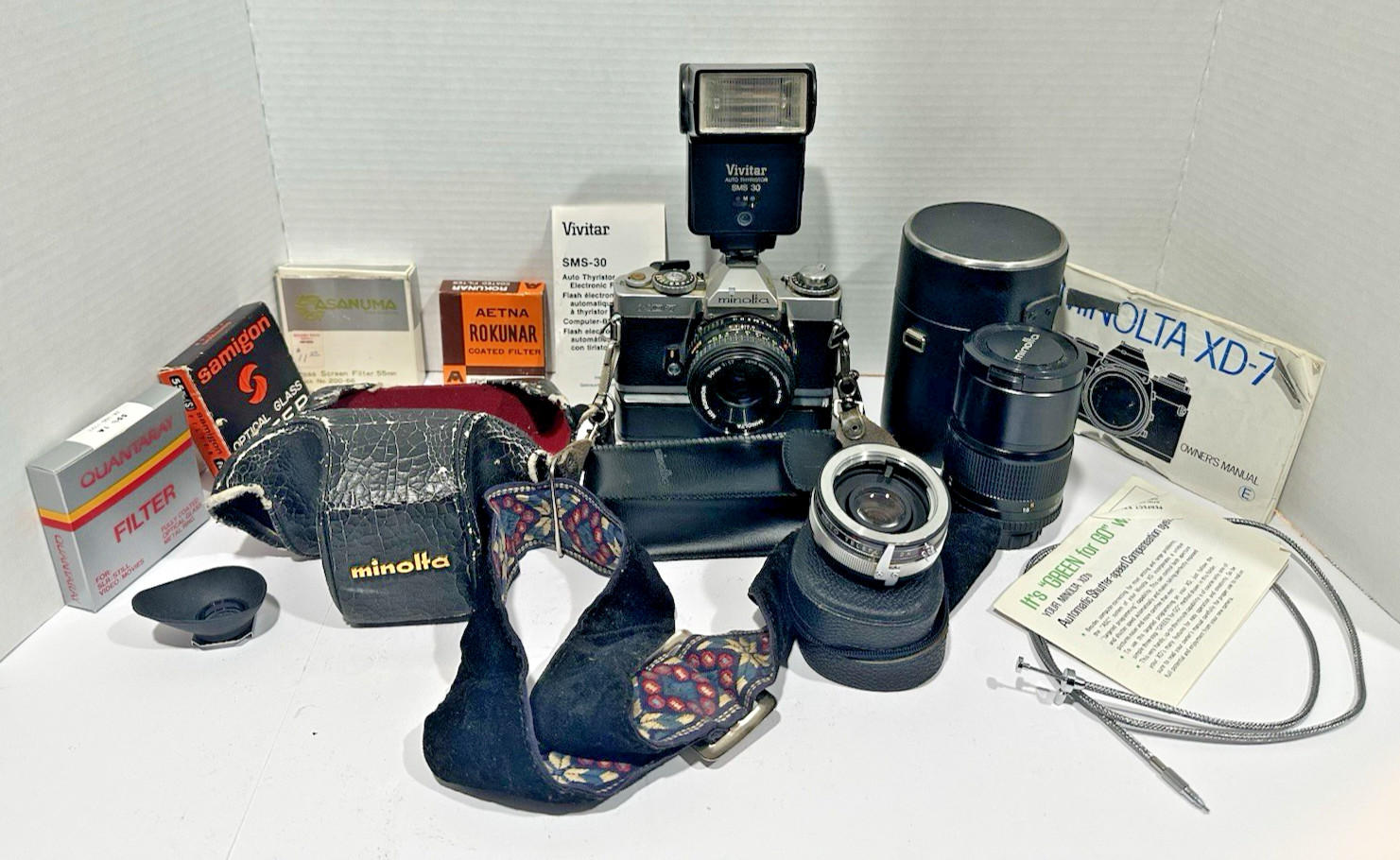
As an eBay Partner, we earn from qualifying purchases. This helps support our independent vintage technology research.
Related Models
- Minolta SR-T 200 (1975–1981)
- Minolta Dynax 9 (1998-2004)
- Minolta Maxxum 7000 (1985-1988)
- Minolta SR-T 100 (1969-1975)
- Minolta SR-T 101 (1966-1981)
- Alpa 6 (1948-1953)
- Agfa Agfaflex
- Agfa Ambiflex
- Agfa Easy
- Agfa Futura Af zoom