MINOLTA X-700
The Minolta X-700 is a 35mm manual focus single-lens reflex (SLR) camera introduced in 1981 as the flagship model of Minolta’s X-series line. Renowned for its advanced electronics, user-friendly Program AE mode, and robust mechanical build, the X-700 became one of the most popular amateur and enthusiast SLRs of the 1980s.
Overview
Released at the height of the analog SLR boom, the Minolta X-700 represented a significant leap forward in automation and usability for photographers transitioning from fully manual systems. It was the final and most sophisticated model in Minolta’s X-series, succeeding the X-500 (X-570 in North America) and X-300. Designed for advanced amateurs and serious hobbyists, the X-700 combined professional-grade features with intuitive operation, making it accessible to a broad market. Its hallmark feature was the introduction of Programmed Auto Exposure (Program AE), a pioneering mode for Minolta at the time, which automatically selected both shutter speed and aperture based on scene luminance and the lens in use.
The X-700 featured a vertically traveling, electronically controlled metal-bladed focal-plane shutter with speeds from 1 to 1/1000 second, plus Bulb mode. It supported TTL (through-the-lens) center-weighted metering with LED readout in the viewfinder and an additional LCD exposure information panel on the top plate. The camera used Minolta’s proprietary SR (later known as MC/MD) lens mount, ensuring compatibility with a wide range of manual focus Rokkor lenses. Its modular design, durable construction, and comprehensive exposure system earned it the European Camera of the Year award in 1981, a rare accolade for a Japanese SLR.
Positioned above the X-500/X-570 and below the professional X-1 (XE in some markets), the X-700 was Minolta’s technological showcase for the consumer segment. It bridged the gap between fully manual shooting and emerging automation trends, offering aperture-priority AE, manual exposure, and the innovative Program mode—all in a compact, lightweight body. Despite being marketed as an advanced amateur camera, its reliability and feature set made it a favorite among semi-professionals and educators. Production continued until 1999, an unusually long run that speaks to its enduring design and popularity.
Specifications
| Specification | Value |
| Type | 35mm manual focus SLR |
| Film Format | 35mm (135 cartridge) |
| Years Produced | 1981–1999 |
| Lens Mount | Minolta SR (MC/MD mount) |
| Shutter | Electronically controlled vertical-travel metal focal-plane; 1 – 1/1000 sec in 1/2 stop increments, plus Bulb (B) |
| Metering | TTL silicon photodiode, center-weighted |
| Exposure Modes | Program AE, Aperture Priority AE, Manual (with stop-down metering), Bulb |
| Viewfinder | Fixed pentaprism, 0.85x magnification, 94% coverage; split-image/microprism focusing aid |
| Dimensions | 140.5 × 89 × 50 mm (5.5 × 3.5 × 2 in); ~585 g (body only, with battery) |
Key Features
- Program AE Mode: One of the first consumer SLRs to offer automatic program exposure, selecting optimal shutter speed and aperture without user input.
- TTL Center-Weighted Metering: Accurate exposure calculation via a silicon photodiode sensor with LED readout in the viewfinder and LCD panel on top.
- Manual and Aperture-Priority Flexibility: Full manual control with stop-down metering, plus aperture-priority autoexposure for creative depth-of-field control.
- Integrated Hot Shoe and PC Sync: Supports both automatic and manual flash with dedicated Minolta flashes (e.g., Auto Electroflash 280PX) and external strobes.
- Long Production Run and Reliability: Built with high-quality materials and robust electronics, contributing to its reputation for durability.
Historical Context
The Minolta X-700 was launched in 1981 during a pivotal era in SLR development, as manufacturers raced to integrate microelectronics into consumer cameras. At the time, Canon, Nikon, and Pentax were also introducing automated exposure systems, but few offered a true program mode in the amateur segment. The X-700 stood out by delivering a professional-level feature set in an affordable, compact body. It was developed alongside the X-500 (X-570), which shared many components but lacked Program AE and the top-plate LCD.
Competitors included the Canon AE-1 Program (released in 1981 with similar program logic), the Nikon EM (1979), and the Pentax ME-F. However, the X-700 distinguished itself with superior build quality, a brighter viewfinder, and more comprehensive manual controls. Its European Camera of the Year award in 1981 underscored its technical excellence and market impact. The camera was heavily marketed in North America and Europe, often bundled with the 50mm f/1.7 MC Rokkor-PF lens, and became a staple in photography schools and rental fleets.
Collectibility & Value
Today, the Minolta X-700 is a sought-after classic among film photography enthusiasts. Its long production run means it is relatively common on the used market, but fully functional units in good cosmetic condition typically sell for $100–$200 USD. Models with the original box, manual, and lens command a premium, especially if they include rare accessories or limited editions. Collectors value the X-700 for its historical significance, elegant design, and role in popularizing program autoexposure.
When purchasing an X-700, buyers should verify the functionality of the shutter at all speeds, the accuracy of the metering system, and the condition of the LCD panel (which can degrade over time). Common issues include capacitor leakage on the circuit board, shutter timing drift due to aging electronics, and worn shutter buttons. The camera requires two 1.5V SR44 or A76 batteries (or equivalent, such as LR44) to power the meter and shutter—without batteries, only the mechanical 1/100 sec speed and Bulb are functional. Due to its electronic nature, servicing often requires specialized knowledge, though replacement circuit boards are occasionally available.
Similar Cameras
- Canon AE-1 Program (1981) – Shared program mode and microprocessor control; popular in photography education.
- Nikon EM (1979) – Compact Nikon SLR with aperture-priority AE; targeted at beginners.
- Pentax ME-F (1981) – Featured autofocus capability (limited) and aperture-priority; technologically ambitious.
- Olympus OM-4 (1983) – Professional-grade OM series with advanced metering and titanium shutter.
- Yashica FX-3 Super 2000 (1982) – Budget-friendly aperture-priority SLR with robust build.
Repair & Maintenance
The Minolta X-700 runs on two 1.5V SR44 (or A76/LR44) batteries, housed in the base. These power the electronic shutter, metering system, and LCD display. A common failure point is the on/off switch, which can become intermittent due to corrosion or wear. The camera’s electronic shutter relies on capacitors and timing circuits that degrade over decades; symptoms include erratic shutter speeds, failure to fire, or incorrect metering. Capacitor replacement and circuit board inspection are recommended for long-term reliability.
Shutter servicing is complex and best handled by technicians familiar with Minolta’s X-series electronics. The top-plate LCD can fail or develop "ghosting," though this does not affect functionality. Lens compatibility is excellent with MC and MD series Rokkor lenses; MD lenses provide full open-aperture metering in aperture-priority mode. Regular use, proper storage, and periodic battery removal when not in use are key to preserving the X-700’s performance. With proper care, it remains a fully functional and rewarding camera for film photographers.
eBay Listings
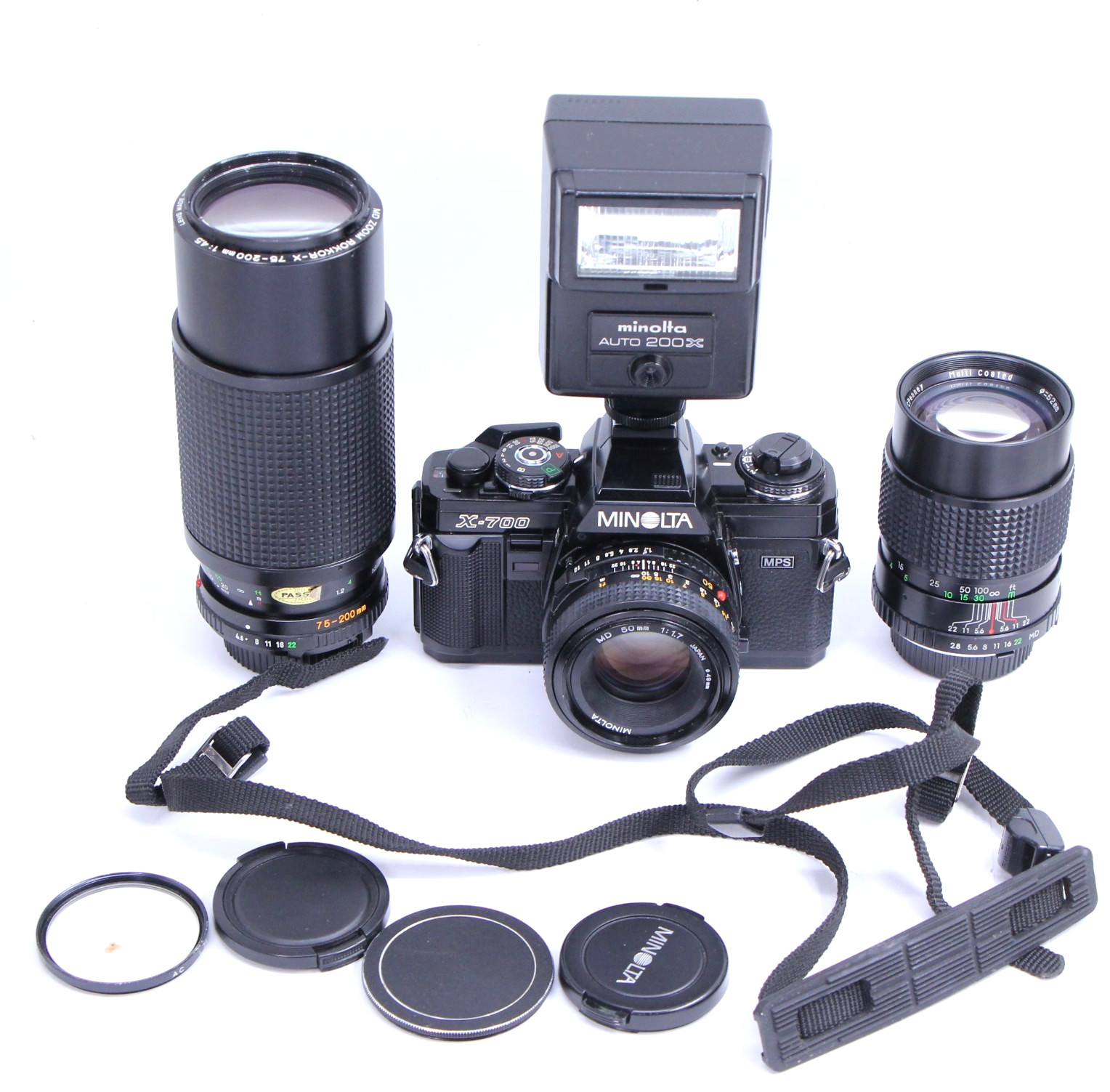
![[EXCELLENT] MINOLTA 35m X-700 SLR Film Camera MD w/Flash + M](https://i.ebayimg.com/images/g/HLkAAeSwNgVotVmj/s-l1600.jpg)


As an eBay Partner, we earn from qualifying purchases. This helps support our independent vintage technology research.
Service Manuals & Schematics
- Manual (2020) — archive.org
- Service Manual (1981) — archive.org
- Catalog — archive.org
Related Models
- Minolta Dynax 9 (1998-2004)
- Minolta Maxxum 7000 (1985-1988)
- Minolta SR-T 100 (1969-1975)
- Minolta SR-T 101 (1966-1981)
- Minolta SR-T 102 (1970–1976)
- Alpa 6 (1948-1953)
- Agfa Agfaflex
- Agfa Ambiflex
- Agfa Easy
- Agfa Futura Af zoom