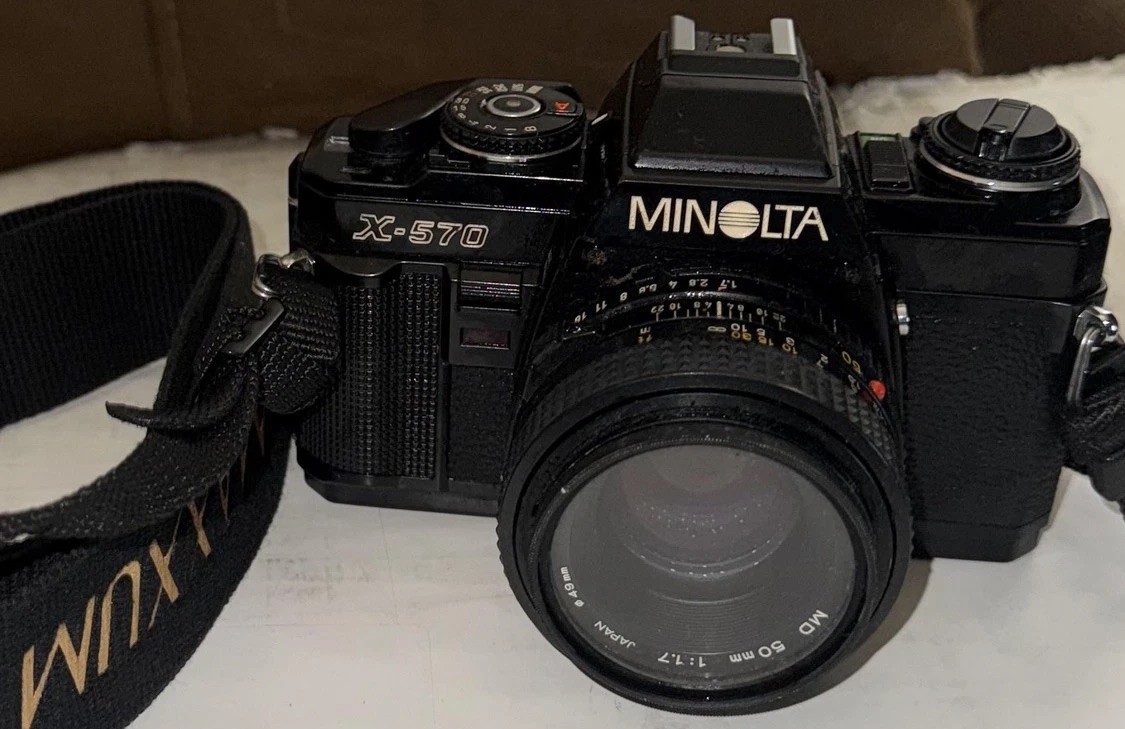
MINOLTA X-570
The Minolta X-570, known as the X-500 in Europe and other regions, is a 35mm film single-lens reflex (SLR) camera introduced in 1983 as a high-end enthusiast model within Minolta’s manual focus X-series lineup. It combines advanced electronic automation with traditional mechanical controls, offering aperture-priority autoexposure and full manual operation, but omits the program mode found in the flagship X-700.
Overview
The Minolta X-570 was developed during a transitional period in SLR design, bridging the gap between fully mechanical cameras and the emerging era of microprocessor-controlled automation. Positioned just below the top-tier X-700, the X-570 shared nearly all of its advanced features—including a sophisticated LED-based exposure display in the viewfinder, TTL flash metering, and a robust electromagnetic metal-bladed vertical-travel focal plane shutter—while excluding only the program autoexposure mode. This strategic differentiation allowed Minolta to offer a slightly more affordable option for photographers who preferred manual or aperture-priority control without sacrificing core functionality.
Targeted at advanced amateurs and semi-professional users, the X-570 featured a durable polycarbonate-over-metal chassis, a large and bright viewfinder with comprehensive exposure feedback, and full compatibility with Minolta’s extensive SR (Manual Focus) lens mount system, including MD and MC Rokkor lenses. Its electronic shutter provided precise exposure control from 4 seconds to 1/1000 second, with a Bulb mode for long exposures, and supported flash sync at 1/60 second. The camera also included TTL (through-the-lens) off-the-film (OTF) flash metering, a rare and advanced feature at the time, allowing automatic flash exposure when used with compatible Minolta flashes such as the Auto Electroflash 280PX or 360PX.
Within Minolta’s X-series SLR family—comprising the X-300, X-500/X-570, X-700, and the professional X-1/X-7—the X-570 occupied a premium tier, offering most of the X-700’s capabilities at a reduced cost. It represented the culmination of Minolta’s manual focus SLR engineering before the company shifted focus to its revolutionary autofocus Maxxum (Dynax/α) system in 1985. Despite being released just two years before that shift, the X-570 remained in production until 1989, a testament to its reliability, performance, and enduring appeal among film photographers.
Specifications
| Specification | Value |
| Type | 35mm Manual Focus SLR |
| Film Format | 35mm (135 cartridge) |
| Years Produced | 1983–1989 |
| Lens Mount | Minolta SR (MD/MC compatible) |
| Shutter | Electronically controlled vertical-travel focal plane; speeds from 4 sec to 1/1000 sec + Bulb |
| Metering | TTL silicon photodiode (SPD) center-weighted metering |
| Exposure Modes | Aperture-priority autoexposure, Manual |
| Viewfinder | Fixed pentaprism, 0.92x magnification, 94% coverage; LED exposure display (up/down arrows + “O” for correct exposure) |
| Dimensions | 140 × 93 × 52 mm (5.5 × 3.7 × 2.0 in); ~585 g (20.6 oz) with battery |
Key Features
- LED Viewfinder Display: Real-time exposure feedback using dual arrows and a center “O” to indicate correct exposure, compatible with both manual and aperture-priority modes.
- TTL OTF Flash Metering: Through-the-lens flash metering off the film surface enables accurate automatic flash exposure with supported Minolta flashes.
- Electronic Shutter with Backup: Full electronic control with a mechanical backup at 1/100 sec if the battery fails.
- Multi-Function LCD Panel: Top-mounted LCD displays shutter speed, exposure mode, frame counter, and battery status.
- Hot Shoe & PC Sync: Full flash connectivity with dedicated TTL support and a PC terminal for studio strobes.
Historical Context
The X-570 was launched in 1983, the same year as the more advanced X-700, as part of Minolta’s push to dominate the mid-to-high-end 35mm SLR market. This period saw intense competition from Nikon (FM2, FE2), Canon (AE-1 Program, New F-1), and Pentax (ME-F, Super Program), all of which were integrating electronics into SLRs while maintaining manual focus. The X-570 distinguished itself with its bright viewfinder, precise metering, and TTL flash automation—features typically reserved for professional models.
Despite lacking program mode, the X-570 was technologically on par with the X-700 in nearly every other respect. Its omission of program mode was a marketing decision rather than a technical limitation, allowing Minolta to segment its product line and preserve the X-700’s flagship status. The camera was well-received by critics and users alike for its balance of automation and control, robust build, and excellent integration with Minolta’s flash system. It remained in production longer than many contemporaries, indicating strong market acceptance even as autofocus technology began to emerge.
Collectibility & Value
Today, the Minolta X-570 is regarded as one of the most capable and user-friendly manual focus SLRs of the 1980s. It is moderately collectible, particularly among film photographers seeking reliable, feature-rich cameras with TTL flash capability. Prices typically range from $75 to $150 USD in working condition, depending on cosmetics and functionality. Fully tested units with clean viewfinders, accurate metering, and responsive shutters command higher values.
When purchasing an X-570, buyers should verify the functionality of the shutter at all speeds, check for mirror slap noise or sluggish movement, and ensure the light seals are replaced to prevent light leaks. A common issue is degraded foam light seals around the film door, which can deteriorate and cause exposure problems. Additionally, the camera uses a single 3V lithium CR2 battery to power both the meter and shutter; while this provides long life, the battery must be present for any shutter operation (except 1/100 sec mechanical backup). Fungal growth in the viewfinder prism and sticky aperture blades on older MD lenses are also potential concerns.
Similar Cameras
- Canon AE-1 Program – Offers program mode and shutter-priority, but lacks TTL flash metering.
- Nikon FE2 – Rugged mechanical design with aperture-priority and manual modes, highly durable but no built-in flash automation.
- Pentax Super Program – Includes program mode and TTL flash, comparable feature set but heavier build.
- Olympus OM-4 – Advanced manual focus SLR with aperture-priority, manual, and program modes (in OM-4T), exceptional build quality.
- Yashica FX-3 Super 2000 – Budget-friendly alternative with aperture-priority and manual modes, but less refined metering and build.
Repair & Maintenance
The Minolta X-570 uses a single CR2 3V lithium battery to power its electronic shutter and metering system. Without the battery, the camera is inoperable except for the mechanical 1/100 sec and Bulb settings. Battery life is typically long—several years with moderate use—due to efficient circuitry. Common repairs include replacing light seals, cleaning the mirror and focusing screen, and servicing the shutter if speeds become inaccurate. The electronic shutter mechanism is generally reliable but can fail due to capacitor degradation or circuit corrosion, especially in humid environments. Professional CLA (Clean, Lubricate, Adjust) services are recommended every 5–10 years for regular users. The camera’s modular design allows for relatively straightforward disassembly, but due to its electronic components, repairs should be handled by technicians experienced with 1980s SLRs.
eBay Listings



As an eBay Partner, we earn from qualifying purchases. This helps support our independent vintage technology research.
Related Models
- Minolta SR-T 200 (1975–1981)
- Minolta Dynax 9 (1998-2004)
- Minolta Maxxum 7000 (1985-1988)
- Minolta SR-T 100 (1969-1975)
- Minolta SR-T 101 (1966-1981)
- Alpa 6 (1948-1953)
- Agfa Agfaflex
- Agfa Ambiflex
- Agfa Easy
- Agfa Futura Af zoom