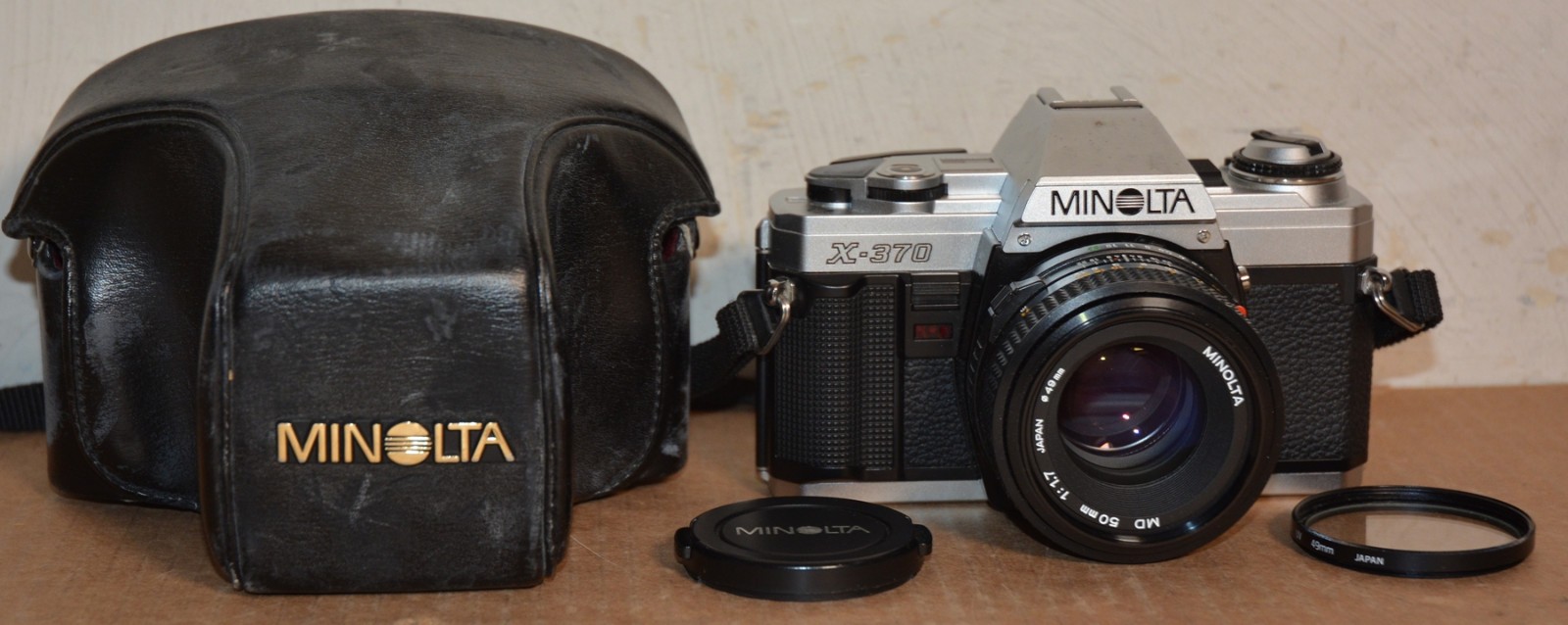
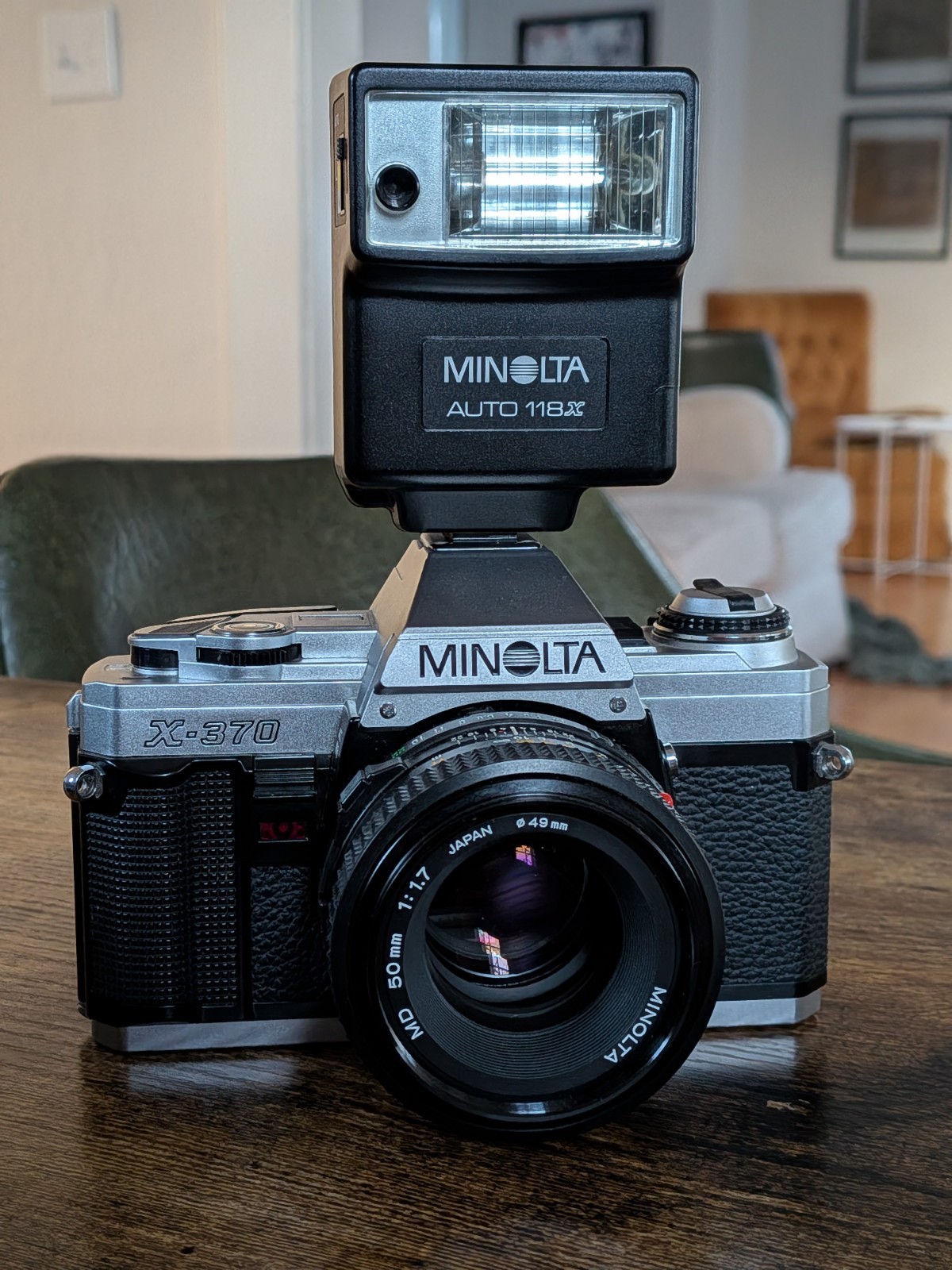
MINOLTA X-370
The Minolta X-370 is a 35mm manual focus single-lens reflex (SLR) camera introduced in 1984 as an affordable, feature-reduced variant of the highly successful Minolta X-700. Designed for amateur photographers and students, it retains core electronic automation while simplifying operation and lowering production costs.
Overview
Released during a period of intense competition in the consumer SLR market, the Minolta X-370 was positioned as an entry-level alternative to the flagship X-700, which had debuted in 1981. While the X-700 offered aperture-priority autoexposure, manual exposure, and a sophisticated LED-based exposure display, the X-370 streamlined functionality by removing manual exposure mode and simplifying the viewfinder interface. Despite these reductions, the X-370 retained the robust mechanical backbone of Minolta’s X-series, including the reliable Copal horizontal-travel focal-plane shutter and compatibility with the full range of Minolta SR-mount (also known as MC/MD mount) lenses.
The X-370 was marketed as a lightweight, battery-efficient, and user-friendly SLR ideal for photography students and casual shooters. It featured shutter-priority autoexposure and a fully automatic flash mode (when used with compatible Minolta Program Flash units like the Auto 280PX), making it particularly appealing for point-and-shoot simplicity within an SLR form factor. Unlike the X-700, it lacked the "M" (manual) exposure mode and the +/- exposure compensation dial, reinforcing its role as a simplified, economy-oriented model.
Despite its reduced feature set, the X-370 shared the same core design language and build quality as its siblings in the X-series, including a polycarbonate-covered metal chassis, a vertically traveling metal-blade shutter, and a well-constructed pentamirror viewfinder. It was produced alongside the X-570 and X-700 until the late 1990s, with final units manufactured as late as 1999 in some markets, making it one of the last widely available 35mm SLRs with full electronic automation before digital began to dominate.
Specifications
| Specification | Value |
| Type | 35mm Manual Focus SLR |
| Film Format | 35mm (135 film) |
| Years Produced | 1984–1999 |
| Lens Mount | Minolta SR (MC/MD mount) |
| Shutter | Horizontal-travel, focal-plane shutter; speeds from 1 sec to 1/1000 sec, plus B (Bulb) |
| Metering | TTL (Through-The-Lens) open-aperture center-weighted averaging metering |
| Exposure Modes | Shutter-priority autoexposure (SP), Program Auto (with compatible flash), Manual (limited to metered manual with no shutter speed control in manual mode) |
| Viewfinder | Fixed pentamirror with split-image rangefinder, microprism collar, and LED exposure indicators (up/down arrows) |
| Dimensions | 139 × 84 × 50 mm (5.5 × 3.3 × 2.0 in); ~520 g (18.3 oz) body only (with battery) |
Key Features
- Shutter-Priority Autoexposure: Allows user to set shutter speed while camera selects appropriate aperture via TTL metering.
- Program Flash Compatibility: When paired with Minolta Program Flash units (e.g., Auto 280PX), enables fully automatic flash exposure with programmed shutter speed and aperture.
- TTL Center-Weighted Metering: Utilizes a silicon photodiode sensor for accurate exposure readings with MC and MD lenses.
- LED Viewfinder Indicators: Simple up/down arrows guide user to correct exposure by adjusting aperture ring.
- Mechanical Backup at 1/100 sec: In case of battery failure, the camera can still operate at 1/100 sec (marked "M" on shutter dial), though without metering.
Historical Context
The Minolta X-370 was introduced in 1984 as part of Minolta’s strategy to expand the reach of its X-series SLRs into budget-conscious segments. The X-700 had achieved critical and commercial success by combining advanced electronics with a sleek design and intuitive interface, but its price point limited accessibility. The X-370 addressed this by removing less essential features—particularly manual exposure mode and exposure compensation—while retaining the core automation and lens compatibility.
It competed directly with other entry-level electronic SLRs of the mid-1980s, such as the Pentax ME-F, Canon AE-1 Program, and Nikon EM. Unlike the Nikon EM, which was criticized for its plasticky build and limited lens compatibility, the X-370 maintained a solid mechanical shutter and full support for Minolta’s extensive MC/MD lens lineup. Its Program Flash mode was a unique selling point, offering a semi-professional automation level rarely seen in budget SLRs.
Market reception was generally positive, especially in educational institutions and developing markets where durability and ease of use were prioritized over full manual control. The X-370, along with the slightly more advanced X-570 (which added manual mode and a brighter viewfinder), helped sustain Minolta’s presence in the SLR market through the 1990s, even as autofocus systems began to emerge.
Collectibility & Value
Today, the Minolta X-370 is considered a reliable and functional vintage SLR, though not particularly rare or collectible in the way that the X-700 is. Its value typically ranges from $30 to $80 in working condition, depending on cosmetic state and included accessories. Fully tested units with clean viewfinders and responsive shutters command higher prices, especially when paired with original lenses like the MD 50mm f/1.7 or f/2.
When purchasing an X-370, buyers should verify that the shutter speeds are accurate, particularly at slower speeds where lubricant degradation can cause sticking. The light seals should be replaced if the camera is to be used regularly, as deteriorated foam can cause light leaks and sticky mirror mechanisms. The most common failure points are the meter circuitry and the battery contacts, which can corrode over time—especially if old batteries were left inside.
While not a premium collector’s item, the X-370 is valued for its reliability, ease of use, and compatibility with high-quality Minolta MD lenses, many of which are now sought after for their optical performance and manual focus characteristics. It serves as an excellent entry point for beginners exploring film photography with a historically significant brand.
Similar Cameras
- Pentax ME Super – Shutter-priority SLR with manual override, similar target market.
- Canon AE-1 Program – Popular entry-level Canon SLR with aperture-priority and program mode.
- Nikon EM – Compact Nikon SLR aimed at beginners, limited lens compatibility.
- Olympus OM-20 – Affordable OM-series model with aperture-priority and TTL metering.
- Yashica FX-3 Super 200 – Budget SLR with similar feature set and electronic automation.
Repair & Maintenance
The Minolta X-370 operates on a single 6V 4LR44 or 4SR44 battery, which powers the light meter and shutter control circuitry. Battery leakage is a common issue, so corroded contacts should be cleaned with isopropyl alcohol. The camera’s electronics are generally robust, but the meter may fail due to aging components or poor contact in the lens mount.
Shutter calibration is critical, especially at slower speeds (1–1/30 sec), where lubricant hardening can cause timing inaccuracies. Regular use helps prevent this, but long-term storage often necessitates CLA (Clean, Lubricate, Adjust) servicing. The film advance and rewind mechanisms are durable but may require lubrication after decades of use.
Replacement light seals and focusing screens are available from specialty vendors. The viewfinder screen can be replaced without disassembling the camera body, though care must be taken with the pentamirror alignment. Overall, the X-370 is considered repairable by experienced technicians and remains a practical choice for daily film use.
eBay Listings


As an eBay Partner, we earn from qualifying purchases. This helps support our independent vintage technology research.
Related Models
- Minolta SR-T 200 (1975–1981)
- Minolta Dynax 9 (1998-2004)
- Minolta Maxxum 7000 (1985-1988)
- Minolta SR-T 100 (1969-1975)
- Minolta SR-T 101 (1966-1981)
- Alpa 6 (1948-1953)
- Agfa Agfaflex
- Agfa Ambiflex
- Agfa Easy
- Agfa Futura Af zoom