MINOLTA X-300
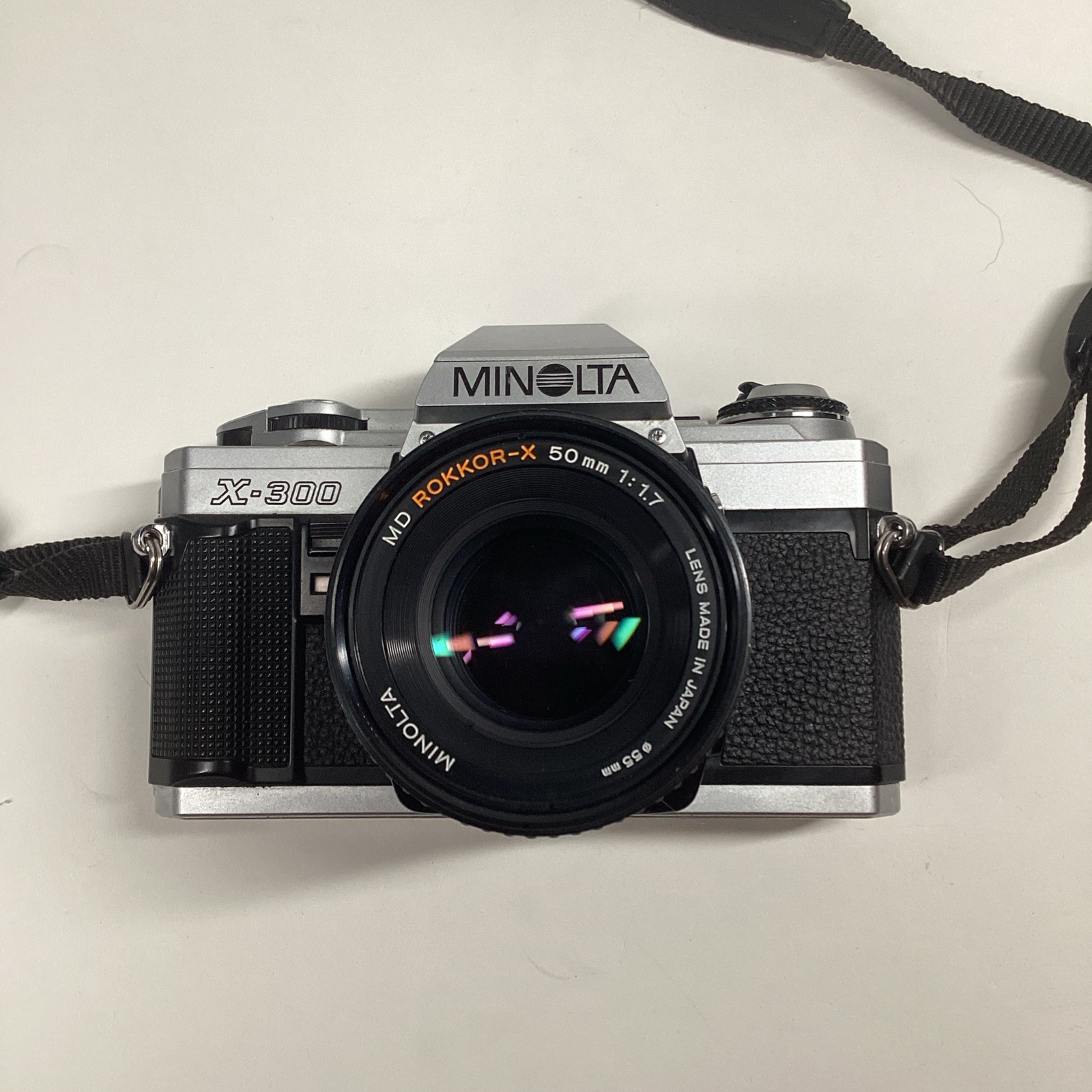
The Minolta X-300 is a 35mm film single-lens reflex (SLR) camera introduced in 1984 as an economy-oriented model tailored primarily for the European market. Functionally a simplified variant of the more advanced X-370, the X-300 omits several features to reduce cost while retaining core manual exposure functionality and reliable mechanical operation.
Overview
Launched during a period of intense competition in the amateur SLR market, the Minolta X-300 was positioned as an entry-level manual-focus SLR designed to appeal to novice photographers and budget-conscious consumers across Europe. It shared its core chassis and shutter mechanism with the X-370 but was stripped of programmable autoexposure and certain ergonomic refinements. The X-300 was part of Minolta’s final generation of manual-focus SLRs using the A-mount (also known as the Minolta SR-mount), which had been introduced in 1985 with the Maxxum 7000 but was backward-compatible with manual-focus Rokkor lenses.
The X-300 offered fully manual exposure control and aperture-priority autoexposure, making it a versatile tool for learning photographic fundamentals. Unlike the X-370, it lacked the "P" (program) mode and the ability to use shutter-priority autoexposure, reflecting its role as a streamlined, cost-reduced model. It featured a vertically traveling, electronically controlled metal focal-plane shutter with speeds from 1 second to 1/1000 second, plus Bulb mode. Flash synchronization was provided at 1/100 second (X-sync), suitable for most electronic flash units.
Built with a polycarbonate body over a metal chassis, the X-300 maintained a robust yet lightweight construction typical of mid-tier SLRs of the era. Its pentamirror viewfinder provided a 92% field of view with a fixed focus screen featuring a central split-image rangefinder and microprism collar for manual focusing assistance. The camera was powered by two 1.5V SR44 or LR44 batteries for metering and shutter operation, a common power source that ensured easy replacement.
Specifications
| Specification | Value |
| Type | 35mm manual-focus SLR |
| Film Format | 35mm (135 film) |
| Years Produced | 1984–1999 |
| Lens Mount | Minolta A-mount (SR-mount), compatible with MC/MD lenses |
| Shutter | Electronically controlled focal-plane shutter, 1 sec – 1/1000 sec + Bulb |
| Metering | TTL full-aperture center-weighted metering |
| Exposure Modes | Manual, Aperture-Priority Autoexposure |
| Viewfinder | Fixed pentamirror, 92% coverage, split-image/microprism focus aid |
| Dimensions | Approx. 135 × 85 × 50 mm; Weight: ~490 g (body only, no battery or film) |
Key Features
- Aperture-Priority and Manual Exposure Modes: Offers flexibility for both automatic and full manual control, ideal for learning exposure principles.
- TTL Center-Weighted Metering: Through-the-lens metering ensures accurate exposure readings with MC and MD series lenses.
- Electronic Shutter with 1/1000 sec Top Speed: High-speed capability suitable for daylight fill-flash and action photography.
- Compact and Lightweight Design: Polycarbonate shell over metal frame provides durability without excess weight.
- Battery-Operated Shutter: Requires power for all shutter speeds, including Bulb; metering disabled when batteries are dead.
Historical Context
The Minolta X-300 was introduced in 1984 as part of Minolta’s strategy to segment its SLR lineup for different markets and skill levels. While the X-700 (1981) served as the flagship manual-focus model with full program mode and advanced features, the X-370 (introduced in 1983) offered most of its functionality at a lower price. The X-300 followed as a further cost-reduced version, specifically marketed in Europe to compete with budget SLRs from brands like Pentax, Olympus, and Chinon.
During the 1980s, the 35mm SLR market was rapidly evolving, with increasing automation and the eventual transition to autofocus. The X-300 represented Minolta’s effort to maintain a presence in the entry-level manual SLR segment even as autofocus systems gained traction. It competed directly with models such as the Pentax ME Super, Olympus OM-2N, and Chinon CE-5. Despite its simplified feature set, the X-300 was praised for its solid build quality, accurate metering, and compatibility with Minolta’s extensive lineup of Rokkor lenses.
Collectibility & Value
Today, the Minolta X-300 is considered a functional and affordable vintage SLR, popular among film photography newcomers and collectors seeking reliable, no-frills cameras. It is not particularly rare, given its mass-market production and long production run (extending into 1999 in some regions), but well-maintained examples are increasingly sought after as interest in analog photography resurges.
In the current market (2024), the X-300 typically sells for $30–$60 USD in working condition, often bundled with a standard 50mm f/1.7 or f/2.0 MC/MD lens. Its value is largely determined by cosmetic condition, shutter accuracy, and meter functionality. Common issues include degraded light seals, sticky shutter blades (especially if stored improperly), and failing CdS meter cells. Because the shutter is electronically controlled, the camera will not operate without functional batteries—unlike fully mechanical SLRs of earlier decades.
When purchasing an X-300, buyers should verify that the meter responds to light changes and that all shutter speeds fire consistently. The rewind crank should operate smoothly, and the film advance lever should provide consistent tension. As with all vintage electronics, moisture exposure and long-term battery leakage are primary concerns.
Similar Cameras
- Pentax ME Super – Manual-focus 35mm SLR with aperture-priority and manual modes; similar target market.
- Olympus OM-2N – Rugged, compact system SLR with TTL metering and manual exposure control.
- Chinon CE-5 – Budget-friendly aperture-priority SLR with excellent build quality for its price.
- Yashica FX-3 Super 200 – Entry-level SLR with aperture-priority automation and reliable Seiko shutter.
- Canon AE-1 Program – Slightly earlier but comparable in market position, offering aperture and shutter priority.
Repair & Maintenance
The Minolta X-300 uses two 1.5V SR44 (or equivalent LR44) silver-oxide batteries, housed in the base of the camera near the rewind crank. These power both the light meter and the electronic shutter control circuitry. Without power, the camera cannot fire the shutter at any speed, including Bulb. It is essential to remove batteries during long-term storage to prevent leakage and corrosion.
Common maintenance issues include worn shutter curtains, inaccurate metering due to aging CdS cells, and degraded light seals that can lead to light leaks on film. The electronic shutter mechanism, while reliable when maintained, can develop timing inaccuracies over time, particularly at slower speeds. Repair requires specialized tools and knowledge, as the top cover must be removed to access the shutter and circuit board.
The camera’s lens mount is robust but should be inspected for wear or misalignment, especially if used with heavy lenses. The film transport system is generally reliable, but the film counter and rewind release mechanisms may require cleaning or lubrication after years of disuse. Given its electronic nature, the X-300 is more complex to service than fully mechanical SLRs, but competent repair technicians familiar with 1980s electronics can restore it to full functionality.
eBay Listings



As an eBay Partner, we earn from qualifying purchases. This helps support our independent vintage technology research.
Service Manuals & Schematics
- Service Manual (1984) — archive.org
Related Models
- Minolta SR-T 200 (1975–1981)
- Minolta Dynax 9 (1998-2004)
- Minolta Maxxum 7000 (1985-1988)
- Minolta SR-T 100 (1969-1975)
- Minolta SR-T 101 (1966-1981)
- Alpa 6 (1948-1953)
- Agfa Agfaflex
- Agfa Ambiflex
- Agfa Easy
- Agfa Futura Af zoom